






 Philippines
Luzon
DENR orders firm to halt molasses discharge going to Binalbagan River
Philippines
Luzon
DENR orders firm to halt molasses discharge going to Binalbagan River
DENR orders firm to halt molasses discharge going to Binalbagan River


BACOLOD CITY – The Department of Environment and Natural Resources-Environment Management Bureau (DENR-EMB) in Western Visayas (Region 6) has issued an interim cease and desist order (CDO) on the molasses discharge in the perimeter canal of Binalbagan-Isabela Sugar Co. (Biscom) Inc. in Binalbagan, Negros Occidental.
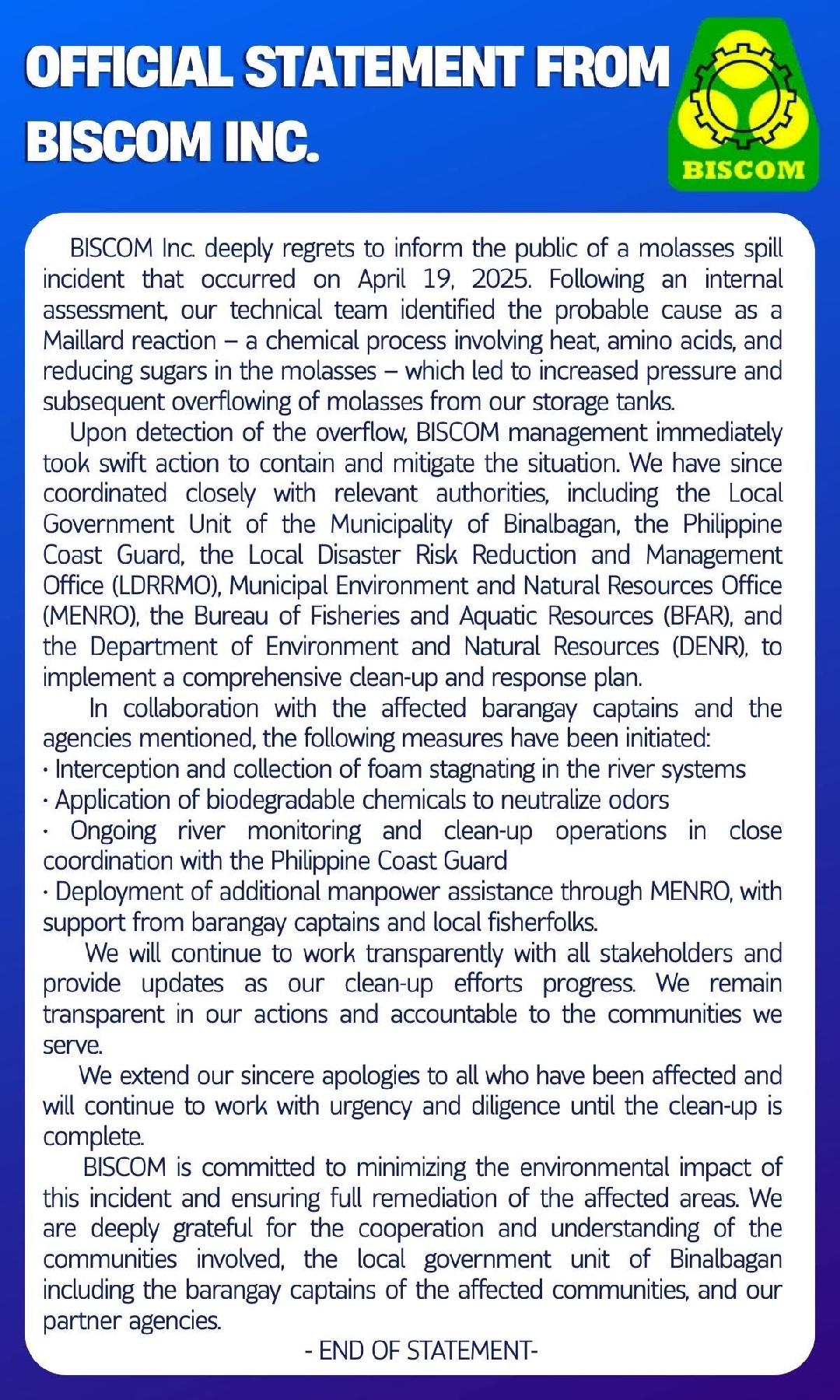
EMB-6 Regional Director Ramar Mel Pascua signed the interim CDO on April 22 following the massive molasses spill from the sugar mill on April 19 that contaminated the Binalbagan River.
In a media interview on Thursday, EMB-6 chief legal officer Wilma Lagance confirmed the issuance of the order, which specifically directs Biscom to “cease, desist, or refrain from discharging molasses in its perimeter canal which ultimately leads to Binalbagan River.”
“This CDO shall be effective only for seven days unless confirmed by the Pollution Adjudication Board (PAB) or the Secretary. In such a case, the interim CDO shall become a regular CDO,” it added.
Pascua said portions of the molasses were still observed flowing into the storm drain despite the implemented mitigating measures to contain the spill, such as redirecting the overflowing molasses into the adjacent ash canal system and installing sandbags along the perimeter canal to prevent further flow into the community canal.
In issuing the CDO, he cited Section 8, Rule V of PAB Resolution 2021-04, providing that “an interim CDO may be immediately issued where there is prima facie evidence that the emission of discharge of pollutants constitutes an immediate threat to life, public health, safety, or welfare, or to animal or plant life, or greatly exceeds the allowable DENR standards.”
Pascua said the ongoing discharge from the facility, together with the continued operations of the sugar mill, and its reliance on a temporary molasses pond with unverified storage capacity, "pose an imminent and substantial threat to the Binalbagan River."
“These circumstances necessitate immediate action to prevent further environmental harm,” he said.
Pascua said that before the incident, pond 2A/288 contained about 4,980 tons of molasses and after the spill, only 2,400 tons remained.
“According to the report submitted by the respondent (Biscom), 2,570 tons were recovered while the estimated loss was only 10 tons. However, these figures are still subject to verification,” he added.