






 Philippines
National
Historic first: Three Filipino cardinals to join papal conclave to elect new pope
Philippines
National
Historic first: Three Filipino cardinals to join papal conclave to elect new pope
Historic first: Three Filipino cardinals to join papal conclave to elect new pope
Three Filipino cardinals will make history by joining the papal conclave to elect the next pope — marking a milestone for the Catholic Church in the Philippines


The Philippines is poised to make history as three Filipino cardinals—Luis Antonio Tagle, Jose Advincula, and Pablo Virgilio David—are expected to participate in the papal conclave to elect the next pope.
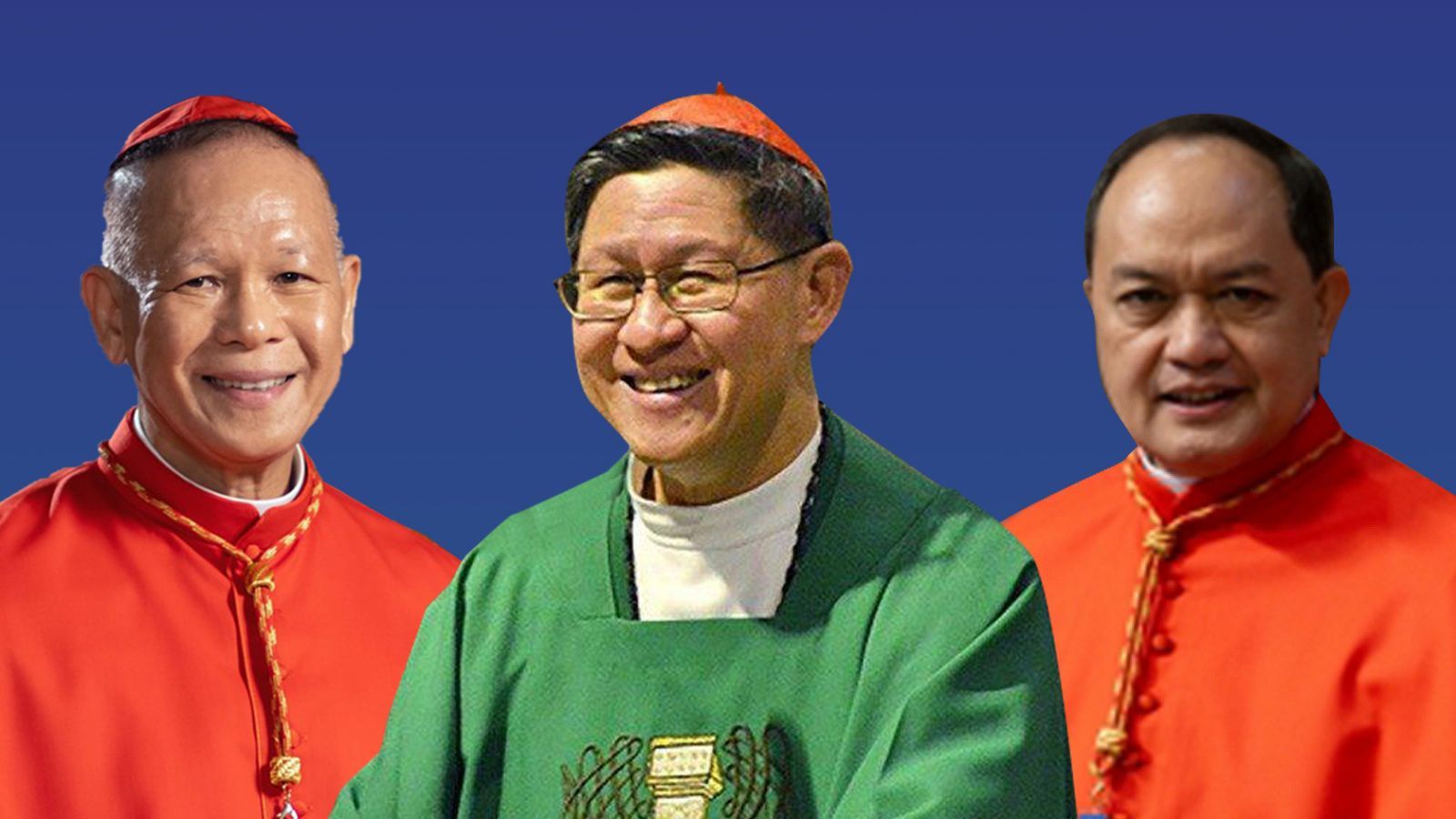
According to the Apostolic Constitution Universi Dominici Gregis, which governs the papal conclave, the “right to elect the Roman Pontiff belongs exclusively to the Cardinals of the Holy Roman Church, with the exception of those who have reached their eightieth birthday before the day of the Roman Pontiff’s death or the day when the Apostolic See becomes vacant.”
Filipino leadership in the Catholic Church
Following the passing of Pope Francis on April 21, the Vatican’s Sistine Chapel is expected to host over a hundred cardinals under the age of 80 for the secretive and sacred selection of the next leader of the Catholic Church.
The participation of three Filipino cardinals—a first for the Philippines—highlights the nation’s deep-rooted Catholic heritage and its growing influence in global theology.
Meet the Filipino cardinals
Cardinal Luis Antonio Tagle is the Pro-Prefect for the Section of First Evangelization of the Dicastery for Evangelization. He is widely respected for his theological expertise and leadership in global Church affairs.
Having served in prominent Vatican positions, Tagle has emerged as a notable contender for the papacy, standing out as the sole Asian among the “papabili” candidates.
Cardinal Jose Advincula, the Archbishop of Manila, is dedicated to social justice and pastoral outreach, fostering strong connections with marginalized communities.
Cardinal Pablo Virgilio David, the Bishop of Kalookan, is a prominent advocate for human rights and social justice, reflecting the Church’s commitment to addressing societal challenges.
There are two other Filipino cardinals — Orlando Quevedo, the former Archbishop of Cotabato, and Gaudencio Rosales, the former Archbishop of Manila and Lipa — both of whom are over 80 years old.
While ineligible to vote in the conclave, they remain eligible to participate in general congregations, contributing to Church governance and the organization of the papal succession.
Global Catholicism
As the largest Catholic-majority country in Asia, the Philippines is home to over 80 million Catholics.
Experts view the participation of three Filipino cardinals as a testament to the country’s increasing impact on Church policy and theological discourse.
All eyes on the upcoming papal election
In the coming weeks, the world will closely watch the conclave as white smoke from the Sistine Chapel signals the election of a new pope—an event that will shape the faith journey of approximately 1.39 billion Catholics worldwide.
Who will be the next Pope?
A popular saying in Vatican circles is that if you "enter a conclave as pope, you leave as a cardinal."
It implies the sacred and secretive process is no popularity contest or campaign, but rather the divinely inspired election of Christ's Vicar on Earth by the princes of the church.
Still, there are always front-runners, known as "papabile," who have at least some of the qualities considered necessary to be pope.
Any baptized Catholic male is eligible, though only cardinals have been selected since 1378. The winner must receive at least two-thirds of the vote from those cardinals under age 80 and thus eligible to participate.
Here are some of the possible candidates:
Cardinal Luis Tagle
Tagle, 67, of the Philippines, would appear to be Francis' pick for the first Asian pope. Francis brought the popular archbishop of Manila to Rome to head the Vatican's missionary evangelization office, which serves the needs of the Catholic Church in much of Asia and Africa. His role took on greater weight when Francis reformed the Vatican bureaucracy and raised the importance of his evangelization office. Tagle often cites his Chinese lineage – his maternal grandmother was part of a Chinese family that moved to the Philippines -- and he is known for becoming emotional when discussing his childhood. Though he has pastoral, Vatican and management experience -- he headed the Vatican's Caritas Internationalis federation of charity groups before coming to Rome permanently -- Tagle would be on the young side to be elected pope for life, with cardinals perhaps preferring an older candidate whose papacy would be more limited.
Cardinal Peter Erdo
Erdo, 72, the archbishop of Budapest and primate of Hungary, was twice elected head of the Council of European Episcopal Conferences, in 2005 and 2011, suggesting he enjoys the esteem of European cardinals who make up the biggest voting bloc of electors. In that capacity, Erdo got to know many African cardinals because the council hosts regular sessions with African bishops' conferences. Erdo had even more exposure when he helped organize Francis' 2014 and 2015 Vatican meetings on the family and delivered key speeches, as well as during papal visits to Budapest in 2021 and 2023.
Cardinal Reinhard Marx
Marx, 71, the archbishop of Munich and Freising, was chosen by Francis as a key adviser in 2013. Marx later was named to head the council overseeing Vatican finances during reforms and belt-tightening. The former president of the German bishops' conference was a strong proponent of the controversial "synodal path" process of dialogue in the German church that began in 2020 as a response to the clergy sexual abuse scandal there. As a result, he is viewed with skepticism by conservatives who considered the process a threat to church unity, given it involved debating issues such as celibacy, homosexuality and women's ordination. Marx made headlines in 2021 when he dramatically offered to resign as archbishop to atone for the German church's dreadful abuse record, but Francis quickly rejected the resignation and told him to stay.
Cardinal Marc Ouellet
Ouellet, 80, of Canada, led the Vatican's influential bishops office for over a decade, overseeing the key clearinghouse for potential candidates to head dioceses around the world. Francis kept Ouellet in the job until 2023, even though he was appointed by Pope Benedict XVI, and thus helped select the more doctrinaire bishops preferred by the German pontiff. Considered more of a conservative than Francis, Ouellet still selected pastorally minded bishops to reflect Francis' belief that bishops should "smell like the sheep" of their flock. Ouellet defended priestly celibacy for the Latin Rite church and upheld the ban on women's ordination but called for women to have a greater role in church governance.
Cardinal Pietro Parolin
Parolin, 70, of Italy, has been Francis' secretary of state since 2014 and is considered one of the main contenders to be pope, given his prominence in the Catholic hierarchy. The veteran diplomat oversaw the Holy See's controversial deal with China over bishop nominations and was involved -- but not charged -- in the Vatican's botched investment in a London real estate venture that led to a 2021 trial of another cardinal and nine others. A former ambassador to Venezuela, Parolin knows the Latin American church well. He would be seen as someone who would continue in Francis' tradition but as a more sober and timid diplomatic insider, returning an Italian to the papacy after three successive outsiders: St. John Paul II (Poland); Benedict (Germany) and Francis (Argentina). But while Parolin has managed the Vatican bureaucracy, he has no real pastoral experience. His ties to the London scandal, in which his office lost tens of millions of dollars to bad deals and shady businessmen, could count against him.
Cardinal Robert Prevost
The idea of an American pope has long been taboo, given the geopolitical power already wielded by the United States. But the Chicago-born Prevost, 69, could be a first. He has extensive experience in Peru, first as a missionary and then an archbishop, and he is currently prefect of the Vatican's powerful dicastery for bishops, in charge of vetting nominations for bishops around the world. Francis clearly had an eye on him for years and sent him to run the diocese of Chiclayo, Peru, in 2014. He held that position until 2023, when Francis brought him to Rome for his current role. Prevost is also president of the Pontifical Commission for Latin America, a job that keeps him in regular contact with the Catholic hierarchy in the part of the world that still counts the most Catholics. In addition to his nationality, Prevost's comparative youth could count against him if his brother cardinals don't want to commit to a pope who might reign for another two decades.
Cardinal Robert Sarah
Sarah, 79, of Guinea, the retired head of the Vatican's liturgy office, was long considered the best hope for an African pope. Beloved by conservatives, Sarah would signal a return to the doctrinaire and liturgically minded papacies of John Paul II and Benedict. Sarah, who had previously headed the Vatican's charity office Cor Unum, clashed on several occasions with Francis, none more seriously than when he and Benedict co-authored a book advocating the "necessity" of continued celibacy for Latin Rite priests. The book came out as Francis was weighing whether to allow married priests in the Amazon to address a priest shortage there. The implication was that Sarah had manipulated Benedict into lending his name and moral authority to a book that had all the appearances of being a counterweight to Francis' own teaching. Francis dismissed Benedict's secretary and several months later retired Sarah after he turned 75. Even Sarah's supporters lamented the episode hurt his papal chances.
Cardinal Christoph Schoenborn
Schoenborn, 80, the archbishop of Vienna, Austria, was a student of Benedict's, and thus on paper seems to have the doctrinaire academic chops to appeal to conservatives. However, he became associated with one of Francis' most controversial moves by defending his outreach to divorced and civilly remarried Catholics as an "organic development of doctrine," not the rupture that some conservatives contended. Schoenborn's parents divorced when he was a teen, so the issue is personal. He also took heat from the Vatican when he criticized its past refusal to sanction high-ranking sexual abusers, including his predecessor as archbishop of Vienna. Schoenborn has expressed support for civil unions and women as deacons, and was instrumental in editing the 1992 update of the Catechism of the Catholic Church, the handbook of the church's teaching that Benedict had spearheaded when he headed the Vatican's doctrine office.
Cardinal Matteo Zuppi
Zuppi, 69, the archbishop of Bologna and president of the Italian bishops conference, elected in 2022, is closely affiliated with the Sant'Egidio Community, a Rome-based Catholic charity that was influential under Francis, particularly in interfaith dialogue. Zuppi was part of Sant'Egidio's team that helped negotiate the end of Mozambique's civil war in the 1990s and was named Francis' peace envoy for Russia's war in Ukraine. Francis made him a cardinal in 2019 and later made clear he wanted him in charge of Italy's bishops, a sign of his admiration for the prelate who, like Francis, is known as a "street priest." In another sign of his progressive leanings and closeness to Francis, Zuppi wrote the introduction to the Italian edition of "Building a Bridge," by the Rev. James Martin, an American Jesuit, about the church's need to improve its outreach to the LGBTQ+ community.
What happens after Pope Francis’ death?
The death of Pope Francis marks the end of a global religious leader's life and the beginning of a sacred and meticulous process rooted in centuries of Catholic tradition.
Guided by the apostolic constitution “Universi Dominici Gregis” and the updated “Ordo Exsequiarum Romani Pontificis” (Order of Funerals for Roman Pontiffs), the process includes mourning, burial, and the election of a new pope.
Here’s a closer look at the process.
1. Confirmation of death
The Camerlengo (Chamberlain of the Holy Roman Church) confirms the pope's death through medical verification.
This marks the beginning of “Sede Vacante” (Vacant See), or the period between popes begins. The Camerlengo takes over the administration of Vatican affairs but is restricted from making major decisions.
All leadership roles are paused until a new pope is elected.
2. Destruction of papal insignia
The Fisherman’s Ring and the papal seal, used to authenticate apostolic letters, are destroyed to prevent misuse.
3. Sealing of papal quarters
The pope’s residence is sealed to secure personal belongings and documents. These remain untouched until a new pontiff is elected.
4. Notification of the Church and the world
The Camerlengo notifies the Archpriest of the Vatican Basilica and the Cardinal Vicar of Rome, who then announces the pope’s death to the city.
The Dean of the College of Cardinals is also informed. He summons all cardinals to Rome and notifies the diplomatic corps and world leaders.
5. Funeral preparations
The pope’s body is placed in a simple wooden coffin lined with zinc. It is first presented for private viewing by the papal household and cardinals and later moved to St. Peter’s Basilica for public viewing.
6. ‘Novendiales’: Nine days of mourning
Vatican’s traditional nine-day mourning begins after the pope dies. Each day, a different cardinal leads a public funeral rite.
7. Funeral and burial
The funeral Mass, usually held five to seven days after death, is celebrated by the Dean of the College of Cardinals.
The traditional papal burial includes covering the face with white silk, placing a red bag with bronze and silver medals from each year of the pontificate at the pope’s feet, and sealing the official burial notice in a lead tube inside the coffin.
The coffin is then sealed and interred beneath the crypt floor, marked by a marble slab.
Pope Francis has requested to be buried at the Basilica of Santa Maria Maggiore, reflecting his devotion to the Virgin Mary. His funeral Mass is expected to be held in St. Peter’s Square.
8. Conclave preparation
Fifteen to 20 days after the pope’s death, the conclave begins. All cardinals under the age of 80 are eligible to vote.
The Sistine Chapel is inspected and secured. All participants swear an oath of secrecy.
Cardinals are sequestered for the duration of the conclave.
9. The election
Each cardinal elector writes the name of a candidate on a paper ballot.
Ballots are collected, counted, and burned after each vote:
Black smoke from the chapel chimney signals no decision.
White smoke signals that a new pope has been chosen.
10. Announcement and first blessing
Once a candidate receives a two-thirds majority and accepts the role, he chooses a papal name.
The senior Cardinal Deacon then steps onto the central balcony of St. Peter’s Basilica to declare: “Habemus Papam!” (We have a pope!)
The new pope then appears before the world and delivers his first “Urbi et Orbi” blessing, “to the city and the world.” (With reports from the Associated Press and Ellalyn De Vera-Ruiz)
RELATED STORY:
https://mb.com.ph/2025/4/22/what-happens-after-pope-francis-death