






 Philippines
National
PH, US militaries to hold 'full-scale battle’ test as Balikatan Exercise kicks off
Philippines
National
PH, US militaries to hold 'full-scale battle’ test as Balikatan Exercise kicks off
PH, US militaries to hold 'full-scale battle’ test as Balikatan Exercise kicks off


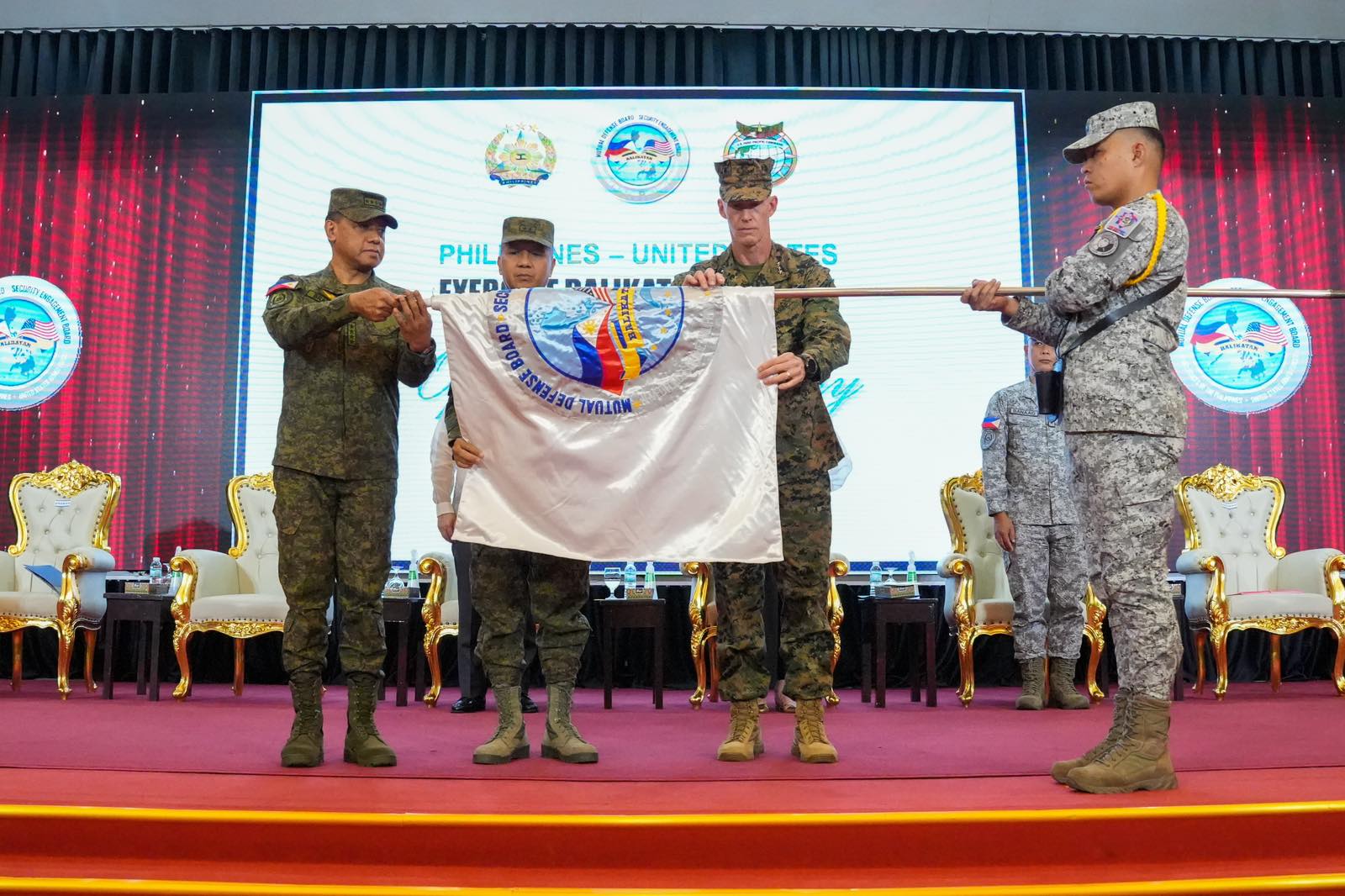
Around 17,000 military personnel from the Armed Forces of the Philippines (AFP) and United States Indo-Pacific Command (Indopacom) will train together for three weeks as part of this year’s Balikatan Exercise featuring a “full-scale battle” scenario, which was formally launched on Monday, April 21, at Camp Aguinaldo in Quezon City.
AFP Chief General Romeo Brawner Jr. said the 40th iteration of the Balikatan drills, which translates to "shoulder to shoulder", will focus on enhancing the two armed forces’ interoperability to respond to various threats, which will help strengthen their land, air, sea, and cyber domain capabilities.
"It is our way of ensuring that the AFP remains a capable, agile, and forward-thinking force - prepared to defend, ready to respond, and poised to lead," he said.
A major concept in this year’s exercise is the conduct of a full-battle test to simulate their capability to operate together in case of a conflict, particularly in the West Philippine Sea (WPS) or in Taiwan close to Batanes island where China continues to assert its presence.
Combined military doctrines and procedures will be incorporated during the simulated battles, and observers from around 20 nations will witness the exercise set to conclude on May 9.
Lieutenant General James Glynn, commander of the US Marine Corps and US Exercise Director, said the Balikatan Exercise seeks to strengthen the ironclad alliance between the United States and the Philippines, improve their capable combined force, and demonstrate their commitment to regional security and stability.
“This year's Balikatan demonstrates not just our shared commitment to the Mutual Defense Treaty but our ability and willingness to respond," Glynn said. "Nothing builds bonds more quickly than shared adversity."
The US Marines’ 3rd Marine Littoral Regiment deployed “ship-killer” missile NMESIS or Navy-Marine Expeditionary Ship Interdiction System to northern Luzon in support of the Balikatan Exercise.
The NMESIS, an anti-ship missile launcher capable of hitting targets up to 200 kilometers, will be employed by the US Marines during a maritime key terrain security operation in northern Luzon and Batanes Islands, simulating a defense scenario in the northern part of the country near Taiwan, where Brawner earlier directed troops to prepare in case of an invasion by China.
“Once on the islands, U.S. and Philippine Marines will work together to establish a Fires Expeditionary Advanced Base,” the US Marines said.
The NMESIS will not be fired during the Balikatan but the exercise presents an opportunity for both militaries to practice placing it on islands in the Luzon Strait for simulated fires missions.
The NMESIS has sea denial capability which strengthens deterrence by extending the Joint Force’s ability to target and engage from both land and sea. It also helps in shaping the AFP’s defensive capabilities in accordance with its coastal defense strategy.
President Marcos Jr. earlier expressed interest in joining one of the Balikatan events, namely the integrated air and missile defense simulation, which will be conducted for the first time by the two countries’ militaries, according to the Balikatan Exercise spokesperson Brig. Gen. Michael Logico.
Other exercises include a multilateral maritime event involving the Japan Self-Defense Forces (JSDF) for the first time, a command and control exercise, combined joint all-domain operations, maritime strike and counter landing live fire exercises.
These will be held in Cagayan, Batanes, Zambales, Palawan, and West Philippine Sea (WPS).
Major Gen. Francisco Lorenzo, commander of AFP Education, Training, and Doctrine Command (AFPETDC) and Philippines Exercise Director, said the drills were aimed at equipping the participating troops with the knowledge and skills to confront contemporary security challenges.