






 Philippines
National
OCD chief outlines 3 key points for effective earthquake preparedness
Philippines
National
OCD chief outlines 3 key points for effective earthquake preparedness
OCD chief outlines 3 key points for effective earthquake preparedness


At A Glance
- Office of Civil Defense (OCD) Administrator Usec. Ariel Nepomuceno discussed the crucial need for earthquake preparedness in the Philippines, particularly in anticipation of the "Big One," a potential magnitude 7.2 earthquake along the West Valley Fault that could have devastating impacts on Metro Manila.
- Speaking during the Security Bank First Quarter 2025 Townhall, Nepomuceno emphasized three key areas for preparedness: engineering solutions, practicing the "duck, cover, and hold" technique, and enhancing government response capabilities.
- He stressed the importance of compliance with the National Building Code, collaboration with the Department of Trade and Industry (DTI) and private sector engineers to improve construction material quality, and the need for public awareness about building in safe zones using tools like HazardHunterPH.
- He highlighted the importance of regular drills and planning for evacuation and safety measures in families and workplaces.
- He also mentioned efforts to strengthen the response capabilities of government and volunteer agencies, expanding partnerships with organizations such as the Philippine Disaster Resilience Foundation (PDRF) and ARISE Philippines
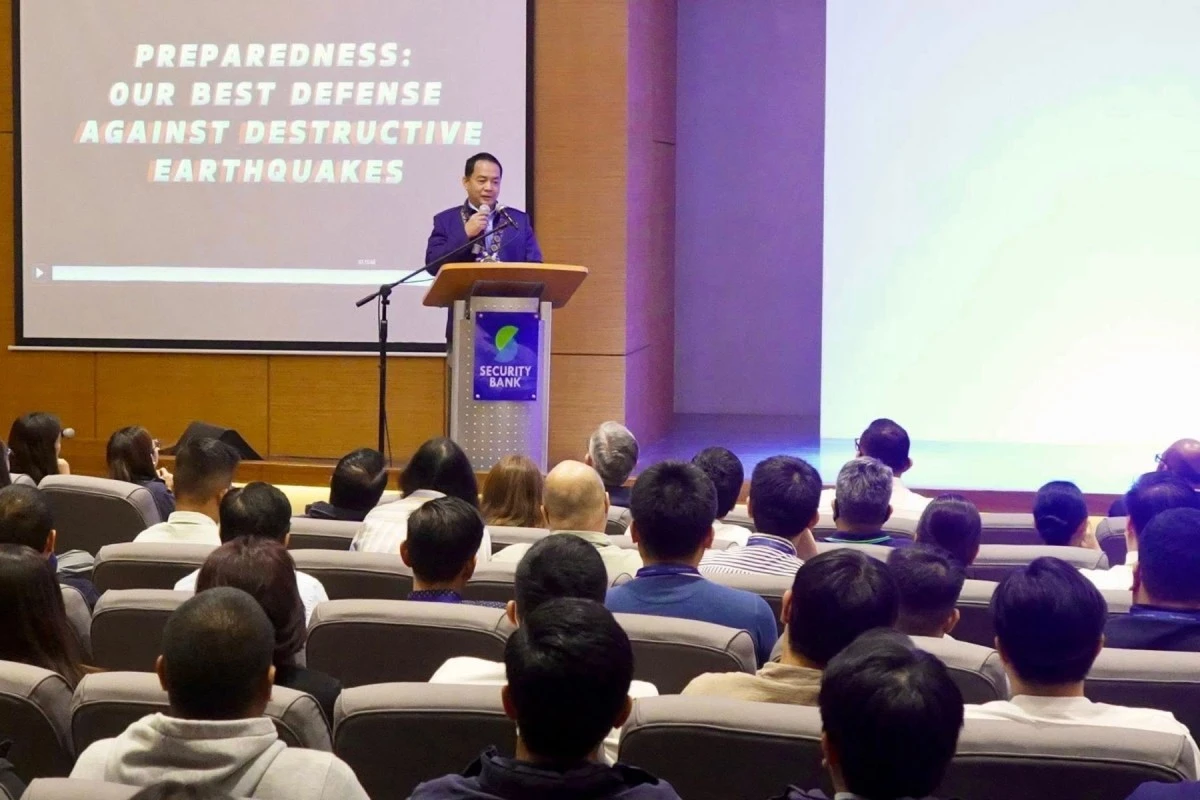
Office of Civil Defense (OCD) Administrator Usec. Ariel Nepomuceno highlighted three crucial areas for earthquake preparedness, emphasizing that the occurrence of the “Big One” is not a matter of if, but when.
In a statement Sunday, May 4, the OCD said that Nepomuceno delivered a compelling call to action for earthquake preparedness during the recent Security Bank First Quarter 2025 Townhall where he stressed to bank employees and officers that the Philippines must be ready for the inevitable: the next major earthquake.
The OCD chief emphasized that engineering solutions, practice of the life-saving technique “duck, cover and hold”, and strengthening government response capabilities are the three crucial areas that would ensure the public’s readiness in case the Big One strikes.
The Big One is a potential magnitude 7.2 earthquake along the West Valley Fault that could strike Metro Manila with devastating consequences. Government data suggested that such an event could result in the deaths of 30,000 to 50,000 people, injuries of at least 160,000 individuals, and displacement of millions.
First, Nepomuceno said that engineering solutions are the “first line of defense”.
“Compliance with the National Building Code is non-negotiable,” he declared. “Buildings must be designed and constructed to withstand at least a magnitude 8.5 earthquake.”
As such, Nepomuceno said the OCD has collaborated with the Department of Trade and Industry (DTI) and private sector engineers to improve the quality of construction materials, such as steel rebars, and to crack down on substandard imports that undermine building safety hazards.
He also highlighted the importance of avoiding construction in no-build zones such as fault lines and landslide-prone areas.
He recommended the use of HazardHunterPH, a platform that enables the public to check for geohazards and plan safer locations for development.
Second, Nepomuceno discussed the importance of the simple yet life-saving technique of “duck, cover, and hold” where an individual gets down to his/her knees to prevent being knocked over, takes cover under a sturdy piece of furniture to shield self from falling debris, and holds on to the shelter until the shaking stops before moving to a safer area.
He urged families and workplaces to go beyond drills by creating concrete plans that identify evacuation routes, establish meet-up points, and find open spaces where people can safely regroup, especially when communication networks are disrupted.
Third, Nepomuceno addressed the need to strengthen government response capabilities.
He said the OCD has actively coordinated with the Armed Forces of the Philippines, Metropolitan Manila Development Authority (MMDA), Red Cross, Philippine Coast Guard, and other agencies to increase the number of trained responders.
A unified roster of deployable personnel and assets is being developed, and partnerships are expanding with reserve forces, college volunteers through the National Service Reserve Corps (NSRC) and National Service Training Program (NSTP), as well as private organizations such as the Philippine Disaster Resilience Foundation (PDRF) and ARISE Philippines, he added.
Nepomuceno urged the public to take individual and collective responsibility for disaster readiness.
“The most effective way to reduce the impact of earthquakes is through proactive preparation, community awareness, and strict adherence to safety standards,” he concluded.