ADVERTISEMENT

Machine using ultrasound and AI can gauge the fattiness of a tuna fish

Published Apr 10, 2025 06:31 am

TUNA PHOTO1.jpg

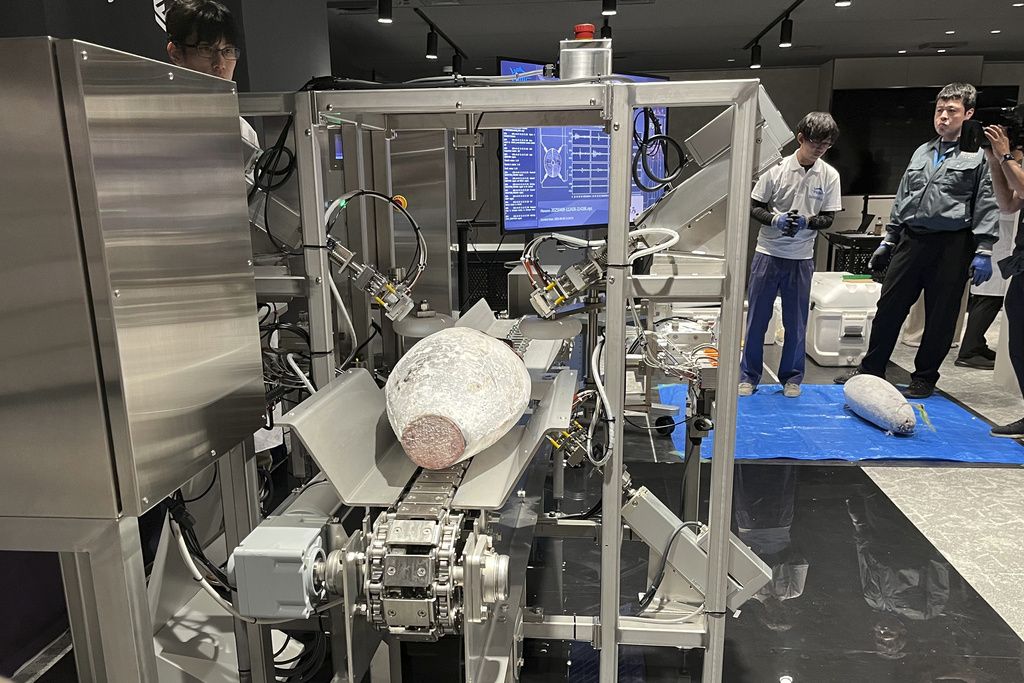
Tuna goes into a special machine called Sonofai that can detect the amount of fattiness in the fish meat by using ultrasound, sensors and AI at a Fujitsu facility in Kawasaki, Japan Wednesday, April 9, 2025. (AP Photo/Yuri Kageyama)


KAWASAKI, Japan (AP) — Seafood lovers know the fatty marbling is what makes tuna sashimi and sushi so tasty, so for the industry, it's the fish's level of fattiness that's used to judge its quality and pricing.
 

Usually, several people assess how fatty a tuna is by cutting the tail with a giant saw-like knife, an operation that takes about 60 seconds per fish.
 

But now a machine called Sonofai uses ultrasound waves to do the job in 12 seconds, operated by a person without prior knowledge of how to carve fish.
 

Fujitsu, the Japanese company behind the technology, invited reporters this week for a demonstration of Sonofai, a word blended from "sono" referring to "sound," "f" for Fujitsu, and "ai," or artificial intelligence. The name refers to its components but also stands for "son of AI."
 

A conveyor belt transports a whole frozen tuna fish, about a meter (3 feet) in size, into a machine that beams ultrasound waves. Sensors pick up the waves to draw a zigzagging diagram on a screen to indicate the fish's fattiness.
 

Fatty meat absorbs fewer sound waves than lean meat and AI sorts real data from misleading "noise," or irregularities.
Hisashi Ishida, president of Sonofai, the startup behind the technology, who also heads Ishida Tec Co., which makes food-manufacturing equipment, says it's safer, more sanitary and efficient.
 

"Fatty fish tastes good, feels better on your tongue and is called 'toro,' " he said. "Overseas needs are growing because sushi culture is now appreciated around the world."
 

TUNA PHOTO2.jpg
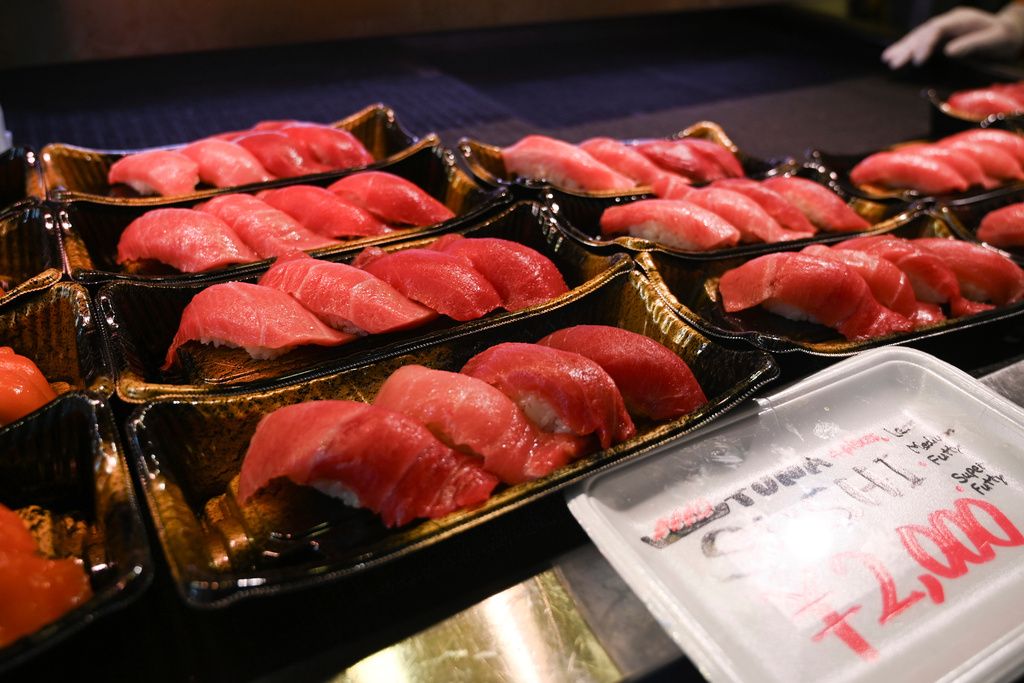
Tuna sushi sets being sold at a market stall in Tokyo, Japan, Thursday, April 10, 2025. (AP Photo/Ayaka McGill)


Beef has a grading system for fat and expected flavor, but being able to gauge the quality of tuna is new, according to Hideto Okada, who oversees AI at Fujitsu.
 

Sonofai uses the same technology as medical ultrasound scans where high-frequency inaudible sound waves are absorbed or bounced back to create video-like images of things that aren't visible, like a fetus inside a mother's womb. Unlike the CT scan or X-ray, it doesn't use radiation, which can harm tissue.
 

Chris Edwards, a medical doctor and professor at Queensland University of Technology, who trains sonographers, or health-care professionals who specialize in ultrasound, has studied how ultrasound can be used to see the fattiness of a human liver, linked to diabetes and other health problems.
 

"They can look at one fish and compare it to another and say 'Oh, that one's definitely got more fat than that one,'" he told The Associated Press in an interview.
 

But Sonofai won't be at your neighborhood sushi chef.
 

Fish-processing outfits and fishing organizations are the likely buyers. The machine is set to go on sale in June for about 30 million yen ($207,000) each, at first in Japan but expanding to the U.S. and other places later. They'll also work on future upgrades to test for freshness, firmness and other characteristics of tuna and other fish varieties.


Related Tags

WORLDNEWS
ADVERTISEMENT
.most-popular .layout-ratio{ padding-bottom: 79.13%; } @media (min-width: 768px) and (max-width: 1024px) { .widget-title { font-size: 15px !important; } }

{{ articles_filter_1561_widget.title }}

.most-popular .layout-ratio{ padding-bottom: 79.13%; } @media (min-width: 768px) and (max-width: 1024px) { .widget-title { font-size: 15px !important; } }

{{ articles_filter_1562_widget.title }}

.most-popular .layout-ratio{ padding-bottom: 79.13%; } @media (min-width: 768px) and (max-width: 1024px) { .widget-title { font-size: 15px !important; } }

{{ articles_filter_1563_widget.title }}

{{ articles_filter_1564_widget.title }}

.mb-article-details { position: relative; } .mb-article-details .article-body-preview, .mb-article-details .article-body-summary{ font-size: 17px; line-height: 30px; font-family: "Libre Caslon Text", serif; color: #000; } .mb-article-details .article-body-preview iframe , .mb-article-details .article-body-summary iframe{ width: 100%; margin: auto; } .read-more-background { background: linear-gradient(180deg, color(display-p3 1.000 1.000 1.000 / 0) 13.75%, color(display-p3 1.000 1.000 1.000 / 0.8) 30.79%, color(display-p3 1.000 1.000 1.000) 72.5%); position: absolute; height: 200px; width: 100%; bottom: 0; display: flex; justify-content: center; align-items: center; padding: 0; } .read-more-background a{ color: #000; } .read-more-btn { padding: 17px 45px; font-family: Inter; font-weight: 700; font-size: 18px; line-height: 16px; text-align: center; vertical-align: middle; border: 1px solid black; background-color: white; } .hidden { display: none; }
function initializeAllSwipers() { // Get all hidden inputs with cms_article_id document.querySelectorAll('[id^="cms_article_id_"]').forEach(function (input) { const cmsArticleId = input.value; const articleSelector = '#article-' + cmsArticleId + ' .body_images'; const swiperElement = document.querySelector(articleSelector); if (swiperElement && !swiperElement.classList.contains('swiper-initialized')) { new Swiper(articleSelector, { loop: true, pagination: false, navigation: { nextEl: '#article-' + cmsArticleId + ' .swiper-button-next', prevEl: '#article-' + cmsArticleId + ' .swiper-button-prev', }, }); } }); } setTimeout(initializeAllSwipers, 3000); const intersectionObserver = new IntersectionObserver( (entries) => { entries.forEach((entry) => { if (entry.isIntersecting) { const newUrl = entry.target.getAttribute("data-url"); if (newUrl) { history.pushState(null, null, newUrl); let article = entry.target; // Extract metadata const author = article.querySelector('.author-section').textContent.replace('By', '').trim(); const section = article.querySelector('.section-info ').textContent.replace(' ', ' '); const title = article.querySelector('.article-title h1').textContent; // Parse URL for Chartbeat path format const parsedUrl = new URL(newUrl, window.location.origin); const cleanUrl = parsedUrl.host + parsedUrl.pathname; // Update Chartbeat configuration if (typeof window._sf_async_config !== 'undefined') { window._sf_async_config.path = cleanUrl; window._sf_async_config.sections = section; window._sf_async_config.authors = author; } // Track virtual page view with Chartbeat if (typeof pSUPERFLY !== 'undefined' && typeof pSUPERFLY.virtualPage === 'function') { try { pSUPERFLY.virtualPage({ path: cleanUrl, title: title, sections: section, authors: author }); } catch (error) { console.error('ping error', error); } } // Optional: Update document title if (title && title !== document.title) { document.title = title; } } } }); }, { threshold: 0.1 } ); function showArticleBody(button) { const article = button.closest("article"); const summary = article.querySelector(".article-body-summary"); const body = article.querySelector(".article-body-preview"); const readMoreSection = article.querySelector(".read-more-background"); // Hide summary and read-more section summary.style.display = "none"; readMoreSection.style.display = "none"; // Show the full article body body.classList.remove("hidden"); } document.addEventListener("DOMContentLoaded", () => { let loadCount = 0; // Track how many times articles are loaded const offset = [1, 2, 3, 4, 5, 6, 7, 8, 9, 10]; // Offset values const currentUrl = window.location.pathname.substring(1); let isLoading = false; // Prevent multiple calls if (!currentUrl) { console.log("Current URL is invalid."); return; } const sentinel = document.getElementById("load-more-sentinel"); if (!sentinel) { console.log("Sentinel element not found."); return; } function isSentinelVisible() { const rect = sentinel.getBoundingClientRect(); return ( rect.top < window.innerHeight && rect.bottom >= 0 ); } function onScroll() { if (isLoading) return; if (isSentinelVisible()) { if (loadCount >= offset.length) { console.log("Maximum load attempts reached."); window.removeEventListener("scroll", onScroll); return; } isLoading = true; const currentOffset = offset[loadCount]; window.loadMoreItems().then(() => { let article = document.querySelector('#widget_1690 > div:nth-last-of-type(2) article'); intersectionObserver.observe(article) loadCount++; }).catch(error => { console.error("Error loading more items:", error); }).finally(() => { isLoading = false; }); } } window.addEventListener("scroll", onScroll); });

Sign up by email to receive news.