ADVERTISEMENT

PH open to visiting forces deal with UK to deepen defense ties

Published Mar 9, 2025 01:34 am

Manalo_Lammy.jpeg
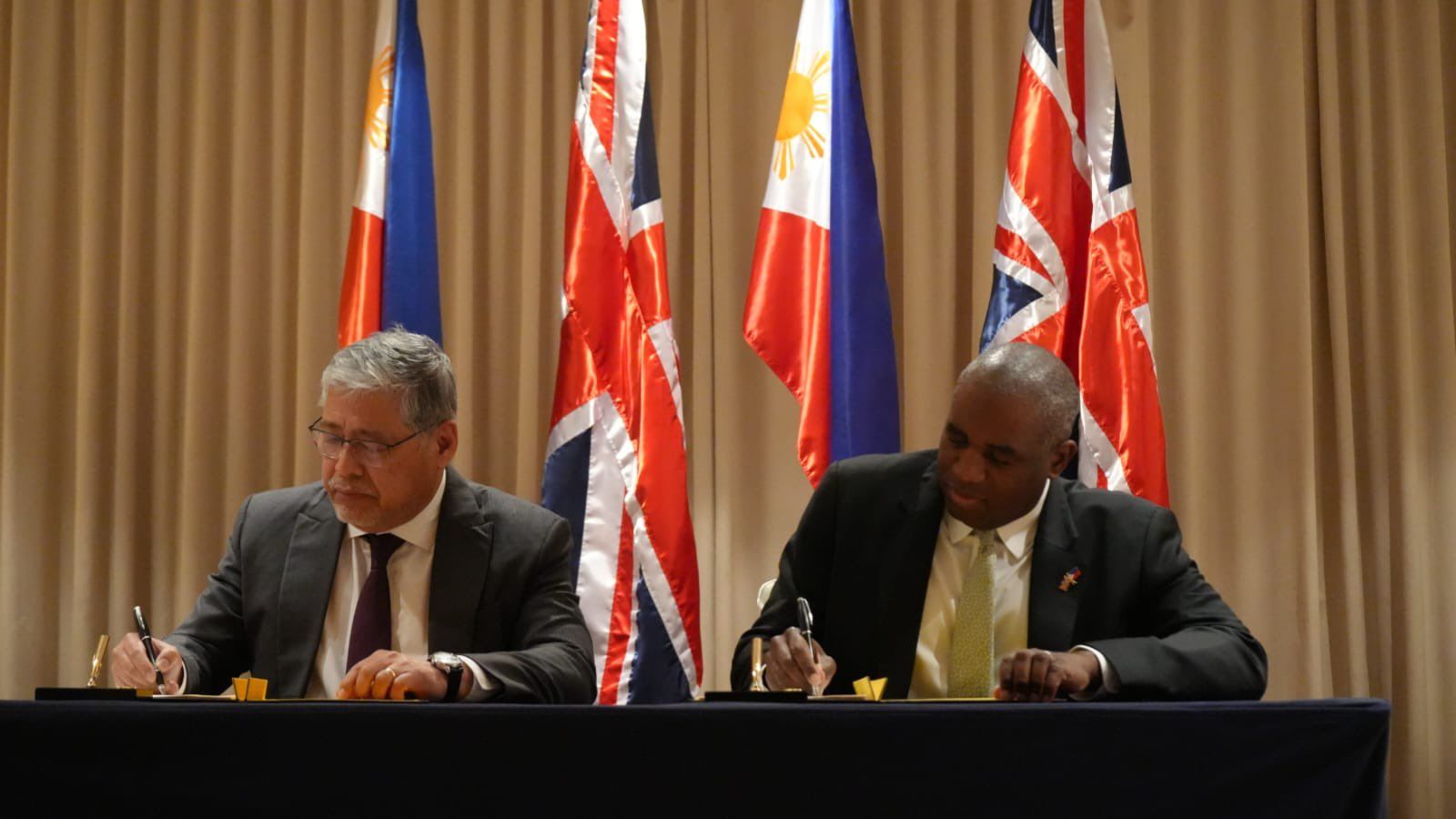
(From left) DFA Secretary Enrique Manalo and British Foreign Secretary David Lammy sign a framework agreement that will further strengthen the two countries' ties in politics, economics, consular services, climate change, and defense on March 8, 2025. (Photo from Sec. Manalo)


The Philippines is mulling the possibility of a Visiting Forces Agreement (VFA) with the United Kingdom to strengthen its defense cooperation.

Department of Foreign Affairs (DFA) Secretary Enrique Manalo met on Saturday, March 8, with British Foreign Minister David Lammy in Manila to sign an enhanced partnership framework to strengthen the two countries’ ties in politics, economics, consular services, climate change, and defense.

“Well, it’s still a possibility, I think, in general thoughts. But nothing’s firm yet but it’s certainly something that could be on the horizon,” he said in a media interview after the signing ceremony.

In their joint presser, Lammy talked about the importance of visiting the Philippines and other like-minded nations.

The British foreign secretary said that the Philippines and UK “are charting a new course for our relationship amidst a lot of global volatility.

“We must strengthen ties with like-minded partners like the Philippines,” he added. “There is so much we can do together.”

Lammy also shared that the UK places importance on its obligations in the region.

“We are countries that are committed to international law. We are countries that are committed to the rules-based order. We are countries that take our obligations under the UN (United Nations) Charter seriously,” he said.

The signed Philippines-UK Joint Framework agreement will chart the direction of the two countries’ relationship and cooperation in trade, defense, human rights, and regional security.

Manalo said he and Lammy agreed “to sustain cooperation on matters of pressing mutual concern such as defense and security, human rights, maritime, and economic resilience.”

For his part, the UK foreign secretary said that the Philippines and UK “are charting a new course for our relationship amidst a lot of global volatility.”
“We must strengthen ties with like-minded partners like the Philippines,” he added. “There is so much we can do together.”
In his statement, Manalo disclosed that the two countries are working on a number of agreements and engagements—an Implementing Arrangement under the 2024 Memorandum of Understanding on Defense Cooperation, an MOU on information sharing concerning maritime domain awareness, continued participation and exchanges in joint military exercises and maritime patrols, port calls of British naval vessels, and the launch of the inaugural PH-UK Joint Economic Committee (JETCO) meeting in London this month.
The JETCO, in particular, aims to further develop cooperation in key areas such as infrastructure development, agriculture, and energy, including renewables.
A proposed PH-UK agreement on financial cooperation is also in the pipeline. This is expected to unlock a £5.2-billion credit facility for the Philippines through the UK Export Finance, on 15 key sectors including agriculture, transportation, ICT, water sanitation, and health.

PH-Canada defense pact

The two officials made these remarks after the Philippines and Canada have finished their discussions on the proposed Status of Visiting Forces Agreement (SOVFA) and are now set to sign the deal.

“This significant achievement reflects the unwavering commitment of both parties to strengthen bilateral relations. It stands as a strong testament to the trust and confidence in our partnership and its future growth,” the Canadian Embassy in Manila said in a statement on Saturday.

“Canada is deeply appreciative of the Philippines’ support and spirit of collaboration to negotiate this important Agreement,” it added.

The embassy also stated that the agreement “will launch a new chapter in the Philippines-Canadian bilateral defense relationship” that will allow them to work “much more closely as trusted partners.”

“It will bolster defense and military ties between the two countries, enabling the Armed Forces of the Philippines and the Canadian Armed Forces to operate and train together in each other’s territories,” it stressed.

Canadian naval forces have increased their military engagement in the Indo-Pacific region in recent months, participating in several joint sails in the West Philippine Sea with the Philippines, United States, Australia, and Japan.

The 1987 Philippine Constitution prohibits foreign troops from establishing permanent military bases in the country but through agreements like the VFA, foreign militaries may be allowed to enter the countries for activities.

The Philippines have several VFAs, including one with the United States that serves a legal framework to allow US forces to visit Manila temporarily for military exercises.

It also has an existing deal with Australia, as well as Reciprocal Access Agreement (RAA) with Japan that will allow Filipino soldiers to undergo combat training with their counterparts in Japan.

These increased maritime and defense alliances came on the heels of China’s aggressive actions in the region, which it continues to claim almost in its entirety despite the 2016 arbitral tribunal win that invalidated the basis of these claims.

Related Tags

Enrique Manalo United Kingdom DFA visiting forces agreement
ADVERTISEMENT
.most-popular .layout-ratio{ padding-bottom: 79.13%; } @media (min-width: 768px) and (max-width: 1024px) { .widget-title { font-size: 15px !important; } }

{{ articles_filter_1561_widget.title }}

.most-popular .layout-ratio{ padding-bottom: 79.13%; } @media (min-width: 768px) and (max-width: 1024px) { .widget-title { font-size: 15px !important; } }

{{ articles_filter_1562_widget.title }}

.most-popular .layout-ratio{ padding-bottom: 79.13%; } @media (min-width: 768px) and (max-width: 1024px) { .widget-title { font-size: 15px !important; } }

{{ articles_filter_1563_widget.title }}

{{ articles_filter_1564_widget.title }}

.mb-article-details { position: relative; } .mb-article-details .article-body-preview, .mb-article-details .article-body-summary{ font-size: 17px; line-height: 30px; font-family: "Libre Caslon Text", serif; color: #000; } .mb-article-details .article-body-preview iframe , .mb-article-details .article-body-summary iframe{ width: 100%; margin: auto; } .read-more-background { background: linear-gradient(180deg, color(display-p3 1.000 1.000 1.000 / 0) 13.75%, color(display-p3 1.000 1.000 1.000 / 0.8) 30.79%, color(display-p3 1.000 1.000 1.000) 72.5%); position: absolute; height: 200px; width: 100%; bottom: 0; display: flex; justify-content: center; align-items: center; padding: 0; } .read-more-background a{ color: #000; } .read-more-btn { padding: 17px 45px; font-family: Inter; font-weight: 700; font-size: 18px; line-height: 16px; text-align: center; vertical-align: middle; border: 1px solid black; background-color: white; } .hidden { display: none; }
function initializeAllSwipers() { // Get all hidden inputs with cms_article_id document.querySelectorAll('[id^="cms_article_id_"]').forEach(function (input) { const cmsArticleId = input.value; const articleSelector = '#article-' + cmsArticleId + ' .body_images'; const swiperElement = document.querySelector(articleSelector); if (swiperElement && !swiperElement.classList.contains('swiper-initialized')) { new Swiper(articleSelector, { loop: true, pagination: false, navigation: { nextEl: '#article-' + cmsArticleId + ' .swiper-button-next', prevEl: '#article-' + cmsArticleId + ' .swiper-button-prev', }, }); } }); } setTimeout(initializeAllSwipers, 3000); const intersectionObserver = new IntersectionObserver( (entries) => { entries.forEach((entry) => { if (entry.isIntersecting) { const newUrl = entry.target.getAttribute("data-url"); if (newUrl) { history.pushState(null, null, newUrl); let article = entry.target; // Extract metadata const author = article.querySelector('.author-section').textContent.replace('By', '').trim(); const section = article.querySelector('.section-info ').textContent.replace(' ', ' '); const title = article.querySelector('.article-title h1').textContent; // Parse URL for Chartbeat path format const parsedUrl = new URL(newUrl, window.location.origin); const cleanUrl = parsedUrl.host + parsedUrl.pathname; // Update Chartbeat configuration if (typeof window._sf_async_config !== 'undefined') { window._sf_async_config.path = cleanUrl; window._sf_async_config.sections = section; window._sf_async_config.authors = author; } // Track virtual page view with Chartbeat if (typeof pSUPERFLY !== 'undefined' && typeof pSUPERFLY.virtualPage === 'function') { try { pSUPERFLY.virtualPage({ path: cleanUrl, title: title, sections: section, authors: author }); } catch (error) { console.error('ping error', error); } } // Optional: Update document title if (title && title !== document.title) { document.title = title; } } } }); }, { threshold: 0.1 } ); function showArticleBody(button) { const article = button.closest("article"); const summary = article.querySelector(".article-body-summary"); const body = article.querySelector(".article-body-preview"); const readMoreSection = article.querySelector(".read-more-background"); // Hide summary and read-more section summary.style.display = "none"; readMoreSection.style.display = "none"; // Show the full article body body.classList.remove("hidden"); } document.addEventListener("DOMContentLoaded", () => { let loadCount = 0; // Track how many times articles are loaded const offset = [1, 2, 3, 4, 5, 6, 7, 8, 9, 10]; // Offset values const currentUrl = window.location.pathname.substring(1); let isLoading = false; // Prevent multiple calls if (!currentUrl) { console.log("Current URL is invalid."); return; } const sentinel = document.getElementById("load-more-sentinel"); if (!sentinel) { console.log("Sentinel element not found."); return; } function isSentinelVisible() { const rect = sentinel.getBoundingClientRect(); return ( rect.top < window.innerHeight && rect.bottom >= 0 ); } function onScroll() { if (isLoading) return; if (isSentinelVisible()) { if (loadCount >= offset.length) { console.log("Maximum load attempts reached."); window.removeEventListener("scroll", onScroll); return; } isLoading = true; const currentOffset = offset[loadCount]; window.loadMoreItems().then(() => { let article = document.querySelector('#widget_1690 > div:nth-last-of-type(2) article'); intersectionObserver.observe(article) loadCount++; }).catch(error => { console.error("Error loading more items:", error); }).finally(() => { isLoading = false; }); } } window.addEventListener("scroll", onScroll); });

Sign up by email to receive news.