






 Philippines
National
'It's about PH interest': DFA chief frowns on distortion of South China Sea issue
Philippines
National
'It's about PH interest': DFA chief frowns on distortion of South China Sea issue
'It's about PH interest': DFA chief frowns on distortion of South China Sea issue


Department of Foreign Affairs (DFA) Secretary Enrique Manalo denied China’s claims that Manila has launched a smear campaign to pit Beijing against Western powers in the South China Sea issue.
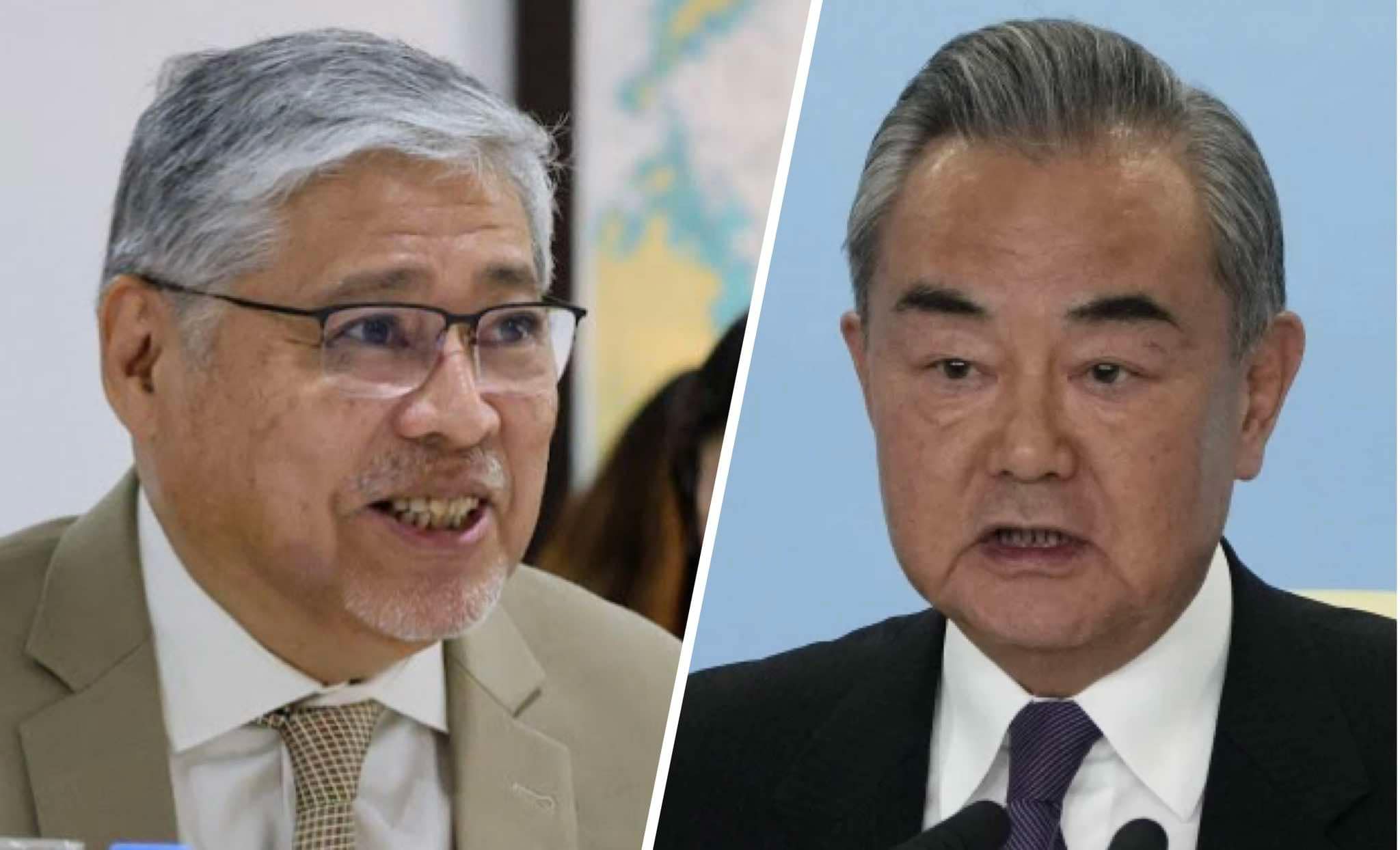
DFA Secretary Enrique Manalo and Chinese Foreign Minister Wang Yi (Photos from DFA, AP)
In a media interview on Saturday, March 8, the DFA chief stated that China’s comment was “distorting the issue.”
“You know, here we are again, in a way, distorting the issue that is being cast in light of the strategic rivalry among the big powers where actually the issue is really an issue of Philippine interest and how it affects the Philippines,” he said.
Manalo insisted that Manila “has no connections with any kind of strategic rivalry among the big powers.”
“That should not be viewed that way and if that’s unfortunately the way they viewed it then, certainly it won’t really lead to any productive talk. So, we really hope that we look at this as an issue which concerns Philippine interest, specifically, not any other country,” he added.
Chinese Foreign Minister Wang Yi recently described the tensions between Beijing and Manila as a “shadow play.”
“For every move on the sea by the Philippines, there is a screenplay written by external forces, the show is livestreamed by Western media, and the plot is invariably to smear China. People are not interested in watching the same performance again and again,” he added.
A shadow play is a traditional theatrical art of performing using puppets that move behind a thin translucent curtain or screen.
Beijing and Manila continue to be at loggerheads over the resource-rich South China Sea, which China claims in almost its entirety, including the exclusive economic zones (EEZs) of the Philippines.
Confronted by China’s massive naval posture in the contested waters, the Philippines forged several defense partnerships with the United States, Japan, Australia, and Canada.
But it also largely depended on its oldest ally, the United States, in protecting its territorial and maritime rights, as well as a 2016 arbitral tribunal victory that invalidated the basis of China’s claim to the region.
This was frowned upon by China as it rejected the ruling multiple times, and called out Western interventions into what it said was a regional issue.