






 Philippines
National
Marcos signs law allowing qualified Pinoys to earn degrees via non-traditional means
Philippines
National
Marcos signs law allowing qualified Pinoys to earn degrees via non-traditional means
Marcos signs law allowing qualified Pinoys to earn degrees via non-traditional means


At A Glance
- The new law allows Filipino citizens at least 23 years old, residing in the Philippines or abroad.
- Applicants should have completed a secondary school program.
- They must have at least five years of aggregate work experience in the industry related to the academic degree program or discipline where equivalency of learning is sought.
President Marcos has signed the measure enabling Filipinos, especially working professionals, to earn college degrees without formal classroom study for career advancement.
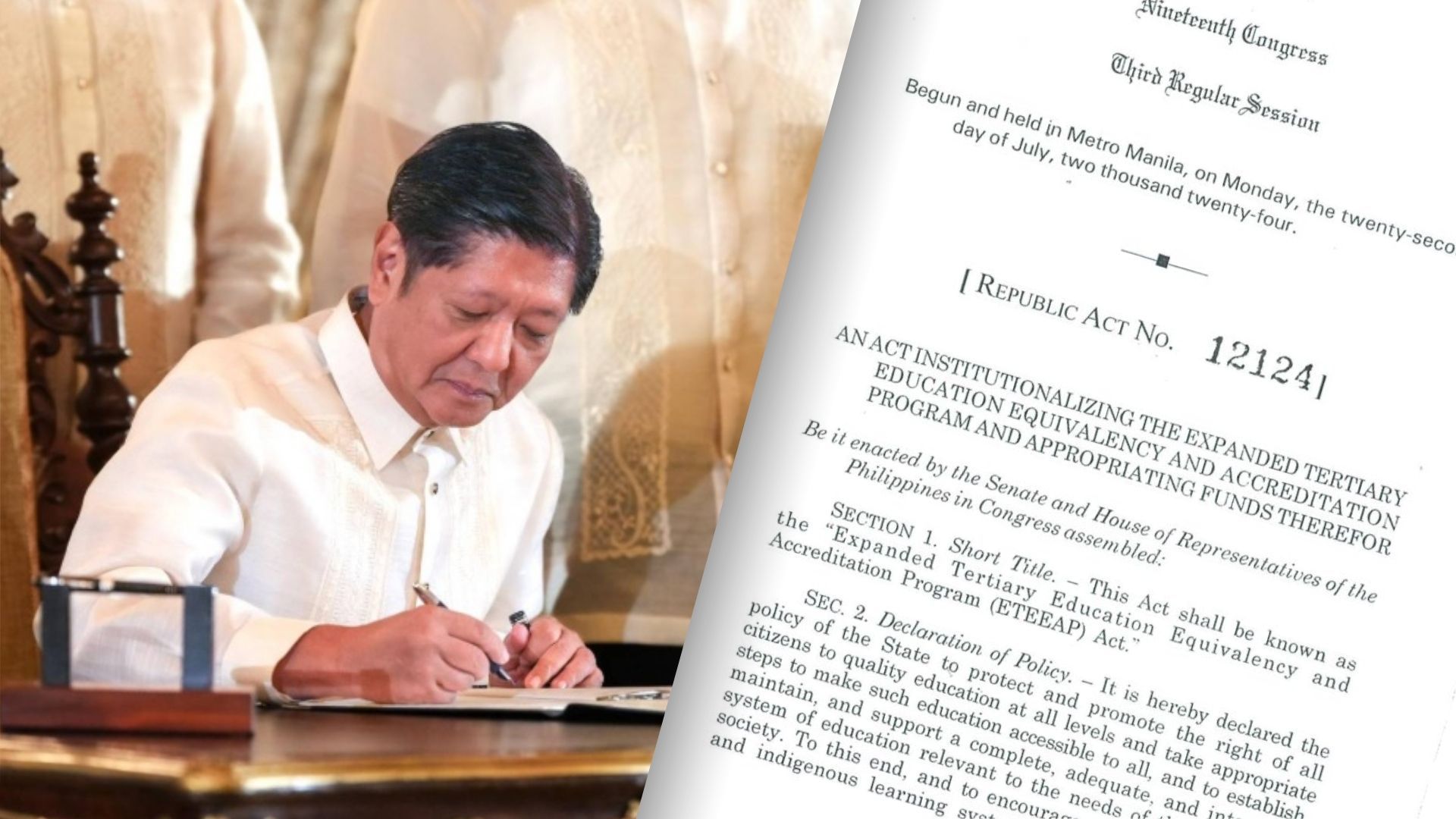
Marcos signed Republic Act (RA) No. 12124, or the Expanded Tertiary Education Equivalency and Accreditation Program (ETEEAP) Act, on Monday, March 3.
The ETEEAP Act will identify, assess, validate, and assign equivalent undergraduate-level and special graduate programs of prior learning from formal, non-formal, and informal learning systems and relevant work experiences to qualified individuals for the grant of appropriate academic degrees.
The new law allows Filipino citizens at least 23 years old, residing in the Philippines or abroad, to apply for equivalency and accreditation if they satisfy the requirements.
Applicants should have completed a secondary school program, as evidenced by a high school diploma or a result of the Philippine Educational Placement Test or Alternative Learning System Accreditation and Equivalency Assessment and Certification stating that the individual concerned is qualified to enter college.
They must also have at least five years of aggregate work experience in the industry related to the academic degree program or discipline where equivalency of learning is sought.
The Commission on Higher Education (CHED) will serve as the lead agency in implementing ETEEAP.
Its functions include deputizing higher education institutions (HEIs) with academic degrees to be opened for the ETEEAP, developing standards for a diversified mode of assessing skills, values, knowledge, and levels of competence, and granting or revoking HEIs' authority to implement the ETEEAP.
The CHED is also tasked to monitor and evaluate the implementation of the ETEEAP by deputized HEIs, convening broad-based and inter-agency consultation meetings, and setting standard fees and other administrative charges for accreditation that will contribute to ETEEAP's special account.
To ensure the effective implementation of ETEEAP, the Office of Programs and Standards Development (OPSD) under CHED will be strengthened to serve as the permanent technical secretariat for carrying out the new law's functions.