ADVERTISEMENT

Pope Francis no longer requires mechanical ventilation after respiratory crisis

Published Mar 4, 2025 02:26 pm
AP25062648740003 (1).jpg
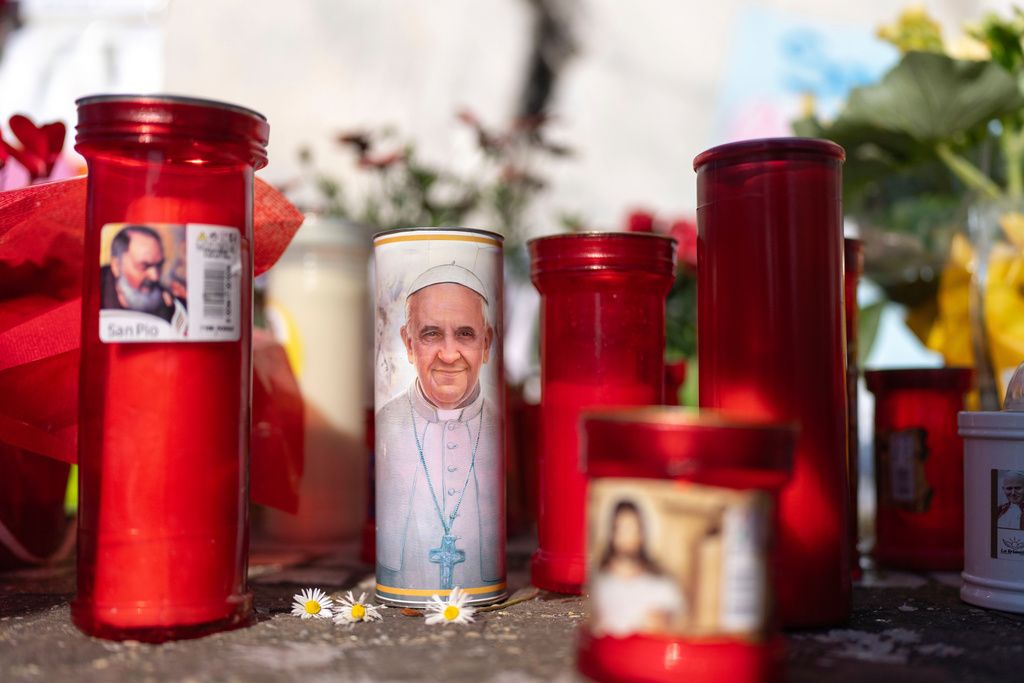
Candles left outside the Agostino Gemelli Polyclinic, in Rome, Monday, March 3, 2025 where Pope Francis is hospitalized since Friday, Feb. 14. (AP Photo/Mosa'ab Elshamy)

ROME (AP) — Pope Francis stabilized enough Tuesday after two respiratory crises to resume using a nasal tube for oxygen, rather than a ventilation mask, as he continued to fight pneumonia, the Vatican said.

The 88-year-old pope, who has chronic lung disease and had part of one lung removed as a young man, woke up after sleeping through the night, the Vatican said. The fact that Francis no longer needed the mask by Tuesday morning was a sign of some improvement after crises that required doctors to extract “copious” amounts of mucus from his lungs.

But the doctors’ prognosis remained guarded, meaning he was not out of danger.

The Vatican said as of Tuesday morning, Francis no longer needed to wear the noninvasive mechanical ventilation mask that covers his nose and mouth to pump oxygen into his lungs and was just receiving supplemental oxygen through a nasal tube.

Francis suffered two respiratory crises a day earlier. Doctors performed two bronchoscopies, in which a camera-tipped tube was sent into his airways with a sucker at the tip to suction out fluid. The pope remained alert, oriented and cooperated with medical personnel during the crises, the Vatican said.

His medical team has not provided an in-person update on his condition since Feb. 21, a sign of the up-and-down nature of his hospitalization, the longest of his 12-year papacy.

Francis' treatment comes as the Vatican prepares for Lent, the solemn period leading up to Easter on April 20. As it is, a cardinal has been designated to take Francis' place this week on Ash Wednesday, which opens Lent with a traditional service and procession in Rome. The pope was also supposed to attend a spiritual retreat this coming weekend with the rest of the Holy See hierarchy.

On Tuesday, the Vatican said the retreat would go ahead without Francis but in “spiritual communion” with him. The theme, selected weeks ago and well before Francis got sick, was “Hope in eternal life.”

Dr. John Coleman, a pulmonary critical care doctor at Northwestern Medicine in Chicago, said Monday's respiratory episodes were more concerning than the last one on Friday, in which Francis had a coughing fit, inhaled some vomit and was put on the noninvasive mechanical ventilation for a day.

The use of bronchoscopies reflects a worrying level of mucus and phlegm in the lungs, Coleman said. “The fact that they had to go in there and remove it manually is concerning, because it means that he is not clearing the secretions on his own,” he said.

“He’s taking little steps forward and then steps back,” said Coleman, who is not involved in Francis’ care.

Francis, who is not physically active, uses a wheelchair and is overweight, had been undergoing respiratory physiotherapy to try to improve his lung function. The accumulation of secretions in his lungs was a sign that he doesn’t have the muscle tone to cough vigorously enough to expel the fluid.

Doctors often use noninvasive ventilation to stave off intubation or the use of more invasive mechanical ventilation. Francis has not been intubated during this hospitalization. It’s not clear if he has provided any instructions on the limits of his care if he declines seriously or loses consciousness.

Catholic teaching holds that life must be defended from conception until natural death. It insists that chronically ill patients, including those in vegetative states, must receive “ordinary” care such as hydration and nutrition, but “extraordinary” or disproportionate care can be suspended if it is no longer beneficial or is only prolonging a precarious and painful life.

Francis articulated that in a 2017 speech to a meeting of the Vatican’s bioethics think tank, the Pontifical Academy for Life. He said there was “no obligation to have recourse in all circumstances to every possible remedy.” He added: “It thus makes possible a decision that is morally qualified as withdrawal of ‘overzealous treatment.’”

Archbishop Vincenzo Paglia, who heads the academy which helps articulate the Catholic Church’s position on end-of-life care, said Francis is like any other Catholic and would follow church teaching if it came to that.

“Today the pope is giving us an extraordinary teaching on fragility,” he told reporters Monday. “Today the pope, not through words but with his body, is reminding all of us, we elderly people to begin with, that we are all fragile and therefore we need to take care of each other.”

Related Tags

WORLDNEWS
ADVERTISEMENT
.most-popular .layout-ratio{ padding-bottom: 79.13%; } @media (min-width: 768px) and (max-width: 1024px) { .widget-title { font-size: 15px !important; } }

{{ articles_filter_1561_widget.title }}

.most-popular .layout-ratio{ padding-bottom: 79.13%; } @media (min-width: 768px) and (max-width: 1024px) { .widget-title { font-size: 15px !important; } }

{{ articles_filter_1562_widget.title }}

.most-popular .layout-ratio{ padding-bottom: 79.13%; } @media (min-width: 768px) and (max-width: 1024px) { .widget-title { font-size: 15px !important; } }

{{ articles_filter_1563_widget.title }}

{{ articles_filter_1564_widget.title }}

.mb-article-details { position: relative; } .mb-article-details .article-body-preview, .mb-article-details .article-body-summary{ font-size: 17px; line-height: 30px; font-family: "Libre Caslon Text", serif; color: #000; } .mb-article-details .article-body-preview iframe , .mb-article-details .article-body-summary iframe{ width: 100%; margin: auto; } .read-more-background { background: linear-gradient(180deg, color(display-p3 1.000 1.000 1.000 / 0) 13.75%, color(display-p3 1.000 1.000 1.000 / 0.8) 30.79%, color(display-p3 1.000 1.000 1.000) 72.5%); position: absolute; height: 200px; width: 100%; bottom: 0; display: flex; justify-content: center; align-items: center; padding: 0; } .read-more-background a{ color: #000; } .read-more-btn { padding: 17px 45px; font-family: Inter; font-weight: 700; font-size: 18px; line-height: 16px; text-align: center; vertical-align: middle; border: 1px solid black; background-color: white; } .hidden { display: none; }
function initializeAllSwipers() { // Get all hidden inputs with cms_article_id document.querySelectorAll('[id^="cms_article_id_"]').forEach(function (input) { const cmsArticleId = input.value; const articleSelector = '#article-' + cmsArticleId + ' .body_images'; const swiperElement = document.querySelector(articleSelector); if (swiperElement && !swiperElement.classList.contains('swiper-initialized')) { new Swiper(articleSelector, { loop: true, pagination: false, navigation: { nextEl: '#article-' + cmsArticleId + ' .swiper-button-next', prevEl: '#article-' + cmsArticleId + ' .swiper-button-prev', }, }); } }); } setTimeout(initializeAllSwipers, 3000); const intersectionObserver = new IntersectionObserver( (entries) => { entries.forEach((entry) => { if (entry.isIntersecting) { const newUrl = entry.target.getAttribute("data-url"); if (newUrl) { history.pushState(null, null, newUrl); let article = entry.target; // Extract metadata const author = article.querySelector('.author-section').textContent.replace('By', '').trim(); const section = article.querySelector('.section-info ').textContent.replace(' ', ' '); const title = article.querySelector('.article-title h1').textContent; // Parse URL for Chartbeat path format const parsedUrl = new URL(newUrl, window.location.origin); const cleanUrl = parsedUrl.host + parsedUrl.pathname; // Update Chartbeat configuration if (typeof window._sf_async_config !== 'undefined') { window._sf_async_config.path = cleanUrl; window._sf_async_config.sections = section; window._sf_async_config.authors = author; } // Track virtual page view with Chartbeat if (typeof pSUPERFLY !== 'undefined' && typeof pSUPERFLY.virtualPage === 'function') { try { pSUPERFLY.virtualPage({ path: cleanUrl, title: title, sections: section, authors: author }); } catch (error) { console.error('ping error', error); } } // Optional: Update document title if (title && title !== document.title) { document.title = title; } } } }); }, { threshold: 0.1 } ); function showArticleBody(button) { const article = button.closest("article"); const summary = article.querySelector(".article-body-summary"); const body = article.querySelector(".article-body-preview"); const readMoreSection = article.querySelector(".read-more-background"); // Hide summary and read-more section summary.style.display = "none"; readMoreSection.style.display = "none"; // Show the full article body body.classList.remove("hidden"); } document.addEventListener("DOMContentLoaded", () => { let loadCount = 0; // Track how many times articles are loaded const offset = [1, 2, 3, 4, 5, 6, 7, 8, 9, 10]; // Offset values const currentUrl = window.location.pathname.substring(1); let isLoading = false; // Prevent multiple calls if (!currentUrl) { console.log("Current URL is invalid."); return; } const sentinel = document.getElementById("load-more-sentinel"); if (!sentinel) { console.log("Sentinel element not found."); return; } function isSentinelVisible() { const rect = sentinel.getBoundingClientRect(); return ( rect.top < window.innerHeight && rect.bottom >= 0 ); } function onScroll() { if (isLoading) return; if (isSentinelVisible()) { if (loadCount >= offset.length) { console.log("Maximum load attempts reached."); window.removeEventListener("scroll", onScroll); return; } isLoading = true; const currentOffset = offset[loadCount]; window.loadMoreItems().then(() => { let article = document.querySelector('#widget_1690 > div:nth-last-of-type(2) article'); intersectionObserver.observe(article) loadCount++; }).catch(error => { console.error("Error loading more items:", error); }).finally(() => { isLoading = false; }); } } window.addEventListener("scroll", onScroll); });

Sign up by email to receive news.