

ADVERTISEMENT

'Magulo': Majority of Filipinos view Philippine politics as chaotic, survey finds

Published Mar 23, 2025 06:13 am

At A Glance

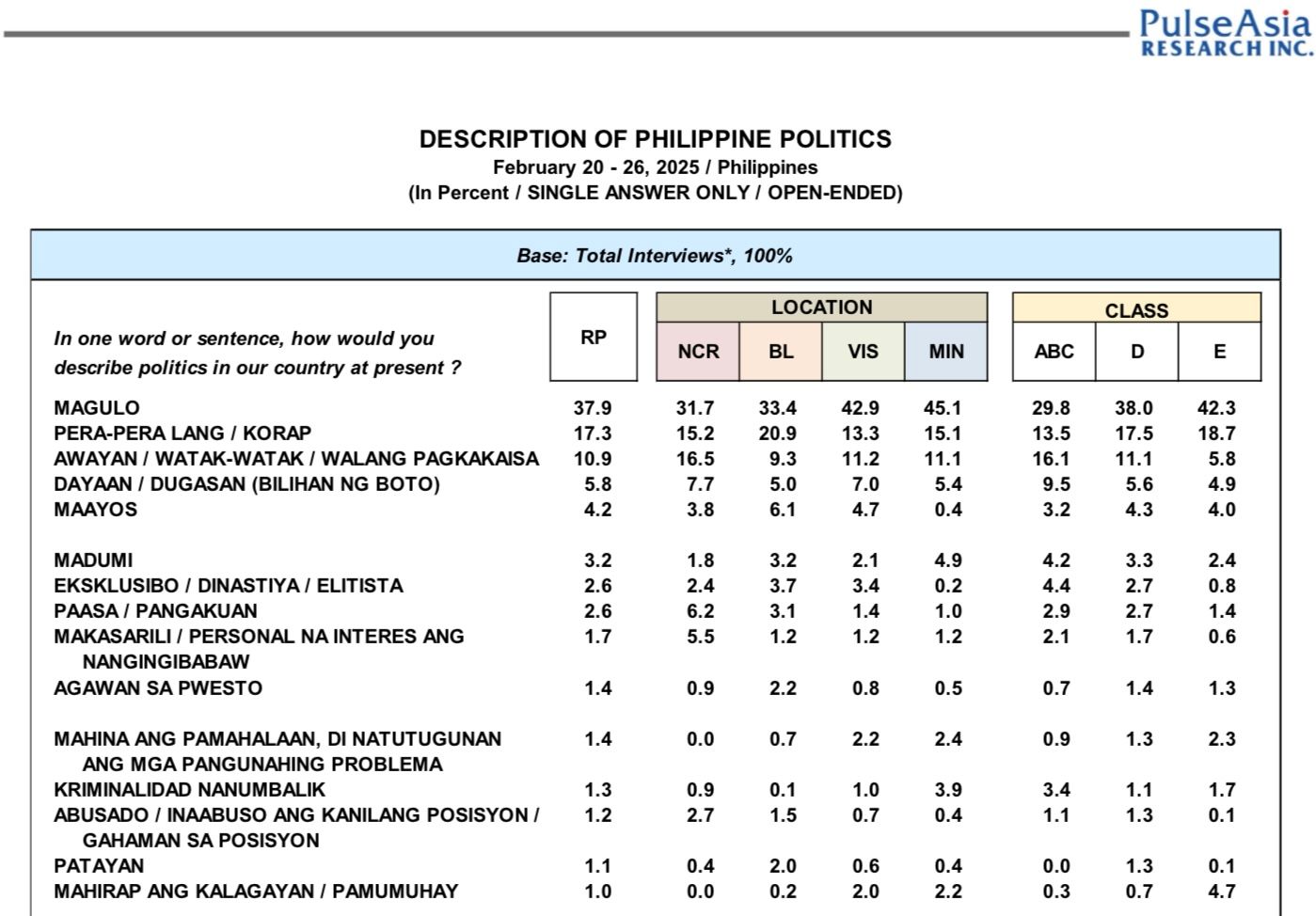
  • The results of the February 2025 "Pulso ng Bayan" Survey showed over a third of respondents (37.9 percent) describe Philippine politics as "magulo" or chaotic.
  • Almost a fifth of those surveyed (17.3 percent) associate Philippine politics with corruption or the exchange of money, often referred to as "pera-pera lang."
  • Only 4.2 percent of registered voters describe Philippine politics as "maayos" or orderly.
IMG_4957.jpeg
Pulse Asia

A survey conducted by Pulse Asia from Feb. 20 to 26 revealed a predominantly negative perception of Philippine politics among Filipino registered voters, with the majority describing it as “magulo” or chaotic.

The results of the February 2025 “Pulso ng Bayan” Survey showed over a third of respondents (37.9 percent) describe Philippine politics as chaotic.

Pulse Asia said this view was consistent across various geographic areas and most socio-economic classes, with 31.7 percent of respondents in the National Capital Region (NCR), 33.4 percent in Balance Luzon (Luzon outside Metro Manila), 42.9 percent in the Visayas, and 45.1 percent in Mindanao describing Philippine politics as magulo.

The perception was also prevalent in socio-economic classes, with 38 percent of respondents in Class D and 42.3 percent in Class E sharing this view.

In contrast, 29.8 percent of those in Class ABC described Philippine politics as chaotic.

In addition, Pulse Asia said almost a fifth of those surveyed (17.3 percent) associate Philippine politics with corruption or the exchange of money, often referred to as “pera-pera lang.”

Another significant portion of the population, about 10.9 percent, highlighted the divisive nature of local politics, with terms such as “awayan,” “watak-watak,” or “walang pagkakaisa.”

Moreover, 5.8 percent cited electoral fraud, such as cheating or vote buying, as a defining feature of the country’s politics.

Meanwhile, only 4.2 percent of registered voters describe Philippine politics as “maayos” or orderly.

Pulse Asia said a range of other responses, each cited by at least 1 percent of those surveyed, were “generally negative in nature.”

These include views such as “madumi” (dirty) at 3.2 percent, “eksklusibo/dinastiya/elitista” (exclusive/dynastic/elitist) at 2.6 percent, and “paasa/pangakuan” (misleading/promising without intention to deliver) at 2.6 percent.

Other negative descriptions included “makasarili/personal na interes ang nangingibabaw” (self-serving/personal interests take precedence) at 1.7 percent, “agawan sa pwesto” (scramble for positions) at 1.4 percent, “mahina ang pamahalaan” (weak government) at 1.4 percent, “kriminalidad nanumbalik” (resurgence of criminality) at 1.3 percent, “abusado/inaabuso ang kanilang posisyon/gahaman sa posisyon” (abusive/abusing their position/greedy for power) at 1.2 percent, “patayan” (killings) at 1.1 percent; and “mahirap ang kalagayan/pamumuhay” (difficult living conditions) at 1 percent.

Related Tags

matalinong boto 2025 pulse asia
ADVERTISEMENT
.most-popular .layout-ratio{ padding-bottom: 79.13%; } @media (min-width: 768px) and (max-width: 1024px) { .widget-title { font-size: 15px !important; } }

{{ articles_filter_1561_widget.title }}

.most-popular .layout-ratio{ padding-bottom: 79.13%; } @media (min-width: 768px) and (max-width: 1024px) { .widget-title { font-size: 15px !important; } }

{{ articles_filter_1562_widget.title }}

.most-popular .layout-ratio{ padding-bottom: 79.13%; } @media (min-width: 768px) and (max-width: 1024px) { .widget-title { font-size: 15px !important; } }

{{ articles_filter_1563_widget.title }}

{{ articles_filter_1564_widget.title }}

.mb-article-details { position: relative; } .mb-article-details .article-body-preview, .mb-article-details .article-body-summary{ font-size: 17px; line-height: 30px; font-family: "Libre Caslon Text", serif; color: #000; } .mb-article-details .article-body-preview iframe , .mb-article-details .article-body-summary iframe{ width: 100%; margin: auto; } .read-more-background { background: linear-gradient(180deg, color(display-p3 1.000 1.000 1.000 / 0) 13.75%, color(display-p3 1.000 1.000 1.000 / 0.8) 30.79%, color(display-p3 1.000 1.000 1.000) 72.5%); position: absolute; height: 200px; width: 100%; bottom: 0; display: flex; justify-content: center; align-items: center; padding: 0; } .read-more-background a{ color: #000; } .read-more-btn { padding: 17px 45px; font-family: Inter; font-weight: 700; font-size: 18px; line-height: 16px; text-align: center; vertical-align: middle; border: 1px solid black; background-color: white; } .hidden { display: none; }
function initializeAllSwipers() { // Get all hidden inputs with cms_article_id document.querySelectorAll('[id^="cms_article_id_"]').forEach(function (input) { const cmsArticleId = input.value; const articleSelector = '#article-' + cmsArticleId + ' .body_images'; const swiperElement = document.querySelector(articleSelector); if (swiperElement && !swiperElement.classList.contains('swiper-initialized')) { new Swiper(articleSelector, { loop: true, pagination: false, navigation: { nextEl: '#article-' + cmsArticleId + ' .swiper-button-next', prevEl: '#article-' + cmsArticleId + ' .swiper-button-prev', }, }); } }); } setTimeout(initializeAllSwipers, 3000); const intersectionObserver = new IntersectionObserver( (entries) => { entries.forEach((entry) => { if (entry.isIntersecting) { const newUrl = entry.target.getAttribute("data-url"); if (newUrl) { history.pushState(null, null, newUrl); let article = entry.target; // Extract metadata const author = article.querySelector('.author-section').textContent.replace('By', '').trim(); const section = article.querySelector('.section-info ').textContent.replace(' ', ' '); const title = article.querySelector('.article-title h1').textContent; // Parse URL for Chartbeat path format const parsedUrl = new URL(newUrl, window.location.origin); const cleanUrl = parsedUrl.host + parsedUrl.pathname; // Update Chartbeat configuration if (typeof window._sf_async_config !== 'undefined') { window._sf_async_config.path = cleanUrl; window._sf_async_config.sections = section; window._sf_async_config.authors = author; } // Track virtual page view with Chartbeat if (typeof pSUPERFLY !== 'undefined' && typeof pSUPERFLY.virtualPage === 'function') { try { pSUPERFLY.virtualPage({ path: cleanUrl, title: title, sections: section, authors: author }); } catch (error) { console.error('ping error', error); } } // Optional: Update document title if (title && title !== document.title) { document.title = title; } } } }); }, { threshold: 0.1 } ); function showArticleBody(button) { const article = button.closest("article"); const summary = article.querySelector(".article-body-summary"); const body = article.querySelector(".article-body-preview"); const readMoreSection = article.querySelector(".read-more-background"); // Hide summary and read-more section summary.style.display = "none"; readMoreSection.style.display = "none"; // Show the full article body body.classList.remove("hidden"); } document.addEventListener("DOMContentLoaded", () => { let loadCount = 0; // Track how many times articles are loaded const offset = [1, 2, 3, 4, 5, 6, 7, 8, 9, 10]; // Offset values const currentUrl = window.location.pathname.substring(1); let isLoading = false; // Prevent multiple calls if (!currentUrl) { console.log("Current URL is invalid."); return; } const sentinel = document.getElementById("load-more-sentinel"); if (!sentinel) { console.log("Sentinel element not found."); return; } function isSentinelVisible() { const rect = sentinel.getBoundingClientRect(); return ( rect.top < window.innerHeight && rect.bottom >= 0 ); } function onScroll() { if (isLoading) return; if (isSentinelVisible()) { if (loadCount >= offset.length) { console.log("Maximum load attempts reached."); window.removeEventListener("scroll", onScroll); return; } isLoading = true; const currentOffset = offset[loadCount]; window.loadMoreItems().then(() => { let article = document.querySelector('#widget_1690 > div:nth-last-of-type(2) article'); intersectionObserver.observe(article) loadCount++; }).catch(error => { console.error("Error loading more items:", error); }).finally(() => { isLoading = false; }); } } window.addEventListener("scroll", onScroll); });

Sign up by email to receive news.