ADVERTISEMENT

Indian city sets curfew after Hindu groups demand demolition of 17th century Muslim ruler's tomb

Published Mar 18, 2025 03:06 pm
AP25077355869192.jpg
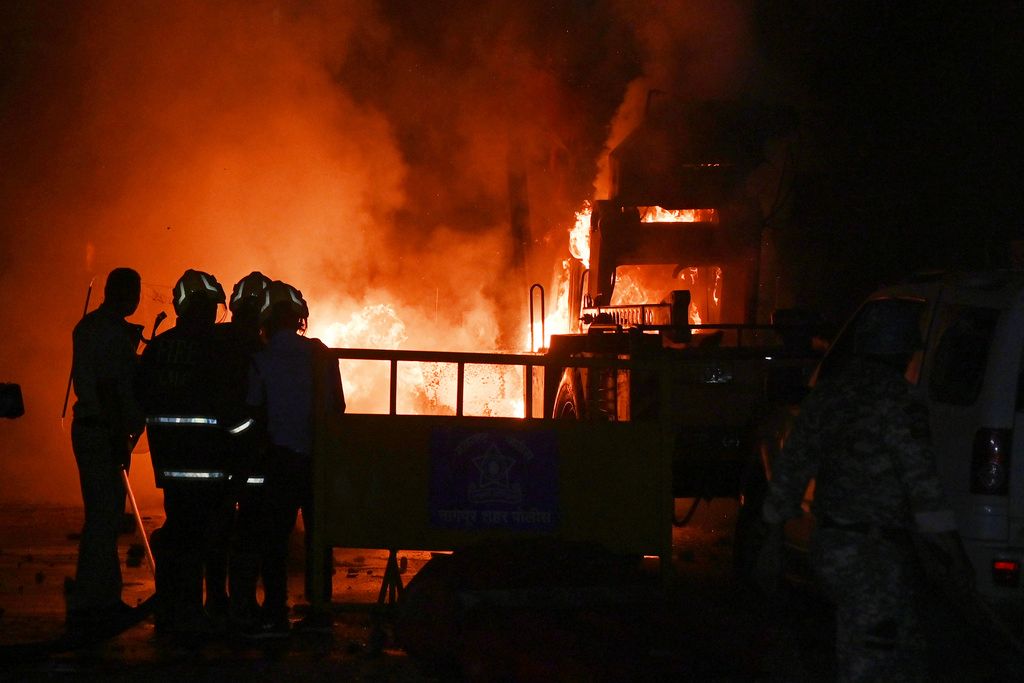
Policemen watch as vehicles are torched during communal clashes sparked by protests demanding removal of the tomb of 17th-century Muslim Mughal ruler Aurangzeb in Nagpur, India, Monday, March 17, 2025. (AP Photo)

NEW DELHI (AP) — Authorities imposed an indefinite curfew in parts of a western Indian city on Tuesday, a day after sectarian clashes were sparked by Hindu nationalist groups who want to demolish the tomb of a 17th-century Muslim Mughal ruler.

Clashes between Hindus and Muslims in Maharashtra state’s Nagpur city broke out on Monday during a protest led by Hindu nationalist groups demanding the demolition of the tomb of Aurangzeb, a Muslim Mughal ruler who has been dead for more than 300 years.

Lawmaker Chandrashekhar Bawankule said at least 34 police personnel and five other people were injured and several houses and vehicles were damaged during the violence. Senior police office Ravinder Singal said at least 50 people have been arrested so far.

Devendra Fadnavis, Maharashtra’s top elected official, said the violence began after “rumors were spread that things containing religious content were burnt” by the protesters, referring to the Quran.

Aurangzeb’s tomb is in Chhatrapati Sambhaji Nagar city, some 500 kilometers (310 miles) from Nagpur. The city was earlier called Aurangabad, after the Mughal ruler.

Aurangzeb is a loathed figure among India’s Hindu nationalists, who accuse him of persecuting Hindus during his rule in the 17th century, even though some historians say such stories are exaggerated.

As tensions between Hindus and Muslims have mounted under Hindu nationalist Prime Minister Narendra Modi, scorn for Aurangzeb has grown. Modi has made references to Aurangzeb in the past, accusing him of persecuting Hindus.

Such remarks have led to anxieties among the country’s significant Muslim minority who in recent years have been at the receiving end of violence from Hindu nationalists, emboldened by a prime minister who has mostly stayed mum on such attacks since he was first elected in 2014.

Tensions over the Mughal ruler have intensified in India after the release of Bollywood movie “Chhaava,” an action film based on a Hindu warrior who fought against Aurangzeb. The film has been lambasted by some movie critics for feeding into a divisive narrative that risks exacerbating religious rifts in the country.

While there have long been tensions between India’s majority Hindu community and Muslims, rights groups say that attacks against minorities have become more brazen under Modi. They also accuse Modi of discriminatory policies towards the country’s Muslims.

Modi’s ruling Hindu nationalist Bharatiya Janata Party denies this.

Hindu extremists have also targeted Muslim places of worship across the country and laid claim to several famous mosques, arguing they are built on the ruins of prominent temples. Many such cases are pending in courts.

Last year, Modi delivered on a longstanding demand from Hindu nationalists — and millions of Hindus — when he opened a controversial temple on the site of a razed mosque in northern India’s Ayodhya city. The 16th-century Babri mosque was demolished in 1992 by Hindu mobs who believe Ram, one of Hinduism's most revered deity, was born at the exact spot.

Related Tags

WORLDNEWS
ADVERTISEMENT
.most-popular .layout-ratio{ padding-bottom: 79.13%; } @media (min-width: 768px) and (max-width: 1024px) { .widget-title { font-size: 15px !important; } }

{{ articles_filter_1561_widget.title }}

.most-popular .layout-ratio{ padding-bottom: 79.13%; } @media (min-width: 768px) and (max-width: 1024px) { .widget-title { font-size: 15px !important; } }

{{ articles_filter_1562_widget.title }}

.most-popular .layout-ratio{ padding-bottom: 79.13%; } @media (min-width: 768px) and (max-width: 1024px) { .widget-title { font-size: 15px !important; } }

{{ articles_filter_1563_widget.title }}

{{ articles_filter_1564_widget.title }}

.mb-article-details { position: relative; } .mb-article-details .article-body-preview, .mb-article-details .article-body-summary{ font-size: 17px; line-height: 30px; font-family: "Libre Caslon Text", serif; color: #000; } .mb-article-details .article-body-preview iframe , .mb-article-details .article-body-summary iframe{ width: 100%; margin: auto; } .read-more-background { background: linear-gradient(180deg, color(display-p3 1.000 1.000 1.000 / 0) 13.75%, color(display-p3 1.000 1.000 1.000 / 0.8) 30.79%, color(display-p3 1.000 1.000 1.000) 72.5%); position: absolute; height: 200px; width: 100%; bottom: 0; display: flex; justify-content: center; align-items: center; padding: 0; } .read-more-background a{ color: #000; } .read-more-btn { padding: 17px 45px; font-family: Inter; font-weight: 700; font-size: 18px; line-height: 16px; text-align: center; vertical-align: middle; border: 1px solid black; background-color: white; } .hidden { display: none; }
function initializeAllSwipers() { // Get all hidden inputs with cms_article_id document.querySelectorAll('[id^="cms_article_id_"]').forEach(function (input) { const cmsArticleId = input.value; const articleSelector = '#article-' + cmsArticleId + ' .body_images'; const swiperElement = document.querySelector(articleSelector); if (swiperElement && !swiperElement.classList.contains('swiper-initialized')) { new Swiper(articleSelector, { loop: true, pagination: false, navigation: { nextEl: '#article-' + cmsArticleId + ' .swiper-button-next', prevEl: '#article-' + cmsArticleId + ' .swiper-button-prev', }, }); } }); } setTimeout(initializeAllSwipers, 3000); const intersectionObserver = new IntersectionObserver( (entries) => { entries.forEach((entry) => { if (entry.isIntersecting) { const newUrl = entry.target.getAttribute("data-url"); if (newUrl) { history.pushState(null, null, newUrl); let article = entry.target; // Extract metadata const author = article.querySelector('.author-section').textContent.replace('By', '').trim(); const section = article.querySelector('.section-info ').textContent.replace(' ', ' '); const title = article.querySelector('.article-title h1').textContent; // Parse URL for Chartbeat path format const parsedUrl = new URL(newUrl, window.location.origin); const cleanUrl = parsedUrl.host + parsedUrl.pathname; // Update Chartbeat configuration if (typeof window._sf_async_config !== 'undefined') { window._sf_async_config.path = cleanUrl; window._sf_async_config.sections = section; window._sf_async_config.authors = author; } // Track virtual page view with Chartbeat if (typeof pSUPERFLY !== 'undefined' && typeof pSUPERFLY.virtualPage === 'function') { try { pSUPERFLY.virtualPage({ path: cleanUrl, title: title, sections: section, authors: author }); } catch (error) { console.error('ping error', error); } } // Optional: Update document title if (title && title !== document.title) { document.title = title; } } } }); }, { threshold: 0.1 } ); function showArticleBody(button) { const article = button.closest("article"); const summary = article.querySelector(".article-body-summary"); const body = article.querySelector(".article-body-preview"); const readMoreSection = article.querySelector(".read-more-background"); // Hide summary and read-more section summary.style.display = "none"; readMoreSection.style.display = "none"; // Show the full article body body.classList.remove("hidden"); } document.addEventListener("DOMContentLoaded", () => { let loadCount = 0; // Track how many times articles are loaded const offset = [1, 2, 3, 4, 5, 6, 7, 8, 9, 10]; // Offset values const currentUrl = window.location.pathname.substring(1); let isLoading = false; // Prevent multiple calls if (!currentUrl) { console.log("Current URL is invalid."); return; } const sentinel = document.getElementById("load-more-sentinel"); if (!sentinel) { console.log("Sentinel element not found."); return; } function isSentinelVisible() { const rect = sentinel.getBoundingClientRect(); return ( rect.top < window.innerHeight && rect.bottom >= 0 ); } function onScroll() { if (isLoading) return; if (isSentinelVisible()) { if (loadCount >= offset.length) { console.log("Maximum load attempts reached."); window.removeEventListener("scroll", onScroll); return; } isLoading = true; const currentOffset = offset[loadCount]; window.loadMoreItems().then(() => { let article = document.querySelector('#widget_1690 > div:nth-last-of-type(2) article'); intersectionObserver.observe(article) loadCount++; }).catch(error => { console.error("Error loading more items:", error); }).finally(() => { isLoading = false; }); } } window.addEventListener("scroll", onScroll); });

Sign up by email to receive news.