

ADVERTISEMENT

Pakistan's army accuses India of sponsoring terror after 26 hostages were killed in a train attack

Published Mar 14, 2025 02:54 pm

ISLAMABAD (AP) — Pakistan’s military accused neighboring India on Friday of sponsoring insurgents in a restive southwestern province, where an unprecedented attack by armed separatists this week killed 26 passengers aboard a hijacked train.
AP25072330507927.jpg
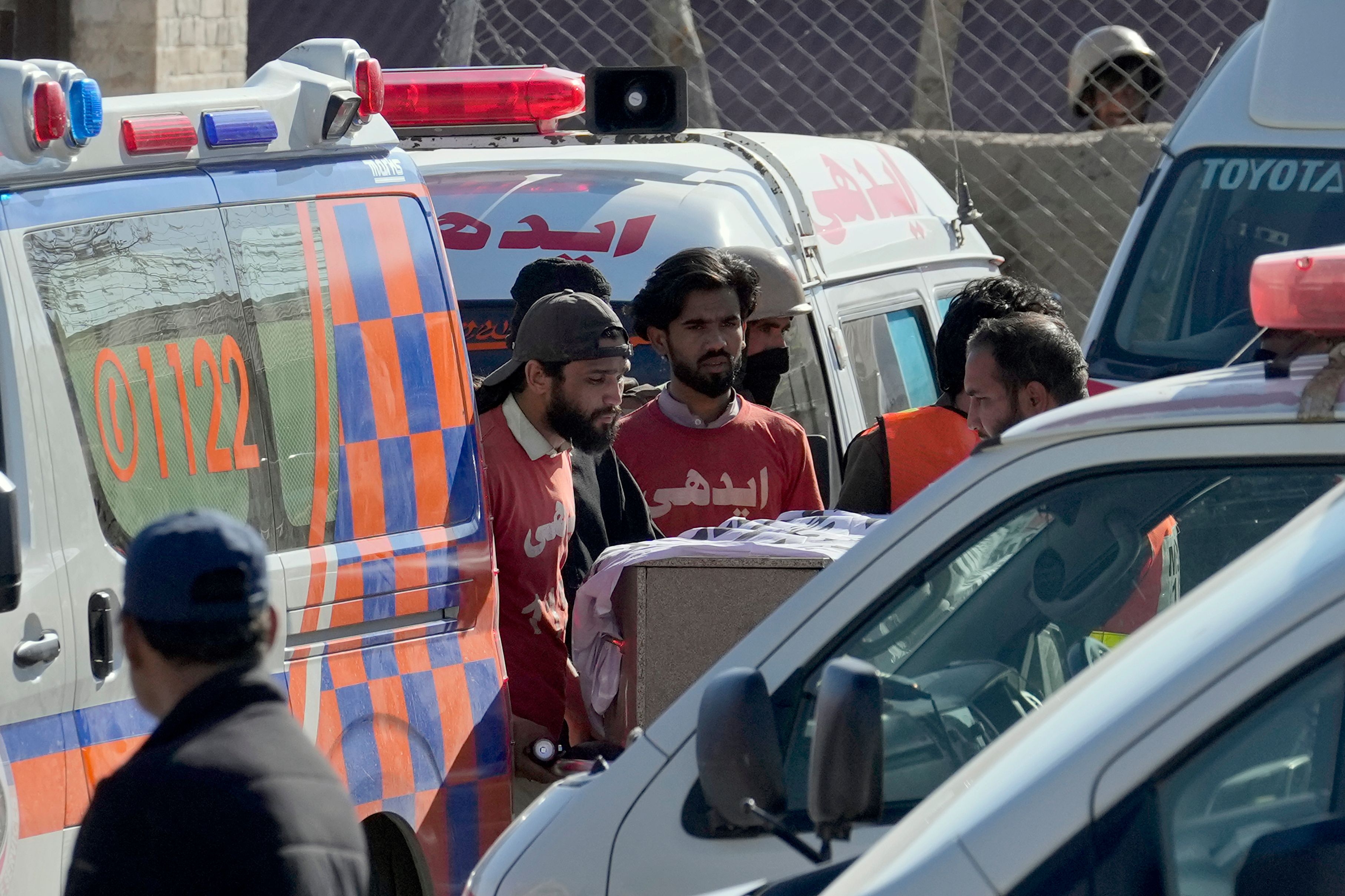
Rescue workers transport a coffin containing the body of a victim from a passenger train attacked by insurgents, upon arrival at a railway station in Much, Pakistan's southwestern Balochistan province, Thursday March 13, 2025. (AP Photo/Anjum Naveed)

The scope of the attack underscored the struggles Pakistan faces in efforts to reign in militant groups as attacks across the country surged in recent years. Accusing India and neighboring Afghanistan has been Pakistan's go-to strategy in the past.

The military provided no evidence of its claim; the accusation was promptly rejected by New Delhi.

In the attack Tuesday, members of the outlawed Baloch Liberation Army ambushed a train in a remote area in Balochistan, took about 400 people onboard hostage and triggered a firefight with security forces. The standoff lasted until late Wednesday, when the army said 33 hijackers were killed.

The BLA has been fighting for more autonomy if not outright independence from the government in Islamabad and a greater share of the province's resources.

At a news conference in Islamabad, army spokesman Lt. Gen. Ahmad Sharif said Friday that “in this terrorist incident in Balochistan, and others before, the main sponsor is your eastern neighbor,” referring to India, without giving proof to back up the claim.

When asked by a reporter, Sharif acknowledged that most of the fatalities on the train were security forces protecting the passengers and troops traveling to their home cities.

It was the first time the BLA had hijacked a train, although it had attacked trains before. Some assailants escaped, and a search operation was underway to find them, Sharif said.

Also speaking at the news conference, Sarfraz Bugti, the chief minister of Balochistan, claimed Pakistan has “solid evidence” of India’s involvement in attacks in the province. He didn't share any specifics.

Sharif added that an Indian naval officer arrested in 2016 and convicted of espionage in Pakistan had worked for Indian intelligence to help the Baloch separatists and other militant groups. The officer, identified as Kulbhushan Jadhav, has been sentenced to death. Sharif did not link him to the train attack.

Pakistan and India are nuclear-armed rivals with a history of bitter relations. They have fought three wars since they gained independence in 1947 from colonial power Britain.

“We strongly reject the baseless allegations made by Pakistan,” India’s foreign ministry spokesman Randhir Jaiswal said in a statement.

Earlier, Pakistan’s Foreign Ministry claimed the train attack was orchestrated from Afghanistan. Kabul denied the accusation and said that the BLA has no presence in Afghanistan.

Sharif, however, claimed the train attackers had been in contact with handlers in Afghanistan. He praised the military for the 36-hour rescue mission, and also claimed that the attackers' weapons originated from both India and Afghanistan.

Both Bugti and Sharif claimed that Indian outlets aired “fake footage” of the hijacked train and used images generated by artificial intelligence to conduct “information warfare” against Pakistan.

Pakistan has suspended all train services to and from Balochistan since the attack. Sharif Ullah, a railway official, said repairs on the tracks, which were blown up by insurgents to stop the train, have not yet started.

Survivors have recounted their harrowing ordeal. Muhammad Farooq, a resident of Quetta, described how BLA stopped the train and ordered passengers to disembark.

“They checked identity cards and started killing people who worked for the armed forces,” Farooq said. Many passengers, he said, fled successfully while the hijackers were exchanging fire with Pakistani troops.

Oil- and mineral-rich Balochistan is Pakistan’s largest and least populated province. Ethnic Baloch residents have long accused the central government of discrimination — a charge Islamabad denies.

Related Tags

World news
ADVERTISEMENT
.most-popular .layout-ratio{ padding-bottom: 79.13%; } @media (min-width: 768px) and (max-width: 1024px) { .widget-title { font-size: 15px !important; } }

{{ articles_filter_1561_widget.title }}

.most-popular .layout-ratio{ padding-bottom: 79.13%; } @media (min-width: 768px) and (max-width: 1024px) { .widget-title { font-size: 15px !important; } }

{{ articles_filter_1562_widget.title }}

.most-popular .layout-ratio{ padding-bottom: 79.13%; } @media (min-width: 768px) and (max-width: 1024px) { .widget-title { font-size: 15px !important; } }

{{ articles_filter_1563_widget.title }}

{{ articles_filter_1564_widget.title }}

.mb-article-details { position: relative; } .mb-article-details .article-body-preview, .mb-article-details .article-body-summary{ font-size: 17px; line-height: 30px; font-family: "Libre Caslon Text", serif; color: #000; } .mb-article-details .article-body-preview iframe , .mb-article-details .article-body-summary iframe{ width: 100%; margin: auto; } .read-more-background { background: linear-gradient(180deg, color(display-p3 1.000 1.000 1.000 / 0) 13.75%, color(display-p3 1.000 1.000 1.000 / 0.8) 30.79%, color(display-p3 1.000 1.000 1.000) 72.5%); position: absolute; height: 200px; width: 100%; bottom: 0; display: flex; justify-content: center; align-items: center; padding: 0; } .read-more-background a{ color: #000; } .read-more-btn { padding: 17px 45px; font-family: Inter; font-weight: 700; font-size: 18px; line-height: 16px; text-align: center; vertical-align: middle; border: 1px solid black; background-color: white; } .hidden { display: none; }
function initializeAllSwipers() { // Get all hidden inputs with cms_article_id document.querySelectorAll('[id^="cms_article_id_"]').forEach(function (input) { const cmsArticleId = input.value; const articleSelector = '#article-' + cmsArticleId + ' .body_images'; const swiperElement = document.querySelector(articleSelector); if (swiperElement && !swiperElement.classList.contains('swiper-initialized')) { new Swiper(articleSelector, { loop: true, pagination: false, navigation: { nextEl: '#article-' + cmsArticleId + ' .swiper-button-next', prevEl: '#article-' + cmsArticleId + ' .swiper-button-prev', }, }); } }); } setTimeout(initializeAllSwipers, 3000); const intersectionObserver = new IntersectionObserver( (entries) => { entries.forEach((entry) => { if (entry.isIntersecting) { const newUrl = entry.target.getAttribute("data-url"); if (newUrl) { history.pushState(null, null, newUrl); let article = entry.target; // Extract metadata const author = article.querySelector('.author-section').textContent.replace('By', '').trim(); const section = article.querySelector('.section-info ').textContent.replace(' ', ' '); const title = article.querySelector('.article-title h1').textContent; // Parse URL for Chartbeat path format const parsedUrl = new URL(newUrl, window.location.origin); const cleanUrl = parsedUrl.host + parsedUrl.pathname; // Update Chartbeat configuration if (typeof window._sf_async_config !== 'undefined') { window._sf_async_config.path = cleanUrl; window._sf_async_config.sections = section; window._sf_async_config.authors = author; } // Track virtual page view with Chartbeat if (typeof pSUPERFLY !== 'undefined' && typeof pSUPERFLY.virtualPage === 'function') { try { pSUPERFLY.virtualPage({ path: cleanUrl, title: title, sections: section, authors: author }); } catch (error) { console.error('ping error', error); } } // Optional: Update document title if (title && title !== document.title) { document.title = title; } } } }); }, { threshold: 0.1 } ); function showArticleBody(button) { const article = button.closest("article"); const summary = article.querySelector(".article-body-summary"); const body = article.querySelector(".article-body-preview"); const readMoreSection = article.querySelector(".read-more-background"); // Hide summary and read-more section summary.style.display = "none"; readMoreSection.style.display = "none"; // Show the full article body body.classList.remove("hidden"); } document.addEventListener("DOMContentLoaded", () => { let loadCount = 0; // Track how many times articles are loaded const offset = [1, 2, 3, 4, 5, 6, 7, 8, 9, 10]; // Offset values const currentUrl = window.location.pathname.substring(1); let isLoading = false; // Prevent multiple calls if (!currentUrl) { console.log("Current URL is invalid."); return; } const sentinel = document.getElementById("load-more-sentinel"); if (!sentinel) { console.log("Sentinel element not found."); return; } function isSentinelVisible() { const rect = sentinel.getBoundingClientRect(); return ( rect.top < window.innerHeight && rect.bottom >= 0 ); } function onScroll() { if (isLoading) return; if (isSentinelVisible()) { if (loadCount >= offset.length) { console.log("Maximum load attempts reached."); window.removeEventListener("scroll", onScroll); return; } isLoading = true; const currentOffset = offset[loadCount]; window.loadMoreItems().then(() => { let article = document.querySelector('#widget_1690 > div:nth-last-of-type(2) article'); intersectionObserver.observe(article) loadCount++; }).catch(error => { console.error("Error loading more items:", error); }).finally(() => { isLoading = false; }); } } window.addEventListener("scroll", onScroll); });

Sign up by email to receive news.