

ADVERTISEMENT

Pakistan says insurgents who attacked a passenger train killed 21 hostages while all others freed

Published Mar 13, 2025 12:42 am

QUETTA, Pakistan (AP) — Insurgents who attacked a passenger train carrying 440 passengers in restive southwestern Pakistan killed 21 hostages before security forces killed all 33 of the assailants, and all other passengers were rescued, officials said Wednesday.
AP25071652118737.jpg

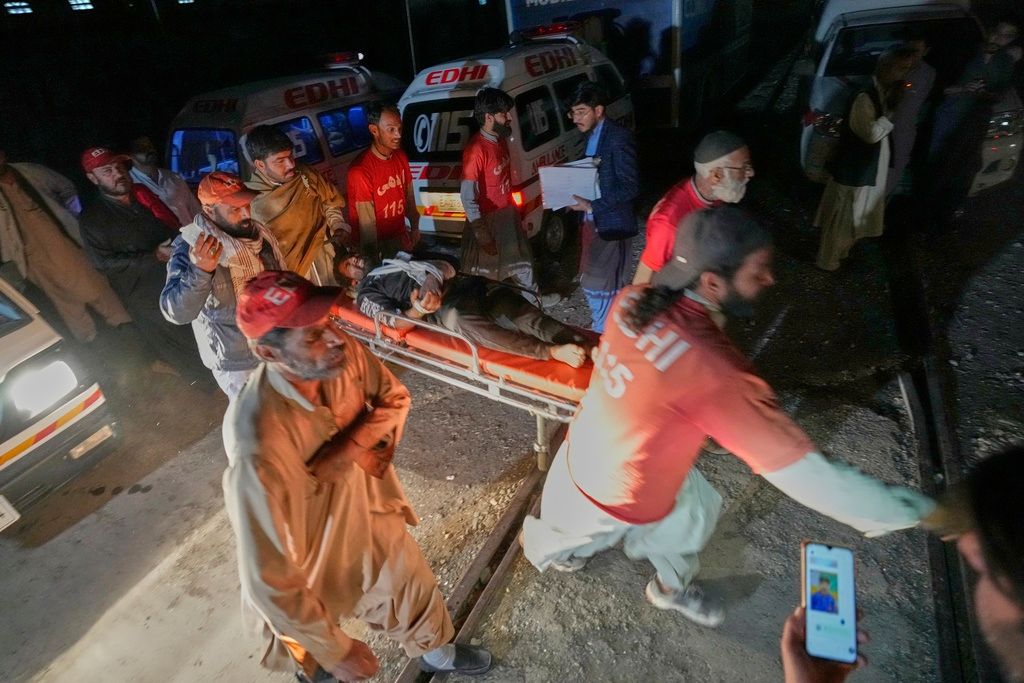
An injured passenger, rescued by security forces from a passenger train attacked by insurgents, is carried on a stretcher after arriving on a special train for the wounded and survivors, organized by the army, at a railway station in Much, in Pakistan's southwestern Balochistan province, Wednesday, March 12, 2025. (AP Photo/Anjum Naveed)


Information Minister Attaullah Tarar said the separatist Baloch Liberation Army group was behind the attack, and the military operation "has successfully reached its logical conclusion."

He said no passengers died because of the operation, and praised the military for “averting a potential catastrophe.” The province’s chief minister, Sarfraz Bugti, told a provincial assembly that troops killed all insurgents involved.

Three soldiers who had been guarding the railroad track were also killed in the attack that began Tuesday in restive Balochistan province, the military spokesman, Lt. Gen. Ahmad Sharif, told local media.

The Baloch Liberation Army claimed responsibility for attacking the train in a tunnel in a remote part of Balochistan. Spokesman Jeeyand Baloch had said the group was ready to free passengers if authorities agreed to release jailed militants.

The BLA regularly targets Pakistani security forces and has also attacked civilians, including Chinese nationals among the thousands working on multibillion-dollar infrastructure projects in Balochistan.

Chinese foreign ministry spokeswoman Mao Ning said her country "will continue to firmly support Pakistan in advancing its counterterrorism efforts.”

Some relatives of hostages were angry at Interior Minister Mohsin Naqvi, who last year claimed that the BLA was not a threat and “an ordinary police inspector could fix this situation.”

What happened?

The train had been traveling from Quetta to the northern city of Peshawar. Officials say the Jafer Express train was partially inside a tunnel when the militants blew up the tracks, forcing the engine and nine coaches to stop.

Oil- and mineral-rich Balochistan is Pakistan’s largest and least populated province. It’s a hub for the country’s ethnic Baloch minority, whose members say they face discrimination and exploitation by the central government.

Balochistan borders Iran and Afghanistan and has long been the scene of insurgency. Separatists demand greater autonomy from the government in Islamabad and a larger share of the region’s natural resources.

Insurgencies on either side of the Iran-Pakistan border have frustrated both countries, whose governments suspect each other of supporting — or at least tolerating — some groups. Iran has sought help from Pakistan in countering the threat from the militant group Jaish al-Adl. Pakistan wants Tehran to deny sanctuaries to BLA fighters.

What did the hijackers want?


Members of the military frequently use trains to travel from Balochistan's capital, Quetta, to other parts of the country. In November, the BLA carried out a suicide bombing at a train station in Quetta, killing 26 people.

The BLA had warned that hostages’ lives would be at risk if the government did not negotiate. Analysts said the attack and its focus on civilians could backfire.

“After failing to damage the Pakistan Army within Balochistan, BLA has shifted its targets from military to unarmed civilians. This may give them instant public and media attention, but it will weaken their support base within the civilian population, which is their ultimate objective,” said Syed Muhammad Ali, an Islamabad-based independent security analyst.

Rescued passengers, including women and children, were being sent to their hometowns. Some of the injured were taken to Quetta, about 100 kilometers (62 miles) away.

Related Tags

WORLDNEWS
ADVERTISEMENT
.most-popular .layout-ratio{ padding-bottom: 79.13%; } @media (min-width: 768px) and (max-width: 1024px) { .widget-title { font-size: 15px !important; } }

{{ articles_filter_1561_widget.title }}

.most-popular .layout-ratio{ padding-bottom: 79.13%; } @media (min-width: 768px) and (max-width: 1024px) { .widget-title { font-size: 15px !important; } }

{{ articles_filter_1562_widget.title }}

.most-popular .layout-ratio{ padding-bottom: 79.13%; } @media (min-width: 768px) and (max-width: 1024px) { .widget-title { font-size: 15px !important; } }

{{ articles_filter_1563_widget.title }}

{{ articles_filter_1564_widget.title }}

.mb-article-details { position: relative; } .mb-article-details .article-body-preview, .mb-article-details .article-body-summary{ font-size: 17px; line-height: 30px; font-family: "Libre Caslon Text", serif; color: #000; } .mb-article-details .article-body-preview iframe , .mb-article-details .article-body-summary iframe{ width: 100%; margin: auto; } .read-more-background { background: linear-gradient(180deg, color(display-p3 1.000 1.000 1.000 / 0) 13.75%, color(display-p3 1.000 1.000 1.000 / 0.8) 30.79%, color(display-p3 1.000 1.000 1.000) 72.5%); position: absolute; height: 200px; width: 100%; bottom: 0; display: flex; justify-content: center; align-items: center; padding: 0; } .read-more-background a{ color: #000; } .read-more-btn { padding: 17px 45px; font-family: Inter; font-weight: 700; font-size: 18px; line-height: 16px; text-align: center; vertical-align: middle; border: 1px solid black; background-color: white; } .hidden { display: none; }
function initializeAllSwipers() { // Get all hidden inputs with cms_article_id document.querySelectorAll('[id^="cms_article_id_"]').forEach(function (input) { const cmsArticleId = input.value; const articleSelector = '#article-' + cmsArticleId + ' .body_images'; const swiperElement = document.querySelector(articleSelector); if (swiperElement && !swiperElement.classList.contains('swiper-initialized')) { new Swiper(articleSelector, { loop: true, pagination: false, navigation: { nextEl: '#article-' + cmsArticleId + ' .swiper-button-next', prevEl: '#article-' + cmsArticleId + ' .swiper-button-prev', }, }); } }); } setTimeout(initializeAllSwipers, 3000); const intersectionObserver = new IntersectionObserver( (entries) => { entries.forEach((entry) => { if (entry.isIntersecting) { const newUrl = entry.target.getAttribute("data-url"); if (newUrl) { history.pushState(null, null, newUrl); let article = entry.target; // Extract metadata const author = article.querySelector('.author-section').textContent.replace('By', '').trim(); const section = article.querySelector('.section-info ').textContent.replace(' ', ' '); const title = article.querySelector('.article-title h1').textContent; // Parse URL for Chartbeat path format const parsedUrl = new URL(newUrl, window.location.origin); const cleanUrl = parsedUrl.host + parsedUrl.pathname; // Update Chartbeat configuration if (typeof window._sf_async_config !== 'undefined') { window._sf_async_config.path = cleanUrl; window._sf_async_config.sections = section; window._sf_async_config.authors = author; } // Track virtual page view with Chartbeat if (typeof pSUPERFLY !== 'undefined' && typeof pSUPERFLY.virtualPage === 'function') { try { pSUPERFLY.virtualPage({ path: cleanUrl, title: title, sections: section, authors: author }); } catch (error) { console.error('ping error', error); } } // Optional: Update document title if (title && title !== document.title) { document.title = title; } } } }); }, { threshold: 0.1 } ); function showArticleBody(button) { const article = button.closest("article"); const summary = article.querySelector(".article-body-summary"); const body = article.querySelector(".article-body-preview"); const readMoreSection = article.querySelector(".read-more-background"); // Hide summary and read-more section summary.style.display = "none"; readMoreSection.style.display = "none"; // Show the full article body body.classList.remove("hidden"); } document.addEventListener("DOMContentLoaded", () => { let loadCount = 0; // Track how many times articles are loaded const offset = [1, 2, 3, 4, 5, 6, 7, 8, 9, 10]; // Offset values const currentUrl = window.location.pathname.substring(1); let isLoading = false; // Prevent multiple calls if (!currentUrl) { console.log("Current URL is invalid."); return; } const sentinel = document.getElementById("load-more-sentinel"); if (!sentinel) { console.log("Sentinel element not found."); return; } function isSentinelVisible() { const rect = sentinel.getBoundingClientRect(); return ( rect.top < window.innerHeight && rect.bottom >= 0 ); } function onScroll() { if (isLoading) return; if (isSentinelVisible()) { if (loadCount >= offset.length) { console.log("Maximum load attempts reached."); window.removeEventListener("scroll", onScroll); return; } isLoading = true; const currentOffset = offset[loadCount]; window.loadMoreItems().then(() => { let article = document.querySelector('#widget_1690 > div:nth-last-of-type(2) article'); intersectionObserver.observe(article) loadCount++; }).catch(error => { console.error("Error loading more items:", error); }).finally(() => { isLoading = false; }); } } window.addEventListener("scroll", onScroll); });

Sign up by email to receive news.