ADVERTISEMENT

Ukraine will propose a limited ceasefire during talks with the US in Saudi Arabia

Published Mar 11, 2025 02:35 am

CEASEFIRE PHOTO.jpg

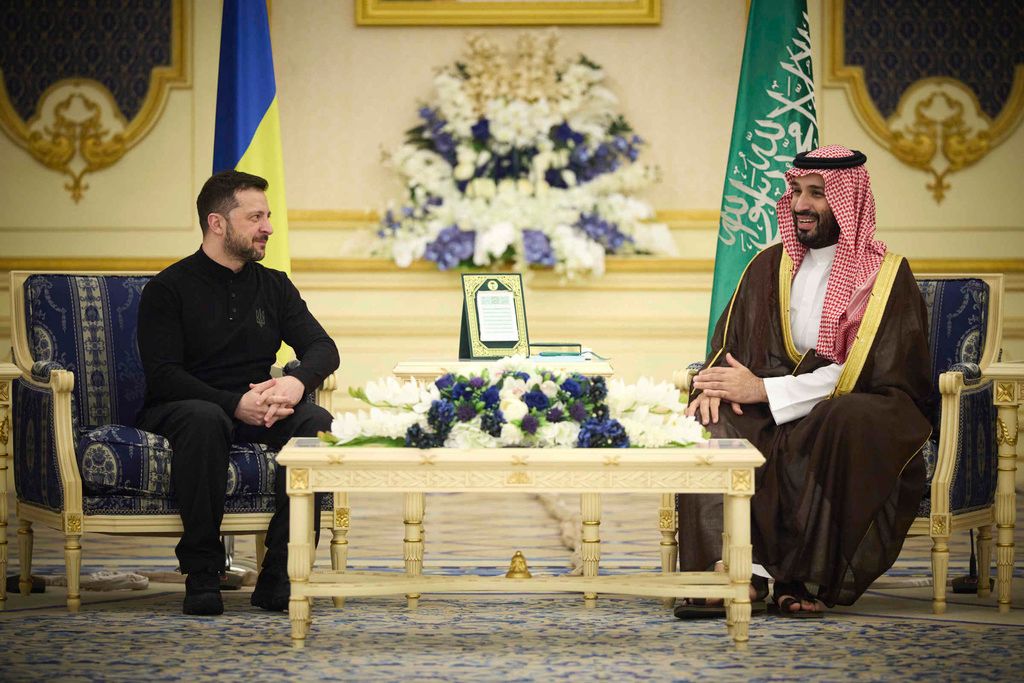
In this photo provided by the Ukrainian Presidential Press Office, Ukrainian President Volodymyr Zelenskyy meets with Saudi's Crown Prince Mohammed bin Salman at the Royal Palace in Riyadh, Saudi Arabia, Monday, March 10, 2025. (Ukrainian Presidential Press Office via AP)

JEDDAH, Saudi Arabia (AP) — A Ukrainian delegation set to meet with America's top diplomat in Saudi Arabia about ending the 3-year war with Russia will propose a ceasefire covering the Black Sea and long-range missile strikes, as well as the release of prisoners, two senior Ukrainian officials said Monday.

The officials, who spoke on condition of anonymity because they were not authorized to speak publicly about Tuesday's meeting, also told The Associated Press that the Ukrainian delegation is ready during the talks to sign an agreement with the United States on access to Ukraine's rare earth minerals — a deal that U.S. President Donald Trump is keen to secure.

The officials discussed the confidence-building measures, with no further details, ahead of the Ukrainian negotiating team's meeting with U.S. Secretary of State Marco Rubio in Jeddah.

Kyiv is trying to repair the damage done when Ukraine President Volodymyr Zelenskyy's Feb. 28 visit to Washington descended into an Oval Office argument with Trump and Vice President JD Vance.

At stake is the military aid and intelligence previously offered by the United States that had helped Ukraine in the war but is now paused as Washington pushes for a peace agreement.

Rubio and Zelenskyy landed a few hours apart Monday in Saudi Arabia, but did not meet.

Zelenskyy met with the kingdom's powerful crown prince Monday evening, with the president saying they "had a detailed discussion on the steps and conditions needed to end the war and secure a reliable and lasting peace."

"Saudi Arabia provides a crucial platform for diplomacy, and we appreciate this," Zelenskyy said online.

Rubio also met Crown Prince Mohammed bin Salman, thanking him for hosting the talks and also discussing Yemen's Houthi rebels, who are threatening to restart their attacks in the Red Sea.

Speaking to reporters aboard his plane before arriving, Rubio said he and national security adviser Mike Waltz would take stock of Ukraine's responses in Saudi Arabia.

If Ukraine and the U.S. reach an understanding acceptable to Trump, that could accelerate his administration's push to peace talks.

"What we want to know is, are they interested entering some sort of peace conversation and general outlines of the kinds of things they could consider, recognizing that it has been a costly and bloody war for the Ukrainians. They have suffered greatly and their people have suffered greatly," Rubio said. "And it's hard in the aftermath of something like that to even talk about concessions, but that's the only way this is going to end and prevent more suffering."

He added: "I'm not going to set any conditions on what they have to or need to do. I think we want to listen to see how far they're willing to go and then compare that to what the Russians want and see how far apart we truly are."

Zelenskyy has said his team meeting Rubio will include his chief of staff Andriy Yermak, Foreign Minister Andriy Sybiha and Defense Minister Rustem Umerov. Rubio will lead the U.S. team.

The rest of Europe remains skeptical about the talks as it has been sidelined by Washington.

The European Union last week agreed to boost the continent's defenses and to free up hundreds of billions of euros for security in response to the Trump administration's shift in stance on Ukraine.

White House special envoy Steve Witkoff told Fox News on Monday that the pause of U.S. intelligence-sharing with Ukraine has not limited defense intelligence-sharing.

"We never shut off intelligence for ... anything defensive that the Ukrainians need," Witkoff said.

A pause on sharing U.S. intelligence that can be used for offensive purposes by Ukrainian forces remains in effect, according to a U.S. official familiar with the matter who was not authorized to comment and spoke on the condition of anonymity.

The official suggested that progress could be made toward reinstating intelligence-sharing with Ukraine during the Saudi talks.

Related Tags

Volodymyr Zelenskyy UKRAINE WAR ceasefire talks WORLDNEWS
ADVERTISEMENT
.most-popular .layout-ratio{ padding-bottom: 79.13%; } @media (min-width: 768px) and (max-width: 1024px) { .widget-title { font-size: 15px !important; } }

{{ articles_filter_1561_widget.title }}

.most-popular .layout-ratio{ padding-bottom: 79.13%; } @media (min-width: 768px) and (max-width: 1024px) { .widget-title { font-size: 15px !important; } }

{{ articles_filter_1562_widget.title }}

.most-popular .layout-ratio{ padding-bottom: 79.13%; } @media (min-width: 768px) and (max-width: 1024px) { .widget-title { font-size: 15px !important; } }

{{ articles_filter_1563_widget.title }}

{{ articles_filter_1564_widget.title }}

.mb-article-details { position: relative; } .mb-article-details .article-body-preview, .mb-article-details .article-body-summary{ font-size: 17px; line-height: 30px; font-family: "Libre Caslon Text", serif; color: #000; } .mb-article-details .article-body-preview iframe , .mb-article-details .article-body-summary iframe{ width: 100%; margin: auto; } .read-more-background { background: linear-gradient(180deg, color(display-p3 1.000 1.000 1.000 / 0) 13.75%, color(display-p3 1.000 1.000 1.000 / 0.8) 30.79%, color(display-p3 1.000 1.000 1.000) 72.5%); position: absolute; height: 200px; width: 100%; bottom: 0; display: flex; justify-content: center; align-items: center; padding: 0; } .read-more-background a{ color: #000; } .read-more-btn { padding: 17px 45px; font-family: Inter; font-weight: 700; font-size: 18px; line-height: 16px; text-align: center; vertical-align: middle; border: 1px solid black; background-color: white; } .hidden { display: none; }
function initializeAllSwipers() { // Get all hidden inputs with cms_article_id document.querySelectorAll('[id^="cms_article_id_"]').forEach(function (input) { const cmsArticleId = input.value; const articleSelector = '#article-' + cmsArticleId + ' .body_images'; const swiperElement = document.querySelector(articleSelector); if (swiperElement && !swiperElement.classList.contains('swiper-initialized')) { new Swiper(articleSelector, { loop: true, pagination: false, navigation: { nextEl: '#article-' + cmsArticleId + ' .swiper-button-next', prevEl: '#article-' + cmsArticleId + ' .swiper-button-prev', }, }); } }); } setTimeout(initializeAllSwipers, 3000); const intersectionObserver = new IntersectionObserver( (entries) => { entries.forEach((entry) => { if (entry.isIntersecting) { const newUrl = entry.target.getAttribute("data-url"); if (newUrl) { history.pushState(null, null, newUrl); let article = entry.target; // Extract metadata const author = article.querySelector('.author-section').textContent.replace('By', '').trim(); const section = article.querySelector('.section-info ').textContent.replace(' ', ' '); const title = article.querySelector('.article-title h1').textContent; // Parse URL for Chartbeat path format const parsedUrl = new URL(newUrl, window.location.origin); const cleanUrl = parsedUrl.host + parsedUrl.pathname; // Update Chartbeat configuration if (typeof window._sf_async_config !== 'undefined') { window._sf_async_config.path = cleanUrl; window._sf_async_config.sections = section; window._sf_async_config.authors = author; } // Track virtual page view with Chartbeat if (typeof pSUPERFLY !== 'undefined' && typeof pSUPERFLY.virtualPage === 'function') { try { pSUPERFLY.virtualPage({ path: cleanUrl, title: title, sections: section, authors: author }); } catch (error) { console.error('ping error', error); } } // Optional: Update document title if (title && title !== document.title) { document.title = title; } } } }); }, { threshold: 0.1 } ); function showArticleBody(button) { const article = button.closest("article"); const summary = article.querySelector(".article-body-summary"); const body = article.querySelector(".article-body-preview"); const readMoreSection = article.querySelector(".read-more-background"); // Hide summary and read-more section summary.style.display = "none"; readMoreSection.style.display = "none"; // Show the full article body body.classList.remove("hidden"); } document.addEventListener("DOMContentLoaded", () => { let loadCount = 0; // Track how many times articles are loaded const offset = [1, 2, 3, 4, 5, 6, 7, 8, 9, 10]; // Offset values const currentUrl = window.location.pathname.substring(1); let isLoading = false; // Prevent multiple calls if (!currentUrl) { console.log("Current URL is invalid."); return; } const sentinel = document.getElementById("load-more-sentinel"); if (!sentinel) { console.log("Sentinel element not found."); return; } function isSentinelVisible() { const rect = sentinel.getBoundingClientRect(); return ( rect.top < window.innerHeight && rect.bottom >= 0 ); } function onScroll() { if (isLoading) return; if (isSentinelVisible()) { if (loadCount >= offset.length) { console.log("Maximum load attempts reached."); window.removeEventListener("scroll", onScroll); return; } isLoading = true; const currentOffset = offset[loadCount]; window.loadMoreItems().then(() => { let article = document.querySelector('#widget_1690 > div:nth-last-of-type(2) article'); intersectionObserver.observe(article) loadCount++; }).catch(error => { console.error("Error loading more items:", error); }).finally(() => { isLoading = false; }); } } window.addEventListener("scroll", onScroll); });

Sign up by email to receive news.