ADVERTISEMENT

Where did the 3 Chinese navy vessels go after entering WPS?

Published Feb 4, 2025 07:02 am
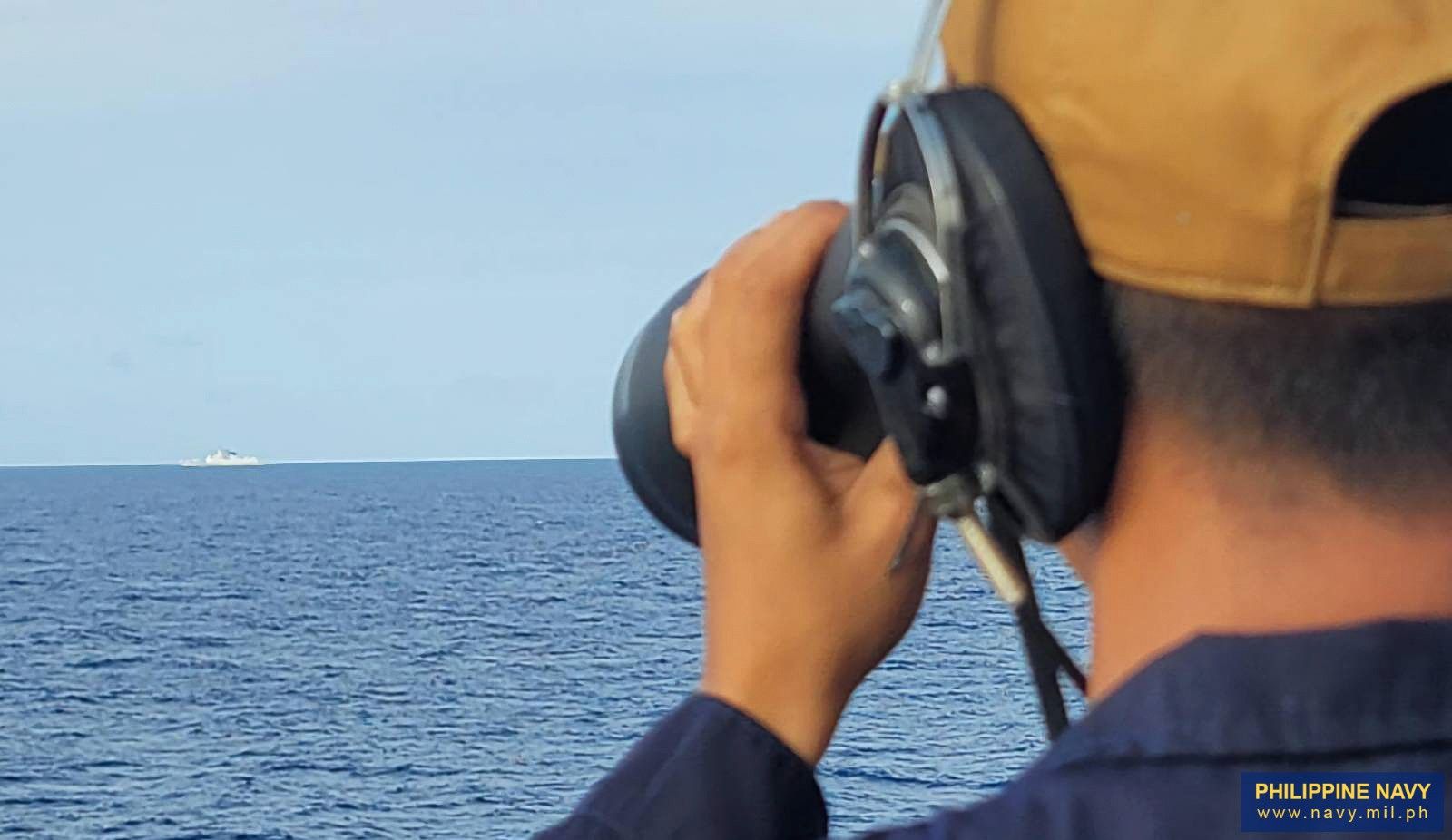
PH Navy BRP Jose Rizal.jpg
A crew member of BRP Jose Rizal (FF-150) monitors the presence of a People's Liberation Army-Navy warship by China in the West Philippine Sea (WPS) on Feb. 3, 2025. (Photo: Philippine Navy)

The three People’s Liberation Army – Navy (PLA-N) vessels detected by the Armed Forces of the Philippines (AFP) in the West Philippine Sea (WPS) were on their way out of the Philippines’ exclusive economic zone (EEZ) as of Tuesday morning, Feb. 4, the Philippine Navy (PN) said.

Many were alarmed when the Western Mindanao Command (WestMinCom) and Philippine Navy (PN) disclosed on Monday night that a Renhai-class guided-missile cruiser, a Jiankai-class frigate II, and a Type 903 Fuchi-class replenishment oiler from the Chinese navy were spotted in the archipelagic waters of the Philippines.

But where did the Chinese ships go and why are they in the country’s waters? The PN offered an explanation.

Detected

Rear Adm. Roy Vincent Trinidad, PN spokesperson for WPS, said the first vessel to be detected by the PN was the Jiankai-class frigate II identified as "Dali" (FFG-553), which was seen in the vicinity of Bajo de Masinloc, Zambales on Feb. 1.

Dali, a missile-capable frigate, proceeded southward and was immediately tracked by PN vessel BRP Jose Rizal (FF-150). It is worthy to note that a frigate is a warship usually used as an escort vessel.

From Bajo de Masinloc, Dali sailed south and upon reaching Mindoro Island, it was joined by the Renhai-Class guided-missile cruiser and the Type 903 Fuchi-class replenishment oiler.

The three Chinese vessels further sailed south until they reached Cuyo Island in Palawan, and passed through the Sulu Sea.

On Feb. 3, the three Chinese vessels were monited off Basilan Channel and around 7:30 a.m. of Feb. 4, they were located at more than 120 nautical miles south of Basilan.

“Palabas na siya sa ating exclusive economic zone (They are on their way out of our exclusive economic zone),” Trinidad said.

All throughout their voyage, the Chinese vessels were tracked by BRP Jose Rizal, BRP Apolinario Mabini (PS-36), four other PN ships, a PN aircraft, and two Philippine Air Force (PAF) aircraft, according to Trinidad.

Trinidad said the Chinese vessels were exercising archipelagic sea lanes passage, which refers to the right of foreign ships and aircraft to transit through the designated sea lanes within an archipelagic state's waters.

“The passage of the three ships by the PLA Navy is authorized under UN [United Nations]. They are using archipelagic sea lanes passage,” Trinidad said.

“[It’s] almost similar [to] freedom of navigation and innocent passage, but ships passing under this mode could travel in normal mode, meaning they could be in formation,” he explained.

As to the reason why the Chinese ships entered the country’s waters, Trinidad said they could be participating in the Multilateral Naval Exercise Komodo (MNEK), a non-combatant exercise held regularly every two years by the Indonesian Navy since 2014.

The PN will also join the Komodo exercise slated from Feb. 14 to 22.

“We'll be sending off a ship this coming Saturday (Feb. 8) to participate in the exercise Komodo which will be hosted by Indonesia. A lot of foreign warships will be participating there. It is safe to surmise that these three PLA Navy ships which are going in southward direction will also be participating in Komodo exercise,” Trinidad said.

Violation

While foreign vessels can pass through the Philippines’ archipelagic waters, Trinidad pointed out that they will have to “travel continuously and in the fastest possible speed or the most expeditious speed.”

This, he said, ensures that foreign ships would not do anything that would violate the rights of the coastal state.

“For this particular case, we monitored them to be traveling at times 30 knots, 40 knots. There were times they slowed down to six or five knots. It is not expeditious. They could have traveled expeditiously,” Trinidad said.

According to the admiral, the slow travel speed of the Chinese ships at times was also the reason why the PN challenged them through radio communication.

“They were challenged all the way. They replied but not in accordance to standard procedures. Standard procedure is that you would identify yourself, you would state where you came from, where you're heading to. The only reply given to Western Mindanao Command was that they are exercising freedom of navigation and innocent passage,” Trinidad bared.

Trinidad said the Chinese ships violated the Philippines’ rights since their travel was not considered expeditious, or done in a normal speed without stopping, and refused to communicate in a standard procedure.

“There were instances in the central part of Sulu Sea that they slowed down to five to six knots. Apart from that, they also did not reply based on the standard replies that we usually get from warships or other merchant vessels traversing our maritime domain,” he said.

The PN has already taken note of the Chinese ships’ possible violations and Trinidad said they will forward it to appropriate government agencies for appropriate response, including the filing of a formal protest if deemed necessary.

Related Tags

Philippine Navy West Philippine Sea (WPS) Chinese Navy
ADVERTISEMENT
.most-popular .layout-ratio{ padding-bottom: 79.13%; } @media (min-width: 768px) and (max-width: 1024px) { .widget-title { font-size: 15px !important; } }

{{ articles_filter_1561_widget.title }}

.most-popular .layout-ratio{ padding-bottom: 79.13%; } @media (min-width: 768px) and (max-width: 1024px) { .widget-title { font-size: 15px !important; } }

{{ articles_filter_1562_widget.title }}

.most-popular .layout-ratio{ padding-bottom: 79.13%; } @media (min-width: 768px) and (max-width: 1024px) { .widget-title { font-size: 15px !important; } }

{{ articles_filter_1563_widget.title }}

{{ articles_filter_1564_widget.title }}

.mb-article-details { position: relative; } .mb-article-details .article-body-preview, .mb-article-details .article-body-summary{ font-size: 17px; line-height: 30px; font-family: "Libre Caslon Text", serif; color: #000; } .mb-article-details .article-body-preview iframe , .mb-article-details .article-body-summary iframe{ width: 100%; margin: auto; } .read-more-background { background: linear-gradient(180deg, color(display-p3 1.000 1.000 1.000 / 0) 13.75%, color(display-p3 1.000 1.000 1.000 / 0.8) 30.79%, color(display-p3 1.000 1.000 1.000) 72.5%); position: absolute; height: 200px; width: 100%; bottom: 0; display: flex; justify-content: center; align-items: center; padding: 0; } .read-more-background a{ color: #000; } .read-more-btn { padding: 17px 45px; font-family: Inter; font-weight: 700; font-size: 18px; line-height: 16px; text-align: center; vertical-align: middle; border: 1px solid black; background-color: white; } .hidden { display: none; }
function initializeAllSwipers() { // Get all hidden inputs with cms_article_id document.querySelectorAll('[id^="cms_article_id_"]').forEach(function (input) { const cmsArticleId = input.value; const articleSelector = '#article-' + cmsArticleId + ' .body_images'; const swiperElement = document.querySelector(articleSelector); if (swiperElement && !swiperElement.classList.contains('swiper-initialized')) { new Swiper(articleSelector, { loop: true, pagination: false, navigation: { nextEl: '#article-' + cmsArticleId + ' .swiper-button-next', prevEl: '#article-' + cmsArticleId + ' .swiper-button-prev', }, }); } }); } setTimeout(initializeAllSwipers, 3000); const intersectionObserver = new IntersectionObserver( (entries) => { entries.forEach((entry) => { if (entry.isIntersecting) { const newUrl = entry.target.getAttribute("data-url"); if (newUrl) { history.pushState(null, null, newUrl); let article = entry.target; // Extract metadata const author = article.querySelector('.author-section').textContent.replace('By', '').trim(); const section = article.querySelector('.section-info ').textContent.replace(' ', ' '); const title = article.querySelector('.article-title h1').textContent; // Parse URL for Chartbeat path format const parsedUrl = new URL(newUrl, window.location.origin); const cleanUrl = parsedUrl.host + parsedUrl.pathname; // Update Chartbeat configuration if (typeof window._sf_async_config !== 'undefined') { window._sf_async_config.path = cleanUrl; window._sf_async_config.sections = section; window._sf_async_config.authors = author; } // Track virtual page view with Chartbeat if (typeof pSUPERFLY !== 'undefined' && typeof pSUPERFLY.virtualPage === 'function') { try { pSUPERFLY.virtualPage({ path: cleanUrl, title: title, sections: section, authors: author }); } catch (error) { console.error('ping error', error); } } // Optional: Update document title if (title && title !== document.title) { document.title = title; } } } }); }, { threshold: 0.1 } ); function showArticleBody(button) { const article = button.closest("article"); const summary = article.querySelector(".article-body-summary"); const body = article.querySelector(".article-body-preview"); const readMoreSection = article.querySelector(".read-more-background"); // Hide summary and read-more section summary.style.display = "none"; readMoreSection.style.display = "none"; // Show the full article body body.classList.remove("hidden"); } document.addEventListener("DOMContentLoaded", () => { let loadCount = 0; // Track how many times articles are loaded const offset = [1, 2, 3, 4, 5, 6, 7, 8, 9, 10]; // Offset values const currentUrl = window.location.pathname.substring(1); let isLoading = false; // Prevent multiple calls if (!currentUrl) { console.log("Current URL is invalid."); return; } const sentinel = document.getElementById("load-more-sentinel"); if (!sentinel) { console.log("Sentinel element not found."); return; } function isSentinelVisible() { const rect = sentinel.getBoundingClientRect(); return ( rect.top < window.innerHeight && rect.bottom >= 0 ); } function onScroll() { if (isLoading) return; if (isSentinelVisible()) { if (loadCount >= offset.length) { console.log("Maximum load attempts reached."); window.removeEventListener("scroll", onScroll); return; } isLoading = true; const currentOffset = offset[loadCount]; window.loadMoreItems().then(() => { let article = document.querySelector('#widget_1690 > div:nth-last-of-type(2) article'); intersectionObserver.observe(article) loadCount++; }).catch(error => { console.error("Error loading more items:", error); }).finally(() => { isLoading = false; }); } } window.addEventListener("scroll", onScroll); });

Sign up by email to receive news.