ADVERTISEMENT

PAF fighter jets, US bomber aircraft begin drills over WPS

Published Feb 4, 2025 07:55 am
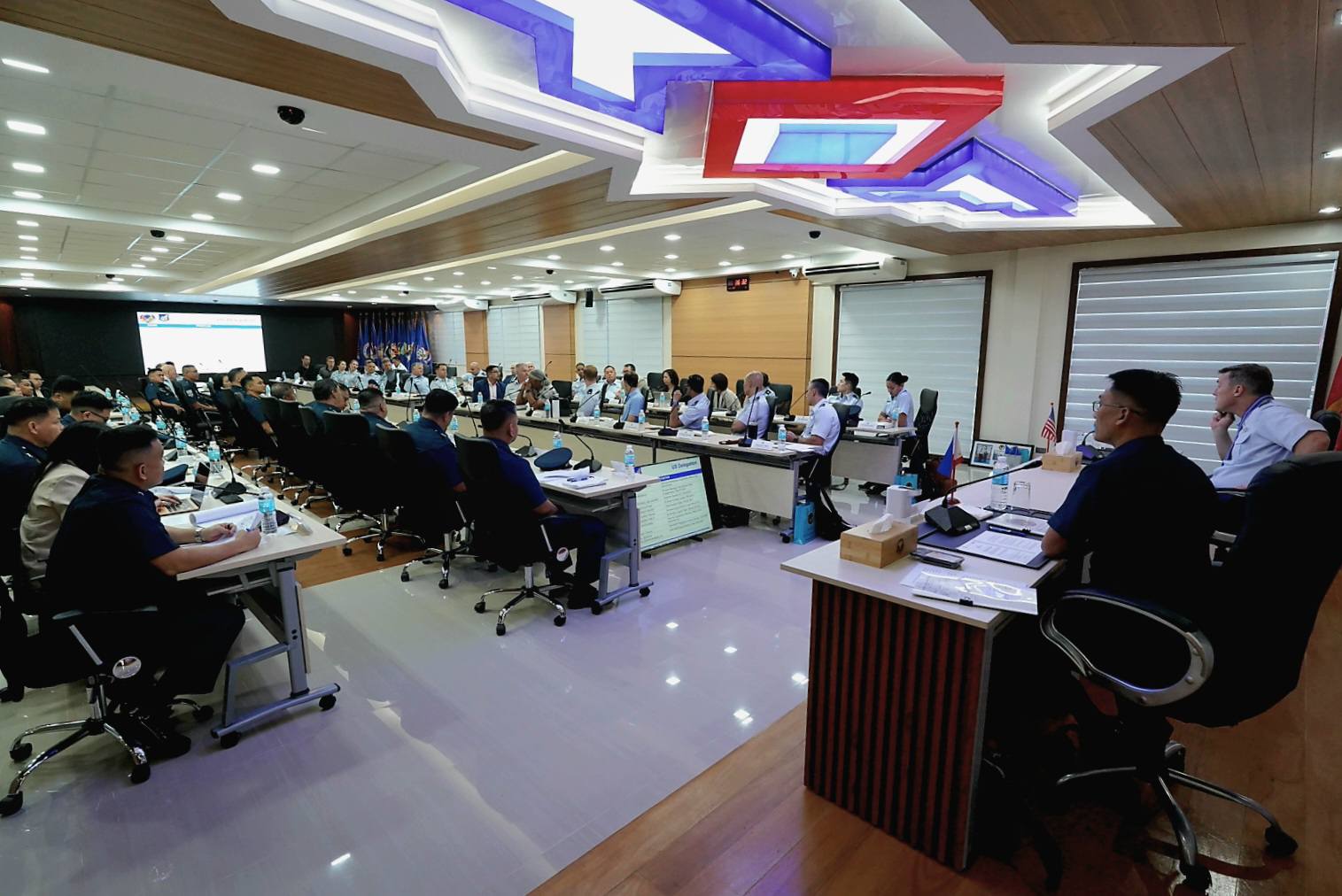
PAF PACAF.jpg
Officials of the Philippine Air Force (PAF) and United States Pacific Air Forces (US PACAF) convene at Villamor Air Base in Pasay City on Feb. 4, 2025 to strengthen their interoperability and deepen cooperation through a series of engagements, including the conduct of military exercises over the West Philippine Sea (WPS). (Photo: PAF)

The Philippine Air Force (PAF) and the United States Pacific Air Forces (PACAF) kicked off a series of exercises over the West Philippine Sea (WPS) on Tuesday, Feb. 4, as authorities continued to call on China to pull out its vessels illegally patrolling the area.

Col. Ma. Consuelo Castillo, PAF spokesperson, said the two countries’ air forces were scheduled to rendezvous off the west coast of the country around noontime, and hold a bilateral bomber air patrol, air intercept training, and photo exercise in the contested features of the WPS including Bajo de Masinloc (BDM) in Zambales in the afternoon.

The PAF - US PACAF exercise would be the first to be held by Manila and Washington under the current administration of US President Donald Trump.

The PAF deployed two FA-50 multi-role fighter jets while the US PACAF sent two B-1 bomber aircraft for the exercise.

“This exercise is a crucial step in enhancing our interoperability, improving air domain awareness and agile combat employment, and supporting our shared bilateral air objectives,” Castillo said.

“This cooperative effort falls under the framework of the Mutual Defense Board – Security Engagement Board (MDB-SEB) activities between the Philippines and the United States, specifically addressing bilateral air activities and joint air patrols,” she added, referring to the mechanism where the two countries’ militaries coordinate their defense and security cooperation.

A crucial part of the drills is the air intercept training where the FA-50 fighter jets and B-1 bombers will link up to simulate a scenario where they intercept a hostile aircraft entering the Philippines’ airspace.

“It's like simulating air intercept. Like if there's an aircraft coming into your territory, how you intercept it. That's a good exercise for our fighter aircraft,” Castillo said.

However, the PAF official clarified that the exercise was not a response to China’s recent aggression in the WPS.

“No, this is not in relation to any particular issue. This is just part of the usual training we have under the MDB-SEB,” she said.

China has maintained the deployment of its coast guard vessels off the coast of Zambales since Jan. 4, prompting the National Security Council (NSC) to call on the Chinese government to withdraw its ships for "illegally" staying in the Philippines' waters.

Chinese coast guard vessels were also detected off Pangasinan’s coast over the weekend, while three Chinese military ships entered the WPS on Feb. 1.

The PAF expressed its readiness in case China obstructs the exercise by sending aircraft or by firing flares, as they have done in the past to drive away Philippine aircraft on patrol missions.

“Definitely, [it’s] expected that there will be challenges. There might be foreign aircraft probably intercepting or flying near the flight but they will definitely receive challenges also, especially if they're flying over our territory or near our territory,” Castillo said.

“At the same time, there will be counter challenges as expected. But as for us, we are doing this training based on international rules-based order and based on protocols. So we will just continue on regardless of the action of other foreign actors,” she noted.

Meanwhile, ranking officials from PAF and US PACAF convened at the PAF headquarters in Villamor Air Base, Pasay City on Tuesday morning for the 13th iteration of Airman-to-Airman (A2A) Talks, ahead of the WPS exercise.

The activity was co-chaired by Brigadier General Alvin Hate wing commander of the PAF's 205ᵗʰ Tactical Helicopter Wing, and Brigadier General Shane Vesely, chief of Staff of the US PACAF.

“This bilateral activity focuses on strengthening interoperability and deepening cooperation between the two air forces. Key discussions include Mutual Defense Board-Security Engagement Board activities, current engagement plans, and proposed activities for 2026. Participants will also provide updates on the ongoing Enhanced Defense Cooperation Agreement (EDCA) projects,” Castillo said.

“The A2A Talks play a vital role in reinforcing the enduring partnership between the PAF and PACAF for future joint exercises, training opportunities, and enhanced security cooperation, contributing to regional stability and mutual defense capabilities,” she stated.

Related Tags

US PACAF Philippine Air Force (PAF) West Philippine Sea (WPS) bomber fa-50
ADVERTISEMENT
.most-popular .layout-ratio{ padding-bottom: 79.13%; } @media (min-width: 768px) and (max-width: 1024px) { .widget-title { font-size: 15px !important; } }

{{ articles_filter_1561_widget.title }}

.most-popular .layout-ratio{ padding-bottom: 79.13%; } @media (min-width: 768px) and (max-width: 1024px) { .widget-title { font-size: 15px !important; } }

{{ articles_filter_1562_widget.title }}

.most-popular .layout-ratio{ padding-bottom: 79.13%; } @media (min-width: 768px) and (max-width: 1024px) { .widget-title { font-size: 15px !important; } }

{{ articles_filter_1563_widget.title }}

{{ articles_filter_1564_widget.title }}

.mb-article-details { position: relative; } .mb-article-details .article-body-preview, .mb-article-details .article-body-summary{ font-size: 17px; line-height: 30px; font-family: "Libre Caslon Text", serif; color: #000; } .mb-article-details .article-body-preview iframe , .mb-article-details .article-body-summary iframe{ width: 100%; margin: auto; } .read-more-background { background: linear-gradient(180deg, color(display-p3 1.000 1.000 1.000 / 0) 13.75%, color(display-p3 1.000 1.000 1.000 / 0.8) 30.79%, color(display-p3 1.000 1.000 1.000) 72.5%); position: absolute; height: 200px; width: 100%; bottom: 0; display: flex; justify-content: center; align-items: center; padding: 0; } .read-more-background a{ color: #000; } .read-more-btn { padding: 17px 45px; font-family: Inter; font-weight: 700; font-size: 18px; line-height: 16px; text-align: center; vertical-align: middle; border: 1px solid black; background-color: white; } .hidden { display: none; }
function initializeAllSwipers() { // Get all hidden inputs with cms_article_id document.querySelectorAll('[id^="cms_article_id_"]').forEach(function (input) { const cmsArticleId = input.value; const articleSelector = '#article-' + cmsArticleId + ' .body_images'; const swiperElement = document.querySelector(articleSelector); if (swiperElement && !swiperElement.classList.contains('swiper-initialized')) { new Swiper(articleSelector, { loop: true, pagination: false, navigation: { nextEl: '#article-' + cmsArticleId + ' .swiper-button-next', prevEl: '#article-' + cmsArticleId + ' .swiper-button-prev', }, }); } }); } setTimeout(initializeAllSwipers, 3000); const intersectionObserver = new IntersectionObserver( (entries) => { entries.forEach((entry) => { if (entry.isIntersecting) { const newUrl = entry.target.getAttribute("data-url"); if (newUrl) { history.pushState(null, null, newUrl); let article = entry.target; // Extract metadata const author = article.querySelector('.author-section').textContent.replace('By', '').trim(); const section = article.querySelector('.section-info ').textContent.replace(' ', ' '); const title = article.querySelector('.article-title h1').textContent; // Parse URL for Chartbeat path format const parsedUrl = new URL(newUrl, window.location.origin); const cleanUrl = parsedUrl.host + parsedUrl.pathname; // Update Chartbeat configuration if (typeof window._sf_async_config !== 'undefined') { window._sf_async_config.path = cleanUrl; window._sf_async_config.sections = section; window._sf_async_config.authors = author; } // Track virtual page view with Chartbeat if (typeof pSUPERFLY !== 'undefined' && typeof pSUPERFLY.virtualPage === 'function') { try { pSUPERFLY.virtualPage({ path: cleanUrl, title: title, sections: section, authors: author }); } catch (error) { console.error('ping error', error); } } // Optional: Update document title if (title && title !== document.title) { document.title = title; } } } }); }, { threshold: 0.1 } ); function showArticleBody(button) { const article = button.closest("article"); const summary = article.querySelector(".article-body-summary"); const body = article.querySelector(".article-body-preview"); const readMoreSection = article.querySelector(".read-more-background"); // Hide summary and read-more section summary.style.display = "none"; readMoreSection.style.display = "none"; // Show the full article body body.classList.remove("hidden"); } document.addEventListener("DOMContentLoaded", () => { let loadCount = 0; // Track how many times articles are loaded const offset = [1, 2, 3, 4, 5, 6, 7, 8, 9, 10]; // Offset values const currentUrl = window.location.pathname.substring(1); let isLoading = false; // Prevent multiple calls if (!currentUrl) { console.log("Current URL is invalid."); return; } const sentinel = document.getElementById("load-more-sentinel"); if (!sentinel) { console.log("Sentinel element not found."); return; } function isSentinelVisible() { const rect = sentinel.getBoundingClientRect(); return ( rect.top < window.innerHeight && rect.bottom >= 0 ); } function onScroll() { if (isLoading) return; if (isSentinelVisible()) { if (loadCount >= offset.length) { console.log("Maximum load attempts reached."); window.removeEventListener("scroll", onScroll); return; } isLoading = true; const currentOffset = offset[loadCount]; window.loadMoreItems().then(() => { let article = document.querySelector('#widget_1690 > div:nth-last-of-type(2) article'); intersectionObserver.observe(article) loadCount++; }).catch(error => { console.error("Error loading more items:", error); }).finally(() => { isLoading = false; }); } } window.addEventListener("scroll", onScroll); });

Sign up by email to receive news.