






 Philippines
National
Enforce impartial gun ban, Comelec urged as spike in violence threatens midterm polls in BARMM
Philippines
National
Enforce impartial gun ban, Comelec urged as spike in violence threatens midterm polls in BARMM
Enforce impartial gun ban, Comelec urged as spike in violence threatens midterm polls in BARMM


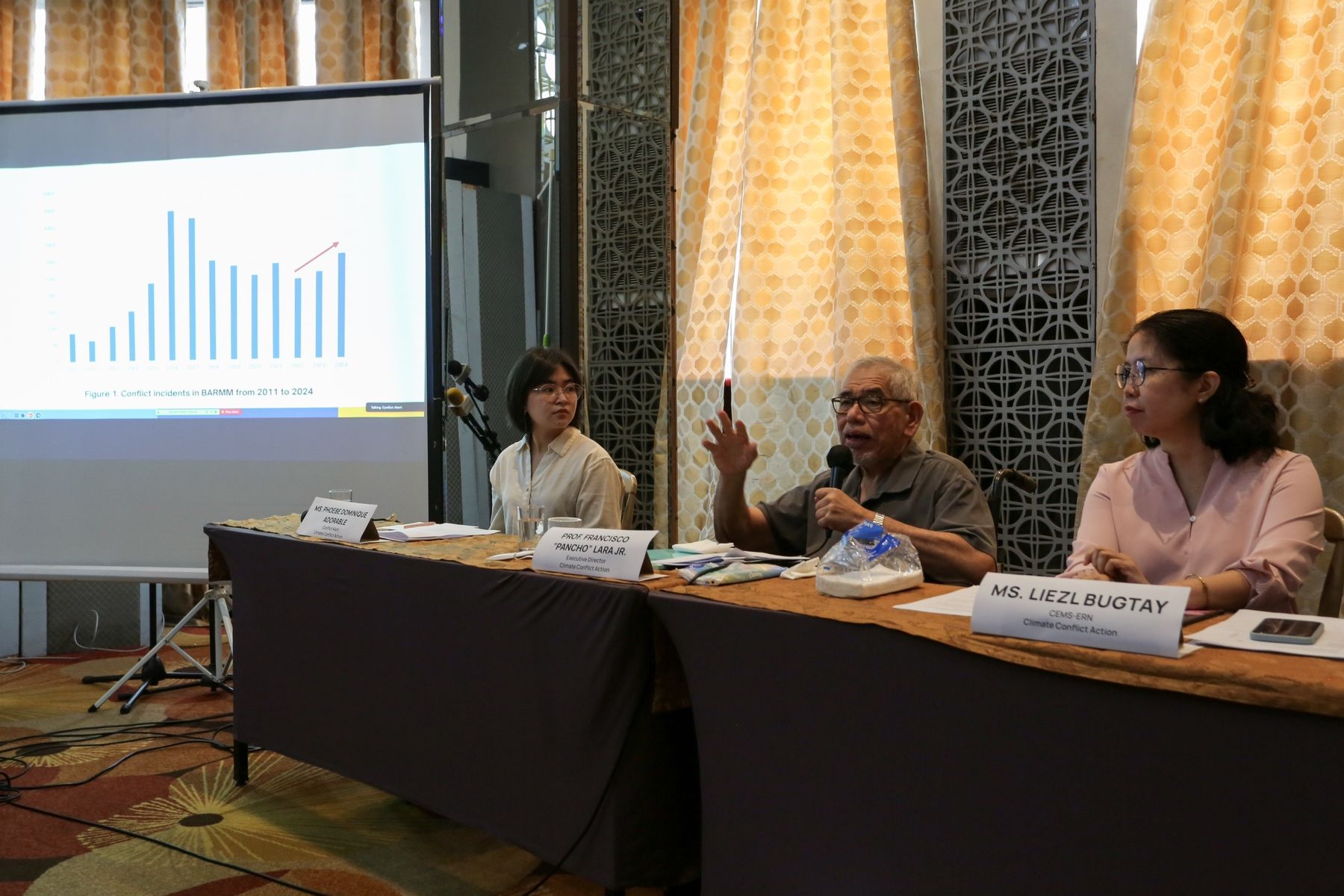
(L-R) Climate Conflict Action (CCAA) Conflict Alert OIC Phoebe Adorable, CCAA Executive Director Prof. Francisco “Pancho” Lara Jr., and CCAA CEMS-ERN Liezl Bugtay speaks during the CCAA Year-Starter Analysis Press Conference discuss the rising conflict incidents in the BARMM from 2011 to 2024 and lead-up to the 2025 National and Local Elections. (Santi San Juan)
Police and military forces should not only implement the gun ban but must also enforce with full impartiality the existing laws and regulations on firearms ownership if they desire to achieve peaceful and honest elections especially in the central and western parts of Mindanao, a local peacebuilding organization said.
For the Climate and Conflict Action Asia (CCAA), all the signs are already pointing to escalation of violence for the May 12 midterm elections—from the biggest increase in violent conflicts in Maguindanao, Lanao del Norte and three other areas in 2024, up to the recent election update wherein a political party identified with the Moro Islamic Liberation Front (MILF) fielded candidates to challenge the incumbent and long-time politicians on a large-scale basis.
According to CCAA executive director Francisco "Pancho" Lara, Jr. this is the first time that the MILF-identified political party, the United Bangsamoro Justice Party (UBJP), formally joined the electoral process on a large-scale basis.
And with both the political challengers and the incumbent leaders having their respective caches of firearms— and backed by experienced armed fighters— the CCAA said the security situation on the ground does not actually paint an optimistic picture as far as bloodless and orderly midterm elections goal is concerned.
“The worst case that the government wants to prevent is the failure of elections but no one is seeing that happening on a wide scale because these were already anticipated. The worst case scenario here would be the number of casualties, the displacement, that will happen. That is already beginning, we know that already,” said Lara in a press briefing in Quezon City.
“The relationship between the political parties and armed groups is very clear. So we are calling on the Comelec (Commission on Elections), the AFP (Armed Forces of the Philippines), and the PNP (Philippine National Police) to ensure that there will be impartial enforcement of the gun ban,” he added.
By impartial enforcement, Lara said it means that the gun ban must cover everyone, the private security of the politicians, the MILF, the Moro National Liberation Front (MNLF) and other groups.
Not only the gun ban, Lara said the Comelec and the government’s law enforcement agencies must also strictly implement the provisions of the Republic Act 10591, or the "Comprehensive Firearms and Ammunition Regulation Act".
The law stipulated that while every Filipino has the right to own a gun, there is some limitation and that gun ownership comes with the obligation to register. Failure to do so means confiscation of the gun, arrest and punishment of incarceration.
But for Lara, such provision of the Republic Act 10591 appears to have been exempting major armed groups in the Bangsamoro Autonomous Region in Muslim Mindanao—and he does not believe that both the local police and military forces are not aware of the existence of loose guns coming from these groups and of the private armies of local political clans.
For the CCAA—and even for the PNP— guns are the main instrument of intimidation and the main threat in the peaceful conduct of the elections. Denying any group, including the private armed groups, the opportunity to use firearms means bloodless and orderly elections.
Something is off?
While those from BARMM areas and those who stayed in the same areas for quite long are aware that almost every family own at least one firearm (either licensed or not) and that most people usually carry whenever they move around, this, however, does not reflect in the gun ban implementation data of the PNP.
The gun ban implementation includes the conduct of checkpoint, gun buy-busts, police response and “other law enforcement operations.”
But as of Feb. 19, data from the PNP since the nationwide gun ban was implemented on Jan. 12 revealed that only 26 firearms were confiscated in BARMM which is way too low compared to the confiscated firearms in Metro Manila with 321.
Gun violence surges
In the latest CCAA report, it said the gun-related violence in BARMM surged in the 2021 to 2023 period due to the increase in the clashes between feuding clans, factions within the MILF and between government troops and extremist groups.
It said 2024 marked the biggest increase in violent conflict since the 2017 Marawi City siege with 2,951 monitored conflicts which is higher compared to 2,475 incidents reported in 2023.
“Since 2021, violence has long been on a steady rise, showing no signs of decline, especially as we enter a traditionally violent election year. The upward trajectory is expected to continue with no significant action taken to address illicit weapons and strengthen governance in response to both vertical and horizontal violence,” the CCAA statement read.
"Vertical conflict" are separatist or non-separatist armed struggles against the State, including terrorist actions that destabilize a State. Rebellions, insurgencies, and extremist violence fall under vertical conflict.
"Horizontal conflict" on the other hand are conflicts between individuals, families, clans, ethnic groups, rival insurgent factions, political parties, private armed groups among others.
“This trend raises serious concerns for 2025. With elections approaching, the risk of an even greater surge in violence is high,” the statement added.
The case of feuding clans
Clashes between feuding clans are one of the major roots of violent clashes in BARMM, especially in Maguindanao del Sur, Maguindanao del Norte and Lanao del Sur, according to the CCAA.
Based on its data, the CCAA said it monitored 28 cases of active feuding clans, 13 of them were traced to having an involvement of the MILF.
In every clan feud, Lara said at least two armed clans are involved and things usually get ugly once other groups, like the MILF possibly due to kinship and other issues such as land ownership, would join the fray.
In 2020, the CCAA recorded 106 incidents of clan feuds with 64 deaths; 137 in 2021 with 83 deaths; 114 in 2022 with 84 deaths; and, 125 in 2023 with 91 deaths.
But why is the presence of clan feuds threatening the midterm polls?
Lara explained that the problem would start if the feuding clans would either support different candidates or the candidates would ask them for support.
And with feuding clans having sufficient firepower and manpower, that means serious trouble according to Lara.
Will BARMM parliamentary poll delay help?
Both the House of Representatives and the Senate ratified a bill that would move the first regular elections in the Bangsamoro Autonomous Region in Muslim Mindanao (BARMM) from the original proposal to have it held with the midterm elections to Oct. 13 this year
The Congress decision, which now awaits the signing of President Marcos, was aimed at giving the national and BARMM governments time to fulfill commitments under signed peace agreements and revise key legislation, including the Bangsamoro Electoral and Local Government Codes.
But for the CCAA, the postponement of the elections of the BARMM parliament may only aggravate the already tense situation in the region.
“The postponement of the parliamentary elections will not lessen that violence, in fact, the postponement threatens to prolong the violence,” said Lara.
What now?
Aside from strict enforcement of the gun ban, the CCAA proposed four other measures to contain the violence in Mindanao for the midterm polls.
It said an independent, autonomous, and redundant election monitoring system must be in place before, during, and after the elections as it argued that violence and displacement often escalate in the post-election period.
“Monitoring is not just about ensuring the credibility of the electoral process—it is also crucial in securing public trust in the results of the polling,” the group said.
“We challenge the Comelec to take proactive measures to ensure that violent incidents do not erupt in previous hotspots such as Cotabato City, Datu Odin Sinsuat, Mamasapano, Marawi City, and Malabang,” it added.
And in order to prevent further escalation of clan feuding, the CCAA said the government should begin securing political settlements and mediation efforts as early as possible.
Political settlements and mediation could be in the form of alliances and agreements and it should be started in the soonest possible time before both the local elections and the upcoming parliamentary elections.
“In parallel, local mechanisms such as the Early Response Network should be strengthened to facilitate coordination, mediation, and rapid response. Empowering community-based networks to monitor tensions, engage key actors, and support local peace processes will be crucial in preventing conflicts from escalating into widespread violence,” it said.
Another intervention, according to the group, is to ensure that the Comelec urgently addresses the growing public distrust in its impartiality.
“In past elections, concerns over Comelec’s integrity have raised serious doubts about the credibility of the electoral process. Comelec must take concrete steps to uphold its neutrality, including preventing last-minute reshuffling of municipal election officers and strictly enforcing its own rules and regulations,” it said.
The groups also urged the government to remain vigilant and ensure that declarations of "violent extremism-free areas" do not lead to complacency in order to address the resurgence of violent extremism.
It said it could start with a strict audit of election expenditures to ensure that campaigns are not being financed through illicit activities.
“Furthermore, the root causes of extremism-such as discrimination, unfulfilled reintegration promises, and the lack of opportunities for young people-must be addressed. The lessons of restorative justice must guide efforts to reduce the appeal of extremist recruitment,” the group said.
With the elections just months away, these measures are not just necessary—they are urgent,” it added.