ADVERTISEMENT

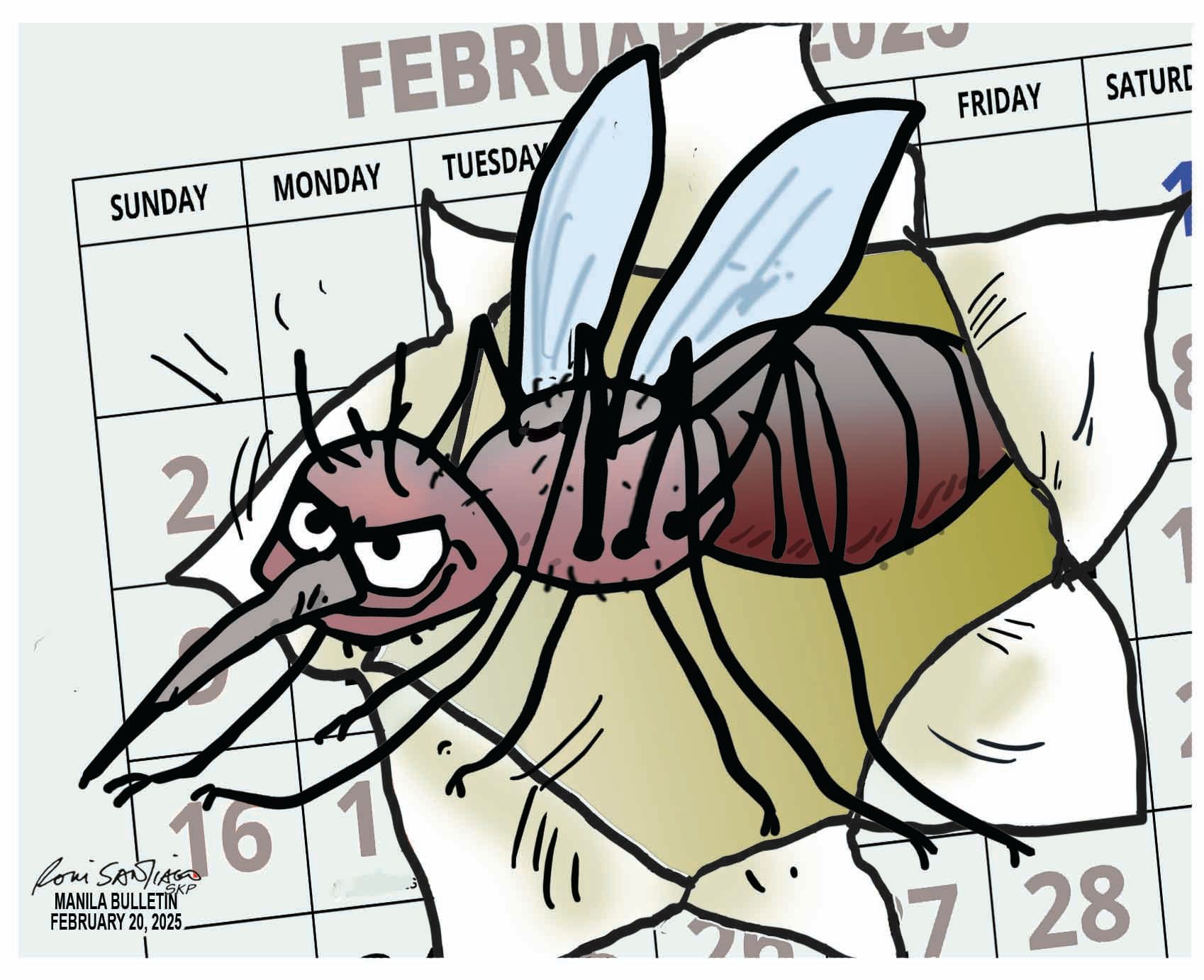
Climate change: Dengue fever outbreak hits too early

Published Feb 20, 2025 01:12 am

E CARTOON FEB 20, 2025.jpg 

Dengue fever has arrived alarmingly early in Metro Manila and nearby regions. The Department of Health (DOH) has reported a rapid surge in cases across Region IV-A, Region III, and Metro Manila, with Quezon City already declaring an outbreak after recording 10 deaths, including eight minors. Health officials now anticipate that eight more areas will soon declare outbreaks as well.

This sudden spike in cases is not just an anomaly — it is a consequence of climate change. The traditional dengue season, typically peaking in the rainy months of June to November, has been disrupted by unpredictable weather patterns. In recent weeks, the Philippines has experienced unseasonal rainfall due to the shearline, Intertropical Convergence Zone (ITCZ), and easterlies. These conditions have created ideal breeding grounds for Aedes mosquitoes, the primary carriers of the dengue virus.

DOH Assistant Secretary Albert Domingo noted: “Before, mosquitoes had specific active periods. But even that has changed. Previously, outbreaks matched the rainy season. But now, there is no longer a pattern because of climate change.”

Dengue outbreaks used to follow a predictable cycle, rising during the wet season when stagnant water accumulates and provides breeding sites for mosquitoes. However, health experts warn that climate change has disrupted this pattern, making dengue a year-round threat.

The DOH official noted that mosquitoes are now breeding and biting outside their usual active periods, leading to earlier and more widespread outbreaks.

Infectious disease experts have also observed that dengue infections are rising in densely populated urban areas such as Quezon City, Baguio, Palawan, and Cebu City. These areas have seen increasing cases since December and January, an unusual trend that underscores the changing behavior of mosquitoes due to environmental shifts.

If this trend continues, 2025 could see dengue cases soar beyond last year’s alarming figures. In 2024, the Philippines recorded 340,860 cases from January to November — an 81 percent increase compared to 2023, according to DOH data. The government and health agencies worked tirelessly to control the outbreak, yet many lives were still lost. This year’s early spike suggests that the country may be on track for another severe dengue season, possibly worse than the last.

Given these conditions, it is crucial for the public to take proactive measures to prevent dengue from spreading further. Fighting dengue starts at home. The DOH urges residents to eliminate mosquito breeding sites by removing stagnant water from containers, tires, and clogged drains where mosquitoes lay eggs. Cleaning surroundings regularly to eliminate potential breeding grounds should be a standard in every home by now. The use of mosquito repellents, nets, and window screens to reduce the risk of bites is also been recommended by health professionals.

The battle against dengue requires both individual vigilance and collective action. Government agencies, local officials, and community leaders must work together to intensify prevention efforts, increase public awareness, and implement effective response measures.

With climate change fueling unpredictable outbreaks, the public can no longer afford to wait for the rainy season to take dengue seriously. Now is the time to act before more lives are lost.

Related Tags

Roni Santiago DENGUE OUTBREAK
ADVERTISEMENT
.most-popular .layout-ratio{ padding-bottom: 79.13%; } @media (min-width: 768px) and (max-width: 1024px) { .widget-title { font-size: 15px !important; } }

{{ articles_filter_1561_widget.title }}

.most-popular .layout-ratio{ padding-bottom: 79.13%; } @media (min-width: 768px) and (max-width: 1024px) { .widget-title { font-size: 15px !important; } }

{{ articles_filter_1562_widget.title }}

.most-popular .layout-ratio{ padding-bottom: 79.13%; } @media (min-width: 768px) and (max-width: 1024px) { .widget-title { font-size: 15px !important; } }

{{ articles_filter_1563_widget.title }}

{{ articles_filter_1564_widget.title }}

.mb-article-details { position: relative; } .mb-article-details .article-body-preview, .mb-article-details .article-body-summary{ font-size: 17px; line-height: 30px; font-family: "Libre Caslon Text", serif; color: #000; } .mb-article-details .article-body-preview iframe , .mb-article-details .article-body-summary iframe{ width: 100%; margin: auto; } .read-more-background { background: linear-gradient(180deg, color(display-p3 1.000 1.000 1.000 / 0) 13.75%, color(display-p3 1.000 1.000 1.000 / 0.8) 30.79%, color(display-p3 1.000 1.000 1.000) 72.5%); position: absolute; height: 200px; width: 100%; bottom: 0; display: flex; justify-content: center; align-items: center; padding: 0; } .read-more-background a{ color: #000; } .read-more-btn { padding: 17px 45px; font-family: Inter; font-weight: 700; font-size: 18px; line-height: 16px; text-align: center; vertical-align: middle; border: 1px solid black; background-color: white; } .hidden { display: none; }
function initializeAllSwipers() { // Get all hidden inputs with cms_article_id document.querySelectorAll('[id^="cms_article_id_"]').forEach(function (input) { const cmsArticleId = input.value; const articleSelector = '#article-' + cmsArticleId + ' .body_images'; const swiperElement = document.querySelector(articleSelector); if (swiperElement && !swiperElement.classList.contains('swiper-initialized')) { new Swiper(articleSelector, { loop: true, pagination: false, navigation: { nextEl: '#article-' + cmsArticleId + ' .swiper-button-next', prevEl: '#article-' + cmsArticleId + ' .swiper-button-prev', }, }); } }); } setTimeout(initializeAllSwipers, 3000); const intersectionObserver = new IntersectionObserver( (entries) => { entries.forEach((entry) => { if (entry.isIntersecting) { const newUrl = entry.target.getAttribute("data-url"); if (newUrl) { history.pushState(null, null, newUrl); let article = entry.target; // Extract metadata const author = article.querySelector('.author-section').textContent.replace('By', '').trim(); const section = article.querySelector('.section-info ').textContent.replace(' ', ' '); const title = article.querySelector('.article-title h1').textContent; // Parse URL for Chartbeat path format const parsedUrl = new URL(newUrl, window.location.origin); const cleanUrl = parsedUrl.host + parsedUrl.pathname; // Update Chartbeat configuration if (typeof window._sf_async_config !== 'undefined') { window._sf_async_config.path = cleanUrl; window._sf_async_config.sections = section; window._sf_async_config.authors = author; } // Track virtual page view with Chartbeat if (typeof pSUPERFLY !== 'undefined' && typeof pSUPERFLY.virtualPage === 'function') { try { pSUPERFLY.virtualPage({ path: cleanUrl, title: title, sections: section, authors: author }); } catch (error) { console.error('ping error', error); } } // Optional: Update document title if (title && title !== document.title) { document.title = title; } } } }); }, { threshold: 0.1 } ); function showArticleBody(button) { const article = button.closest("article"); const summary = article.querySelector(".article-body-summary"); const body = article.querySelector(".article-body-preview"); const readMoreSection = article.querySelector(".read-more-background"); // Hide summary and read-more section summary.style.display = "none"; readMoreSection.style.display = "none"; // Show the full article body body.classList.remove("hidden"); } document.addEventListener("DOMContentLoaded", () => { let loadCount = 0; // Track how many times articles are loaded const offset = [1, 2, 3, 4, 5, 6, 7, 8, 9, 10]; // Offset values const currentUrl = window.location.pathname.substring(1); let isLoading = false; // Prevent multiple calls if (!currentUrl) { console.log("Current URL is invalid."); return; } const sentinel = document.getElementById("load-more-sentinel"); if (!sentinel) { console.log("Sentinel element not found."); return; } function isSentinelVisible() { const rect = sentinel.getBoundingClientRect(); return ( rect.top < window.innerHeight && rect.bottom >= 0 ); } function onScroll() { if (isLoading) return; if (isSentinelVisible()) { if (loadCount >= offset.length) { console.log("Maximum load attempts reached."); window.removeEventListener("scroll", onScroll); return; } isLoading = true; const currentOffset = offset[loadCount]; window.loadMoreItems().then(() => { let article = document.querySelector('#widget_1690 > div:nth-last-of-type(2) article'); intersectionObserver.observe(article) loadCount++; }).catch(error => { console.error("Error loading more items:", error); }).finally(() => { isLoading = false; }); } } window.addEventListener("scroll", onScroll); });

Sign up by email to receive news.