







European leaders want a say in talks to end Russia's war in Ukraine
The US is brushing them off


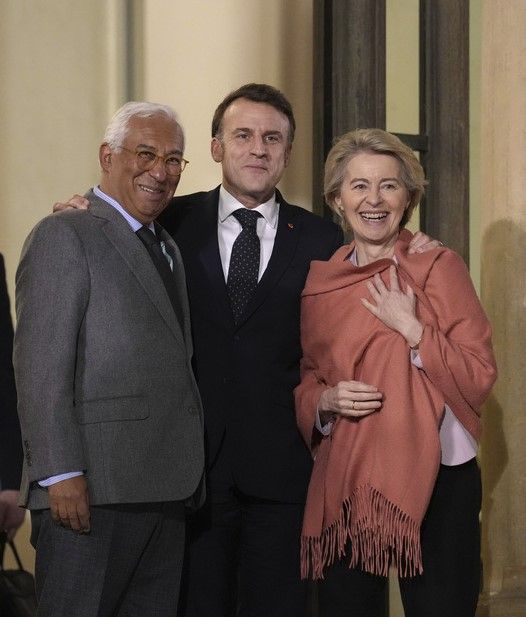
French President Emmanuel Macron, center, speaks with European Council President Antonio Costa, left, and European Commission President Ursula von der Leyen as they leave the Elysee Palace, after an informal meeting of leaders from key European Union nations and the United Kingdom, in Paris, Monday, Feb. 17, 2025. (AP Photo/Aurelien Morissard)
PARIS (AP) — European leaders insisted Monday they must have a say in international talks to end the war in Ukraine despite the clear message from both Washington and Moscow that there was no role for them as yet in negotiations that could shape the future of the continent.
Three hours of emergency talks at the Elysee Palace in Paris left leaders of Germany, the United Kingdom, Italy, Poland, Spain, the Netherlands, Denmark, NATO and the European Union without a common view on possible peacekeeping troops after a U.S. diplomatic blitz on Ukraine last week threw a once-solid trans-Atlantic alliance into turmoil.
U.K. Prime Minister Keir Starmer called for U.S. backing while reaffirming he’s ready to consider sending British forces on the Ukrainian ground alongside others “if there is a lasting peace agreement."
There was a rift though with some EU nations, like Poland, which have said they don't want their military imprint on Ukraine soil. Macron was non-committal.
Dutch Prime Minister Dick Schoof acknowledged the Europeans “need to come to a common conclusion about what we can contribute. And that way we will eventually get a seat at the table,” adding that “just sitting at the table without contributing is pointless.”
Starmer said a trans-Atlantic bond remained essential. “There must be a U.S. backstop, because a U.S. security guarantee is the only way to effectively deter Russia from attacking Ukraine again,” he said.
Top U.S. officials from the Trump administration, on their first visit to Europe last week, left the impression that Washington was ready to embrace the Kremlin while it cold-shouldered many of its age-old European allies.
US to leave Europe out of negotiations
Gen. Keith Kellogg, Trump’s special envoy for Ukraine and Russia, said Monday he didn't think it was “reasonable and feasible to have everybody sitting at the table.”
"We know how that can turn out and that has been our point, is keeping it clean and fast as we can,” he told reporters in Brussels, where he briefed the 31 U.S. allies in NATO, along with EU officials, before heading to Kyiv for talks on Wednesday with Ukrainian President Volodymyr Zelenskyy.
His remarks were echoed by Russian Foreign Minister Sergei Lavrov, who was equally dismissive about a role for Europe. “I don’t know what they have to do at the negotiations table," he said as he arrived in Saudi Arabia for talks with U.S. officials.
Last week, Vice President JD Vance and Defense Secretary Pete Hegseth in a flurry of speeches questioned both Europe’s security commitments and its fundamental democratic principles.
French President Emmanuel Macron, who has long championed a stronger European defense, said their stinging rebukes and threats of non-cooperation in the face of military danger felt like a shock to the system.
The tipping point came when Trump decided to upend years of U.S. policy by holding talks with Russian President Vladimir Putin in hopes of ending the Russia-Ukraine war.
Shortly before the meeting in Paris Monday, Macron spoke with Trump, but Macron’s office would not disclose details about the 20-minute discussion.
Europeans stand by their support to Ukraine
Starmer, who said he will travel to Washington next week to discuss with President Trump "what we see as the key elements of a lasting peace,” appears to be charting a “third way” in Europe’s shifting geopolitical landscape — aligning strategically with the U.S. administration while maintaining EU ties. Some analysts suggest this positioning could allow him to act as a bridge between Trump and Europe, potentially serving as a key messenger to the White House.
German Chancellor Olaf Scholz told reporters a possible peace agreement with Russia cannot be forced on Ukraine. “For us, it must and is clear: This does not mean that peace can be dictated and that Ukraine must accept what is presented to it,” he insisted.
Spanish Prime Minister Pedro Sánchez said that any peace agreement would need to have the active involvement of the EU and Ukraine, so as to not be a false end to the war “as has happened in the past.”
He went on: “What cannot be is that the aggressor is rewarded.”
A strong U.S. component, though, will remain essential for the foreseeable future since it will take many years before many European nations can ratchet up defense production and integrate it into an effective force.
Sending troops after a peace deal?
Highlighting the inconsistencies among many nations about potential troop contributions, Scholz said talk of boots on the ground was “premature."
“This is highly inappropriate, to put it bluntly, and honestly: we don’t even know what the outcome will be” of any peace negotiation, he added.
European nations are bent though on boosting their armed forces where they can after years of U.S. complaints, and most have increased defense spending to 2% of gross domestic product, but the path to reaching 3% is unclear.
"The time has come for a much greater ability of Europe to defend itself," Poland's Prime Minister Donald Tusk said. “There is unanimity here on the issue of increasing spending on defense. This is an absolute necessity." Poland spends more than 4% of its GDP on defense, more than any other NATO member.