ADVERTISEMENT

PH Army tests readiness for national security crisis in expanded 'Katihan' exercise

Published Feb 17, 2025 07:16 am
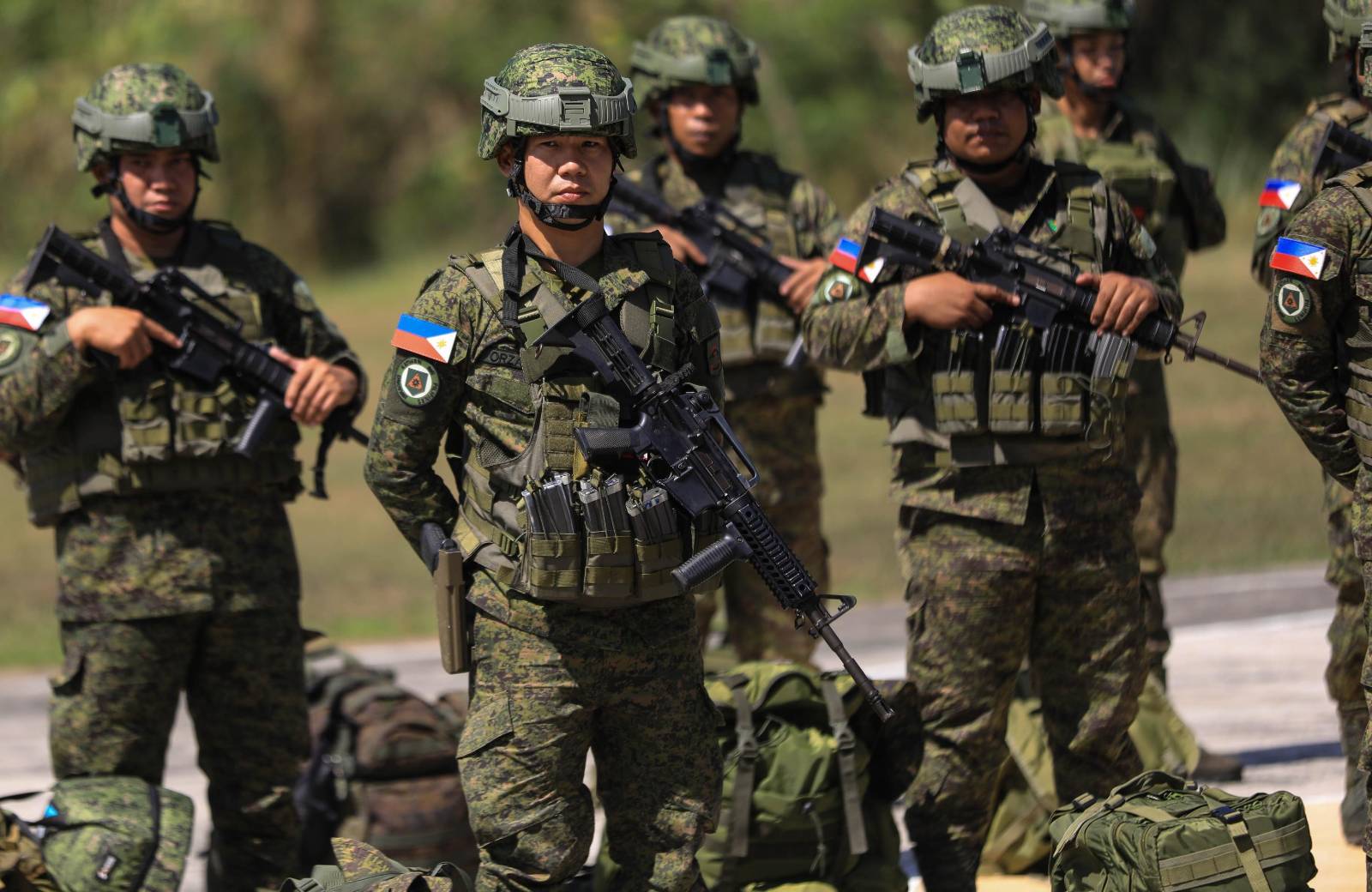
Philippine Army CATEX Katihan.jpg
Members of the Philippine Army's 702nd Infantry Brigade rehearse their movements for the upcoming CATEX Katihan at Camp Tito Abat in Manaoag, Pangasinan on Feb. 14, 2025. The combined arms training exercise will officially commence on March 3 to 22. (Photo: PA)

The Philippine Army (PA) is testing its capability to respond to a national crisis involving threats to national defense and security through the second iteration of the “Combined Arms Training Exercise (CATEX) Katihan”.

Around 6,000 Army personnel are participating in the Army-wide drills which will be held in training areas in Tarlac and Nueva Ecija from March 3 to 22 but the mobilization of troops has already begun on Monday, Feb. 17, according to Lt. Gen. Roy Galido, commanding general of the Army.

For this year, Galido said the CATEX Katihan will also be expanding its training areas to Visayas and Mindanao as troops will hold simultaneous exercises in Camp Jamindan in Capiz and Camp Kabaritan in Bukidnon. 

The exercises will focus on the ability of the Army for command and control (C2) of troops in large-scale formation.

“Wherever you are located in the country, you should be able to command and control the forces. This is what we will be focusing on. We can mobilize our units anywhere in the country, move them from one area to another as we have displayed and presented last year,” Galido said.

“This is more important in territorial defense because command and control now would refer to how we also interoperate with the Air Force and Navy,” he added.

This year’s exercise will also involve more platforms such as light tanks and other artilleries.

“This time, there will be more platforms because we’re testing our platforms that arrived last year,” the Army chief said. “It’s our platforms to deliver fires just like tanks, artilleries, and that’s the role of the Army – to be able to prevent physical occupation of the land and to be able to push them back in case the scenario would exist.”

Galido further stated that the controversial Typhon missile system will be utilized in the training like last year but only through subject matter expert exchanges (SMEEs) where experts from the US Army Pacific (USARPAC) will share their knowledge in operating the mid-range capability (MRC).

“We’re in the level of appreciating the system and being able to utilize it in our defense concept,” he noted.

China has repeatedly criticized the presence of the Typhon missile system in the Philippines, saying it “severely damages peace and stability in the region, and harms the legitimate security interests of other countries.”

China also warned that the Armed Forces of the Philippines’ (AFP) planned procurement of the Typhon might trigger an arms race in the region.

Both the Philippines and China have overlapping territorial claims in the South China Sea.

For his part, Galido argued that the presence of the Typhon missile is meant for defensive purposes, not offensive.

“I wonder why they’re worried,” he said. “All of these platforms, all of these capabilities [are] intended to protect the sovereignty of our country. As to the perception of other parties, it’s all up to them to create their own perception.”

Related Tags

Roy Galido Philippine Army CATEX Katihan
ADVERTISEMENT
.most-popular .layout-ratio{ padding-bottom: 79.13%; } @media (min-width: 768px) and (max-width: 1024px) { .widget-title { font-size: 15px !important; } }

{{ articles_filter_1561_widget.title }}

.most-popular .layout-ratio{ padding-bottom: 79.13%; } @media (min-width: 768px) and (max-width: 1024px) { .widget-title { font-size: 15px !important; } }

{{ articles_filter_1562_widget.title }}

.most-popular .layout-ratio{ padding-bottom: 79.13%; } @media (min-width: 768px) and (max-width: 1024px) { .widget-title { font-size: 15px !important; } }

{{ articles_filter_1563_widget.title }}

{{ articles_filter_1564_widget.title }}

.mb-article-details { position: relative; } .mb-article-details .article-body-preview, .mb-article-details .article-body-summary{ font-size: 17px; line-height: 30px; font-family: "Libre Caslon Text", serif; color: #000; } .mb-article-details .article-body-preview iframe , .mb-article-details .article-body-summary iframe{ width: 100%; margin: auto; } .read-more-background { background: linear-gradient(180deg, color(display-p3 1.000 1.000 1.000 / 0) 13.75%, color(display-p3 1.000 1.000 1.000 / 0.8) 30.79%, color(display-p3 1.000 1.000 1.000) 72.5%); position: absolute; height: 200px; width: 100%; bottom: 0; display: flex; justify-content: center; align-items: center; padding: 0; } .read-more-background a{ color: #000; } .read-more-btn { padding: 17px 45px; font-family: Inter; font-weight: 700; font-size: 18px; line-height: 16px; text-align: center; vertical-align: middle; border: 1px solid black; background-color: white; } .hidden { display: none; }
function initializeAllSwipers() { // Get all hidden inputs with cms_article_id document.querySelectorAll('[id^="cms_article_id_"]').forEach(function (input) { const cmsArticleId = input.value; const articleSelector = '#article-' + cmsArticleId + ' .body_images'; const swiperElement = document.querySelector(articleSelector); if (swiperElement && !swiperElement.classList.contains('swiper-initialized')) { new Swiper(articleSelector, { loop: true, pagination: false, navigation: { nextEl: '#article-' + cmsArticleId + ' .swiper-button-next', prevEl: '#article-' + cmsArticleId + ' .swiper-button-prev', }, }); } }); } setTimeout(initializeAllSwipers, 3000); const intersectionObserver = new IntersectionObserver( (entries) => { entries.forEach((entry) => { if (entry.isIntersecting) { const newUrl = entry.target.getAttribute("data-url"); if (newUrl) { history.pushState(null, null, newUrl); let article = entry.target; // Extract metadata const author = article.querySelector('.author-section').textContent.replace('By', '').trim(); const section = article.querySelector('.section-info ').textContent.replace(' ', ' '); const title = article.querySelector('.article-title h1').textContent; // Parse URL for Chartbeat path format const parsedUrl = new URL(newUrl, window.location.origin); const cleanUrl = parsedUrl.host + parsedUrl.pathname; // Update Chartbeat configuration if (typeof window._sf_async_config !== 'undefined') { window._sf_async_config.path = cleanUrl; window._sf_async_config.sections = section; window._sf_async_config.authors = author; } // Track virtual page view with Chartbeat if (typeof pSUPERFLY !== 'undefined' && typeof pSUPERFLY.virtualPage === 'function') { try { pSUPERFLY.virtualPage({ path: cleanUrl, title: title, sections: section, authors: author }); } catch (error) { console.error('ping error', error); } } // Optional: Update document title if (title && title !== document.title) { document.title = title; } } } }); }, { threshold: 0.1 } ); function showArticleBody(button) { const article = button.closest("article"); const summary = article.querySelector(".article-body-summary"); const body = article.querySelector(".article-body-preview"); const readMoreSection = article.querySelector(".read-more-background"); // Hide summary and read-more section summary.style.display = "none"; readMoreSection.style.display = "none"; // Show the full article body body.classList.remove("hidden"); } document.addEventListener("DOMContentLoaded", () => { let loadCount = 0; // Track how many times articles are loaded const offset = [1, 2, 3, 4, 5, 6, 7, 8, 9, 10]; // Offset values const currentUrl = window.location.pathname.substring(1); let isLoading = false; // Prevent multiple calls if (!currentUrl) { console.log("Current URL is invalid."); return; } const sentinel = document.getElementById("load-more-sentinel"); if (!sentinel) { console.log("Sentinel element not found."); return; } function isSentinelVisible() { const rect = sentinel.getBoundingClientRect(); return ( rect.top < window.innerHeight && rect.bottom >= 0 ); } function onScroll() { if (isLoading) return; if (isSentinelVisible()) { if (loadCount >= offset.length) { console.log("Maximum load attempts reached."); window.removeEventListener("scroll", onScroll); return; } isLoading = true; const currentOffset = offset[loadCount]; window.loadMoreItems().then(() => { let article = document.querySelector('#widget_1690 > div:nth-last-of-type(2) article'); intersectionObserver.observe(article) loadCount++; }).catch(error => { console.error("Error loading more items:", error); }).finally(() => { isLoading = false; }); } } window.addEventListener("scroll", onScroll); });

Sign up by email to receive news.