

ADVERTISEMENT

Comelec warns poll candidates vs pre-shaded ballot scam

Published Feb 13, 2025 05:03 am

Poll candidates are warned against a scam being offered ahead of the May 2025 elections involving pre-shaded ballots with so-called invisible or secret markings.
viber_image_2025-02-13_11-48-57-838.jpg
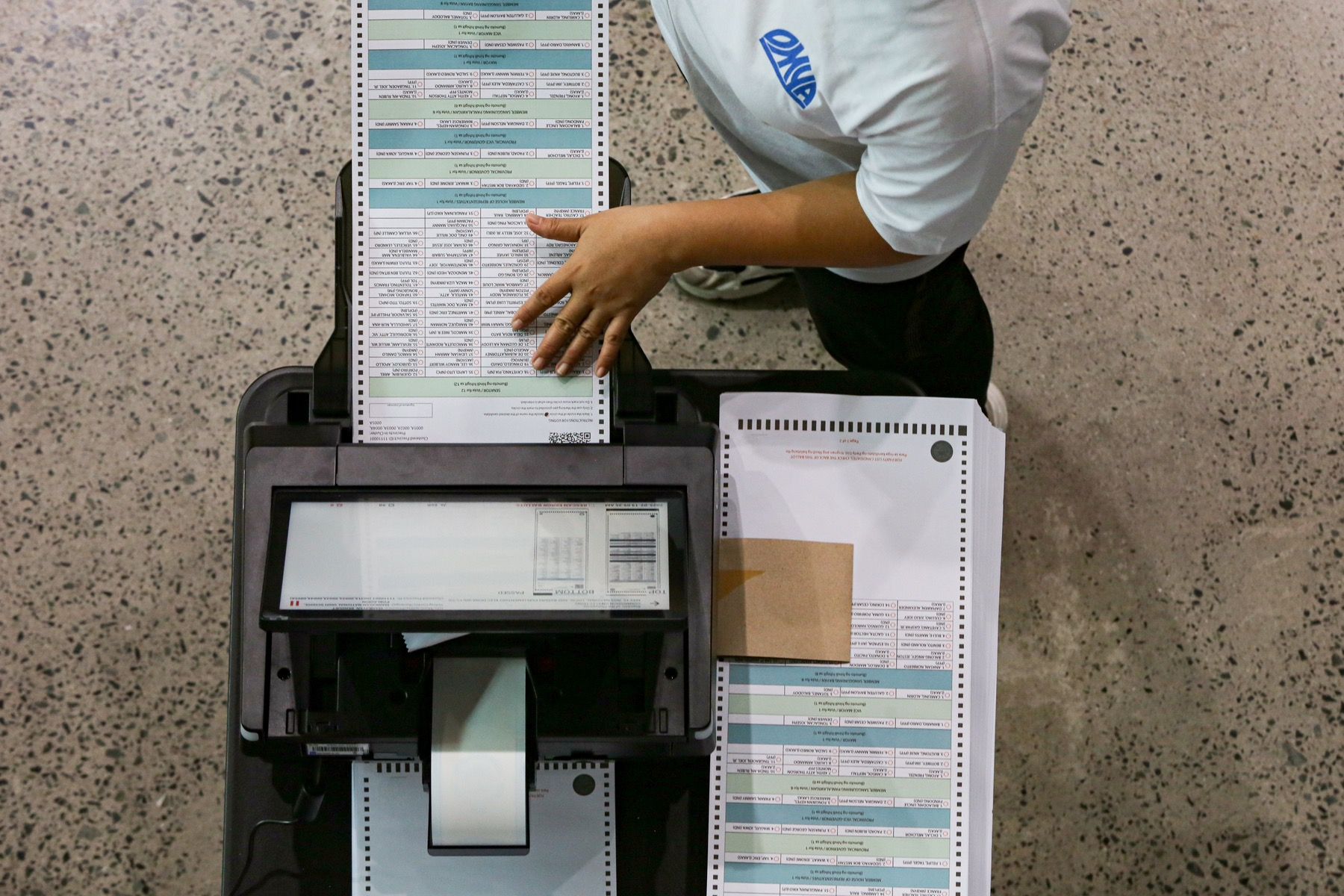
Verifiers of the Commission on Elections (COMELEC) carefully inspect printed ballots for the May 12 National and Local Elections during the first day of COMELEC’s Ballot Verification activity, held at the Amoranto Sports Complex in Quezon City on Thursday, February 13, 2025. COMELEC Chairman George Garcia said that their space at the National Printing Office (NPO) is not enough for ballot verification, so they borrowed a venue from the Quezon City Local Government to expedite and maximize the verification process. (Santi San Juan)

According to Commission on Elections (Comelec) Chairman George Erwin Garcia, this scam targets poll candidates by promising them a secured win in the elections in exchange for a huge sum of money.

During the commencement of the ballot verification on Thursday, Feb. 13 at the Amoranto Stadium in Quezon City, Garcia disproved this, stating that putting invisible or secret markings on the ballot is impossible and is merely a ruse being utilized by syndicates to make money.

"Kahit may invisible shading, makikita 'yan ng machine. Kasi nakikita ng machine eh. Again, hindi totoo yung sinasabi ng mga sindikato dyan na kaya nila magpalagay ng mga invisible shading sa mga balota na pini-print natin (Even with invisible shading, the machine can detect it. Because the machine can see it. Again, it's not true what those syndicates are saying that they can add invisible shading to the ballots we are printing)," Garcia said while showing an original ballot to reporters.

"So nanloloko lang talaga yung mga yun, para lang pagkakitaan (They're really just scamming people to make money)," he added.

In a separate interview on ANC, Garcia stated that these are just "bogus efforts" to discredit the electoral process.

"Ang nakakapagtaka lang diyan is, bakit mayroong nakikipag-usap? Bakit mayroong nagbabayad kahit na initial na payment? Therefore naniniwala sila doon sa binebenta (What's puzzling is, why are there people engaging in conversation? Why are there people making payments even just the initial payment? Therefore, they must believe in what is being sold)," he stated.

"They don't trust the process and the integrity of the entire process. Huwag po sana nilang sasabihin na natatakot lang sila. We have fully explained that tamper-proof ang ating process (They can't tell us that they are just scared. We have fully explained that our process is tamper-proof)," he added.

Ballot verification

After ballots are printed, Garcia explained that these undergo a manual verification process to check the accuracy of their size, color, cut, and secret features. After which it will be machine-verified to know if it's recognized and counted.

According to Garcia, it takes around 7.5 to 80 seconds for a ballot to be verified both manually and through a machine. But this depends on the verifier's expertise.

The poll chief led the inspection of ballot verification at the Amoranto Stadium in Quezon City on Thursday. There, he thanked the Quezon City Government for allowing them to use the venue free of charge.

In a press conference, Garcia said that at the National Printing Office (NPO) they have more or less 260 machines and approximately 600 verifiers. Half of them work during the day while the other half work at night for two shifts.

In Quezon City, they have 200 machines. He said that they are aiming to have 250 machines here and around 500 Emergency Job Order (EJO) workers who will also work on two shifts.

Currently, Garcia said that they have printed more or less 27 million ballots which represents 36 percent of the total number of ballots that should be printed. He disclosed that there have been some rejected or defective ballots and the problem with this is they have to order a reprinting of just one or two ballots.

Once the ballots have been verified, Garcia said that they will be vacuum-sealed for protection.

The last step would be, before the election proper, the final testing and sealing of the ballots and machines.

"Pabobotohin ng original na balota yung mga botante. Ihuhulog ng mga botante ngayon yung balota at titingnan at the end of the voting sa sampung balota kung ang balota ay bumibilang nang tama (Voters will use the original ballot to cast their votes. They will submit their ballots, and at the end of the voting process, ten ballots will be checked to ensure they have been counted correctly)," he said.

Related Tags

ballot printing comelec chairman george erwin garcia matalinong boto 2025 Commission on Elections (Comelec) ballot verification
ADVERTISEMENT
.most-popular .layout-ratio{ padding-bottom: 79.13%; } @media (min-width: 768px) and (max-width: 1024px) { .widget-title { font-size: 15px !important; } }

{{ articles_filter_1561_widget.title }}

.most-popular .layout-ratio{ padding-bottom: 79.13%; } @media (min-width: 768px) and (max-width: 1024px) { .widget-title { font-size: 15px !important; } }

{{ articles_filter_1562_widget.title }}

.most-popular .layout-ratio{ padding-bottom: 79.13%; } @media (min-width: 768px) and (max-width: 1024px) { .widget-title { font-size: 15px !important; } }

{{ articles_filter_1563_widget.title }}

{{ articles_filter_1564_widget.title }}

.mb-article-details { position: relative; } .mb-article-details .article-body-preview, .mb-article-details .article-body-summary{ font-size: 17px; line-height: 30px; font-family: "Libre Caslon Text", serif; color: #000; } .mb-article-details .article-body-preview iframe , .mb-article-details .article-body-summary iframe{ width: 100%; margin: auto; } .read-more-background { background: linear-gradient(180deg, color(display-p3 1.000 1.000 1.000 / 0) 13.75%, color(display-p3 1.000 1.000 1.000 / 0.8) 30.79%, color(display-p3 1.000 1.000 1.000) 72.5%); position: absolute; height: 200px; width: 100%; bottom: 0; display: flex; justify-content: center; align-items: center; padding: 0; } .read-more-background a{ color: #000; } .read-more-btn { padding: 17px 45px; font-family: Inter; font-weight: 700; font-size: 18px; line-height: 16px; text-align: center; vertical-align: middle; border: 1px solid black; background-color: white; } .hidden { display: none; }
function initializeAllSwipers() { // Get all hidden inputs with cms_article_id document.querySelectorAll('[id^="cms_article_id_"]').forEach(function (input) { const cmsArticleId = input.value; const articleSelector = '#article-' + cmsArticleId + ' .body_images'; const swiperElement = document.querySelector(articleSelector); if (swiperElement && !swiperElement.classList.contains('swiper-initialized')) { new Swiper(articleSelector, { loop: true, pagination: false, navigation: { nextEl: '#article-' + cmsArticleId + ' .swiper-button-next', prevEl: '#article-' + cmsArticleId + ' .swiper-button-prev', }, }); } }); } setTimeout(initializeAllSwipers, 3000); const intersectionObserver = new IntersectionObserver( (entries) => { entries.forEach((entry) => { if (entry.isIntersecting) { const newUrl = entry.target.getAttribute("data-url"); if (newUrl) { history.pushState(null, null, newUrl); let article = entry.target; // Extract metadata const author = article.querySelector('.author-section').textContent.replace('By', '').trim(); const section = article.querySelector('.section-info ').textContent.replace(' ', ' '); const title = article.querySelector('.article-title h1').textContent; // Parse URL for Chartbeat path format const parsedUrl = new URL(newUrl, window.location.origin); const cleanUrl = parsedUrl.host + parsedUrl.pathname; // Update Chartbeat configuration if (typeof window._sf_async_config !== 'undefined') { window._sf_async_config.path = cleanUrl; window._sf_async_config.sections = section; window._sf_async_config.authors = author; } // Track virtual page view with Chartbeat if (typeof pSUPERFLY !== 'undefined' && typeof pSUPERFLY.virtualPage === 'function') { try { pSUPERFLY.virtualPage({ path: cleanUrl, title: title, sections: section, authors: author }); } catch (error) { console.error('ping error', error); } } // Optional: Update document title if (title && title !== document.title) { document.title = title; } } } }); }, { threshold: 0.1 } ); function showArticleBody(button) { const article = button.closest("article"); const summary = article.querySelector(".article-body-summary"); const body = article.querySelector(".article-body-preview"); const readMoreSection = article.querySelector(".read-more-background"); // Hide summary and read-more section summary.style.display = "none"; readMoreSection.style.display = "none"; // Show the full article body body.classList.remove("hidden"); } document.addEventListener("DOMContentLoaded", () => { let loadCount = 0; // Track how many times articles are loaded const offset = [1, 2, 3, 4, 5, 6, 7, 8, 9, 10]; // Offset values const currentUrl = window.location.pathname.substring(1); let isLoading = false; // Prevent multiple calls if (!currentUrl) { console.log("Current URL is invalid."); return; } const sentinel = document.getElementById("load-more-sentinel"); if (!sentinel) { console.log("Sentinel element not found."); return; } function isSentinelVisible() { const rect = sentinel.getBoundingClientRect(); return ( rect.top < window.innerHeight && rect.bottom >= 0 ); } function onScroll() { if (isLoading) return; if (isSentinelVisible()) { if (loadCount >= offset.length) { console.log("Maximum load attempts reached."); window.removeEventListener("scroll", onScroll); return; } isLoading = true; const currentOffset = offset[loadCount]; window.loadMoreItems().then(() => { let article = document.querySelector('#widget_1690 > div:nth-last-of-type(2) article'); intersectionObserver.observe(article) loadCount++; }).catch(error => { console.error("Error loading more items:", error); }).finally(() => { isLoading = false; }); } } window.addEventListener("scroll", onScroll); });

Sign up by email to receive news.