






 World
White House fires USAID inspector general after warning about funding oversight, officials say
World
White House fires USAID inspector general after warning about funding oversight, officials say
White House fires USAID inspector general after warning about funding oversight, officials say


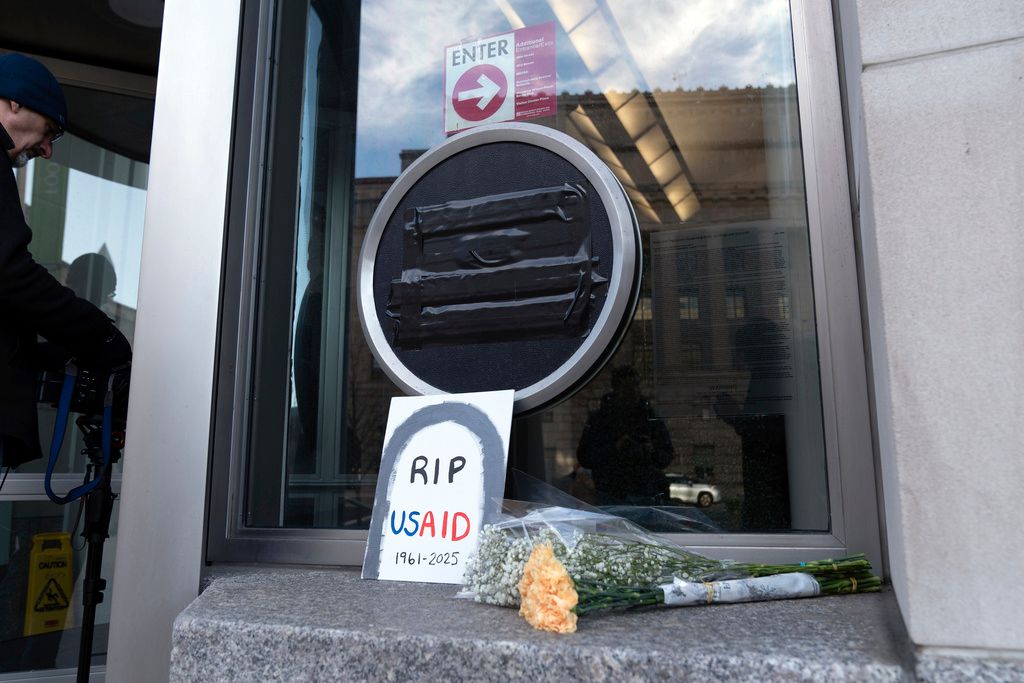
WASHINGTON (AP) — The White House fired the inspector general for the U.S. Agency for International Development on Tuesday, U.S. officials said, a day after his office warned that the Trump administration’s dismantling of USAID had made it all but impossible to monitor $8.2 billion in unspent humanitarian funds.
The White House gave no reason for the firing of Inspector General Paul Martin, one of the officials said. The officials were familiar with the dismissal but not authorized to comment publicly and spoke on condition of anonymity.
Inspectors general are typically independently funded watchdogs attached to government agencies and tasked with rooting out waste, fraud and abuse. The Trump administration earlier purged more than a dozen inspectors general.
On Monday, Martin's office issued a flash report warning that the Trump administration's freeze on all foreign assistance and moves to cut USAID staff had left oversight of the humanitarian aid “largely nonoperational."
That includes the agency’s ability to ensure none of the funding falls into the hands of violent extremist groups or goes astray in conflict zones, the watchdog said.
The dismissal, which was first reported by CNN, is the latest action by the Trump administration affecting the aid agency, including efforts to pull all but a fraction of its staffers worldwide off the job. Trump and ally Elon Musksay its work is out of line with the president’s agenda.
American businesses partnering with USAID sue
A lawsuit filed Tuesday alleged that the unraveling of USAID is stiffing American businesses on hundreds of millions of dollars in unpaid bills for work that has already been done.
The administration’s abrupt foreign aid freeze also is forcing mass layoffs by U.S. suppliers and contractors for USAID, including 750 furloughs at one company, Washington-based Chemonics International, the lawsuit says.
“One cannot overstate the impact of that unlawful course of conduct: on businesses large and small forced to shut down their programs and let employees go; on hungry children across the globe who will go without; on populations around the world facing deadly disease; and on our constitutional order,” the U.S. businesses and organizations said.
An organization representing 170 small U.S. businesses, major suppliers, the American Jewish group HIAS that aids displaced people abroad, the American Bar Association and others joined the legal challenge.
It was filed in U.S. District Court in Washington against President Donald Trump, Secretary of State Marco Rubio, acting USAID Deputy Administrator Peter Marocco, a Trump appointee who has been a central figure in hollowing out the agency, and Russell Vought, Trump’s head of the Office of Management and Budget.
It is at least the third lawsuit over the administration's targeting of USAID and its programs worldwide. A lawsuit brought by federal employees associations has temporarily blocked the administration from pulling thousands of USAID staffers off the job.
The funding freeze and other measures have persisted, including the agency losing the lease on its Washington headquarters.
The new administration terminated contracts without the required 30-day notice and without back payments for work that was already done, according to a U.S. official, a businessperson with a USAID contract and an email seen by The Associated Press. They spoke on condition of anonymity for fear of reprisal by the Trump administration.
For Chemonics, one of the larger of the USAID partners, the funding freeze has meant $103 million in unpaid invoices and almost $500 million in USAID-ordered medication, food and other goods stalled in the supply chain or ports, the lawsuit says.
For the health commodities alone, not delivering them “on time could potentially lead to as many as 566,000 deaths from HIV/AIDS, malaria, and unmet reproductive health needs, including 215,000 pediatric deaths,” the lawsuit says.
The filing asserts that the administration has no authority to block programs and funding mandated by Congress without approval.
Marocco defended the funding cutoff and push to put thousands of USAID staffers on leave in an affidavit filed late Monday in the lawsuit brought by the workers’ groups.
“Insubordination” and “noncompliance” by USAID staffers made it necessary to stop funding and operations by the agency to allow the administration to carry out a program-by-program review to decide what U.S. aid programs could resume overseas, he wrote.
USAID workers deny insubordination, and call the accusation a pretext to dismantle the agency.
GOP lawmakers aim to save food aid program
Seven Republican lawmakers from farm states introduced legislation to safeguard a long-running $1.8 billion food-aid program run by USAID, aiming to move the Food for Peace program under the Department of Agriculture.
Farmers, a politically important bloc for the Trump administration, have been affected by the administration's funding freeze as well.
Kansas Republican Sen. Jerry Moran, who announced the legislation, over the weekend thanked Rubio for interceding to allow delivery of $560 million in U.S.-grown commodities intended for hunger programs worldwide that had been stuck in ports because of the administration's abrupt cutoff of foreign assistance spending.