ADVERTISEMENT

44% of Filipinos expect better quality of life in next 12 months — SWS

Young adults, college graduates lead personal optimism in latest SWS survey

Published Dec 31, 2025 02:27 pm
Courtesy of SWS
Courtesy of SWS
Nearly half of adult Filipinos are optimistic that their quality of life will improve over the next year, according to the latest Social Weather Stations (SWS) survey.
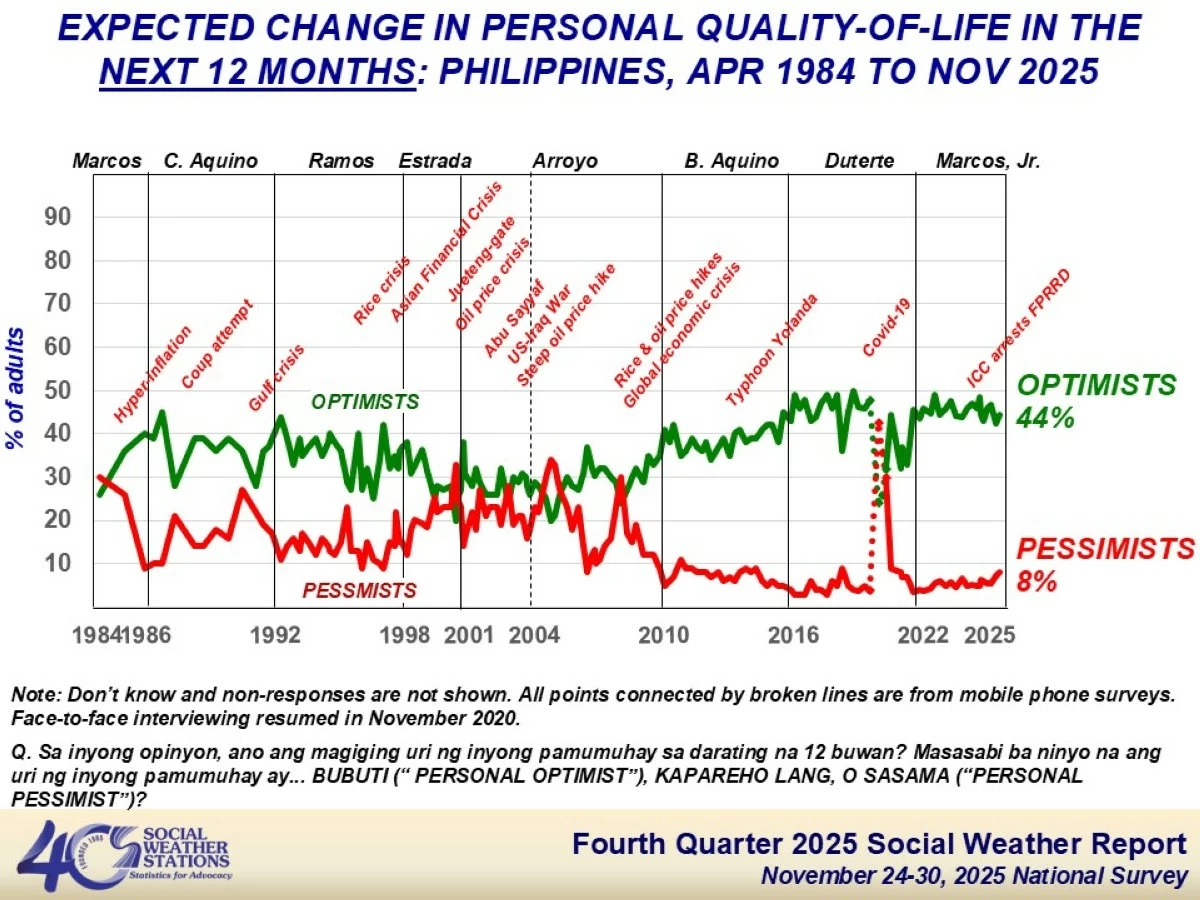
Released on December 30, the national Social Weather Survey—conducted from November 24 to 30—found that 44 percent of adult Filipinos expect their quality of life to improve in the next 12 months. Another 38 percent believe it will stay the same, while eight percent (8%) expect it to worsen. About nine percent (9%) did not answer.
Based on these results, SWS recorded a Net Personal Optimism score of +36—computed as the percentage of optimists minus pessimists—classified as “very high.” This is nearly unchanged from the very high +35 recorded in September 2025.
Optimism back to pre-pandemic levels
SWS noted that optimism about personal quality of life has largely recovered from pandemic-era lows.
Since April 1984, the question on expected changes in quality of life has been asked 163 times, with Net Personal Optimism turning negative only 11 times. The lowest score was recorded in May 2020 (-19) during strict COVID-19 lockdowns.
“Since then, optimism has rebounded and returned to pre-pandemic levels,” SWS said.
Regional trends: Balance Luzon, Mindanao post gains
The slight one-point increase in national optimism from September to November 2025 was driven by improvements in Mindanao and Balance Luzon, offsetting minor declines in Metro Manila and the Visayas.
Based on the survey, Net Personal Optimism in Mindanao rose by four points from +31 to +35, remaining very high.
In Balance Luzon, it increased by two points from +38 to +40, moving from very high to excellent.
In Metro Manila, it fell slightly from +39 to +36 but remained very high.
In the Visayas, it dropped from +33 to +29, slipping from very high to high.
Rural optimism edges up; urban steady
The survey results also showed that optimism remained very high in both rural and urban areas.
SWS noted that rural Net Personal Optimism increased slightly from +34 to +36, while urban areas saw minimal change, rising from +36 to +37.
Men, women both highly optimistic
SWS found similarly high optimism levels across genders. Net Personal Optimism among women rose marginally from +38 to +39, while men posted a slight increase from +33 to +34—both within the “very high” range.
Younger Filipinos most optimistic
SWS noted that while optimism declined gradually with age, younger Filipinos showed the strongest confidence in the future.
The survey recorded gains among most age groups compared to September 2025, particularly among those aged 18–24 and 25–34.
Education: optimism highest among college graduates, SHS learners
By educational attainment, Net Personal Optimism was excellent among college graduates (+44) and those with some senior high school education (+44).
It remained very high among junior high school and elementary graduates, and ranged from high to very high among those with less formal schooling.
The survey also showed a strong link between recent personal experience and future expectations.
Filipinos who said their quality of life had improved over the past year (“Gainers”) posted an excellent Net Personal Optimism score of +58. Those whose situation stayed the same scored +35, while those who said it worsened (“Losers”) recorded a lower but improving +21.
SWS said this pattern—higher optimism among Gainers than among those Unchanged or Losers—has been consistent from 2019 to 2025.
The Fourth Quarter 2025 Social Weather Survey interviewed 1,200 adults nationwide through face-to-face interviews, with equal samples from Metro Manila, Balance Luzon, the Visayas, and Mindanao. The survey has a ±3 percentage point margin of error for national results.

Related Tags

SWS SWS survey young Filipinos optimism Social Weather Stations
ADVERTISEMENT
.most-popular .layout-ratio{ padding-bottom: 79.13%; } @media (min-width: 768px) and (max-width: 1024px) { .widget-title { font-size: 15px !important; } }

{{ articles_filter_1561_widget.title }}

.most-popular .layout-ratio{ padding-bottom: 79.13%; } @media (min-width: 768px) and (max-width: 1024px) { .widget-title { font-size: 15px !important; } }

{{ articles_filter_1562_widget.title }}

.most-popular .layout-ratio{ padding-bottom: 79.13%; } @media (min-width: 768px) and (max-width: 1024px) { .widget-title { font-size: 15px !important; } }

{{ articles_filter_1563_widget.title }}

{{ articles_filter_1564_widget.title }}

.mb-article-details { position: relative; } .mb-article-details .article-body-preview, .mb-article-details .article-body-summary{ font-size: 17px; line-height: 30px; font-family: "Libre Caslon Text", serif; color: #000; } .mb-article-details .article-body-preview iframe , .mb-article-details .article-body-summary iframe{ width: 100%; margin: auto; } .read-more-background { background: linear-gradient(180deg, color(display-p3 1.000 1.000 1.000 / 0) 13.75%, color(display-p3 1.000 1.000 1.000 / 0.8) 30.79%, color(display-p3 1.000 1.000 1.000) 72.5%); position: absolute; height: 200px; width: 100%; bottom: 0; display: flex; justify-content: center; align-items: center; padding: 0; } .read-more-background a{ color: #000; } .read-more-btn { padding: 17px 45px; font-family: Inter; font-weight: 700; font-size: 18px; line-height: 16px; text-align: center; vertical-align: middle; border: 1px solid black; background-color: white; } .hidden { display: none; }
function initializeAllSwipers() { // Get all hidden inputs with cms_article_id document.querySelectorAll('[id^="cms_article_id_"]').forEach(function (input) { const cmsArticleId = input.value; const articleSelector = '#article-' + cmsArticleId + ' .body_images'; const swiperElement = document.querySelector(articleSelector); if (swiperElement && !swiperElement.classList.contains('swiper-initialized')) { new Swiper(articleSelector, { loop: true, pagination: false, navigation: { nextEl: '#article-' + cmsArticleId + ' .swiper-button-next', prevEl: '#article-' + cmsArticleId + ' .swiper-button-prev', }, }); } }); } setTimeout(initializeAllSwipers, 3000); const intersectionObserver = new IntersectionObserver( (entries) => { entries.forEach((entry) => { if (entry.isIntersecting) { const newUrl = entry.target.getAttribute("data-url"); if (newUrl) { history.pushState(null, null, newUrl); let article = entry.target; // Extract metadata const author = article.querySelector('.author-section').textContent.replace('By', '').trim(); const section = article.querySelector('.section-info ').textContent.replace(' ', ' '); const title = article.querySelector('.article-title h1').textContent; // Parse URL for Chartbeat path format const parsedUrl = new URL(newUrl, window.location.origin); const cleanUrl = parsedUrl.host + parsedUrl.pathname; // Update Chartbeat configuration if (typeof window._sf_async_config !== 'undefined') { window._sf_async_config.path = cleanUrl; window._sf_async_config.sections = section; window._sf_async_config.authors = author; } // Track virtual page view with Chartbeat if (typeof pSUPERFLY !== 'undefined' && typeof pSUPERFLY.virtualPage === 'function') { try { pSUPERFLY.virtualPage({ path: cleanUrl, title: title, sections: section, authors: author }); } catch (error) { console.error('ping error', error); } } // Optional: Update document title if (title && title !== document.title) { document.title = title; } } } }); }, { threshold: 0.1 } ); function showArticleBody(button) { const article = button.closest("article"); const summary = article.querySelector(".article-body-summary"); const body = article.querySelector(".article-body-preview"); const readMoreSection = article.querySelector(".read-more-background"); // Hide summary and read-more section summary.style.display = "none"; readMoreSection.style.display = "none"; // Show the full article body body.classList.remove("hidden"); } document.addEventListener("DOMContentLoaded", () => { let loadCount = 0; // Track how many times articles are loaded const offset = [1, 2, 3, 4, 5, 6, 7, 8, 9, 10]; // Offset values const currentUrl = window.location.pathname.substring(1); let isLoading = false; // Prevent multiple calls if (!currentUrl) { console.log("Current URL is invalid."); return; } const sentinel = document.getElementById("load-more-sentinel"); if (!sentinel) { console.log("Sentinel element not found."); return; } function isSentinelVisible() { const rect = sentinel.getBoundingClientRect(); return ( rect.top < window.innerHeight && rect.bottom >= 0 ); } function onScroll() { if (isLoading) return; if (isSentinelVisible()) { if (loadCount >= offset.length) { console.log("Maximum load attempts reached."); window.removeEventListener("scroll", onScroll); return; } isLoading = true; const currentOffset = offset[loadCount]; window.loadMoreItems().then(() => { let article = document.querySelector('#widget_1690 > div:nth-last-of-type(2) article'); intersectionObserver.observe(article) loadCount++; }).catch(error => { console.error("Error loading more items:", error); }).finally(() => { isLoading = false; }); } } window.addEventListener("scroll", onScroll); });

Sign up by email to receive news.