







Flood-control scandal keeps Philippine Q4 growth under water
Published Dec 30, 2025 06:00 pm


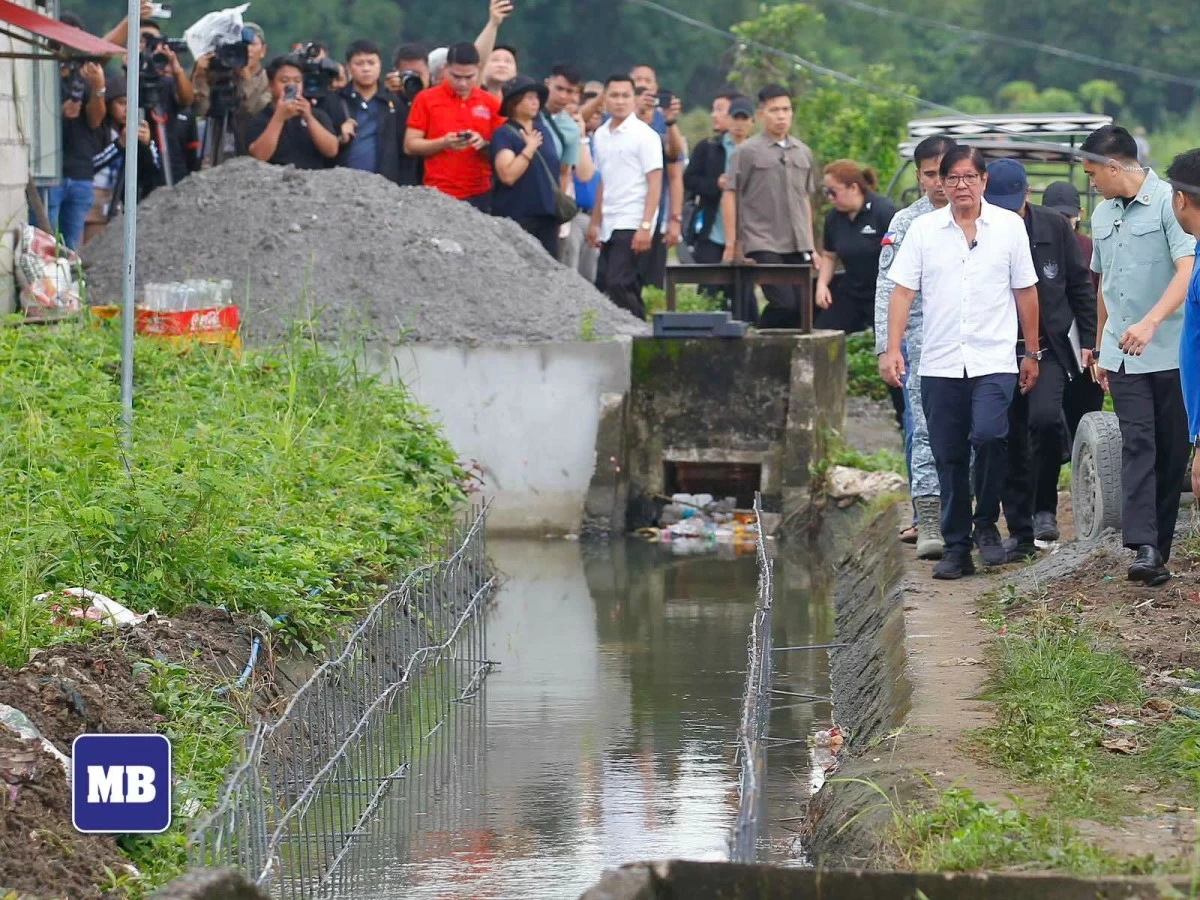
President Ferdinand R. Marcos Jr. leads the inspection of a riverwall in Barangay Piel, Baliuag, Bulacan which was tagged as a 'ghost project.' (Mark Balmores)
Philippine economic growth in the fourth quarter is set to once again disappoint, as spillovers from dampened public and private consumption in the aftermath of the flood-control infrastructure corruption scandal linger, according to think tank Capital Economics.
“Surveys suggest that the scandal has continued to depress activity in the fourth quarter, with the PMIs [purchasing managers’ indices] falling to multi-year lows,” noted Capital Economics senior Asia economist Gareth Leather, deputy chief emerging markets (EMs) economist Jason Tuvey, and Asia economist Shivaan Tandon in a Dec. 29 report. The Philippines’ manufacturing PMI slid to an over four-year low of 47.4 last November—a level below 50, which signals contraction.
The think tank pointed out that third-quarter gross domestic product (GDP) growth already slowed to just four percent year-on-year—a 4.5-year low—as the discovery of “ghost” and substandard flood-control projects led to protests as well as the postponed rollout of other infrastructure projects.
Earlier this month, Capital Economics further slashed its near-term GDP growth forecasts for the Philippines to four percent for 2025, 4.5 percent for 2026, and five percent for 2027.
The government targets a downscaled 5.5- to 6.5-percent GDP expansion this year, with the end-September average at five percent. For 2026, the official GDP growth goal is an also tempered six to seven percent.
Capital Economics said that the “massive corruption scandal in the Philippines is continuing to weigh on economic activity.”
“A key risk is that the corruption scandal causes investor sentiment toward the Philippines to sour,” the think tank warned.
This is already showing in the performance of the Philippine peso, which Capital Economics noted has weakened since President Ferdinand R. Marcos Jr.’s State of the Nation Address (SONA) last July. It was during Marcos’ fourth SONA—marking the start of the second half of his administration ending in 2028—that the President brought to public attention the billions, if not trillions, of pesos wasted on flood-control corruption.
In recent weeks, the local currency reached record-low levels against the United States (US) dollar, breaching the ₱59:$1 mark, and it does not help that “the large current account deficit leaves the peso vulnerable,” Capital Economics said.
Based on the Bangko Sentral ng Pilipinas’ (BSP) latest balance of payments (BOP) forecasts released last week, the current account deficit—the gap in the country’s net dollar earnings from trade in goods and services as well as remittances from overseas Filipinos (OFs)—is now seen easing to 3.2 percent of GDP this year, slightly narrower than the central bank’s previous 3.3-percent forecast.
As of end-September 2025, the current account deficit stood at 3.6 percent of GDP, narrower than the full-year 2024 shortfall equivalent to four percent of GDP.
For 2026, the current account deficit is seen to further narrow to three percent of GDP, although slightly wider than the earlier forecast of 2.9 percent.
Amid weak economic activity coupled with low inflation, Capital Economics believes that “there’s scope for a bit more easing in 2026” following the 25-basis-point (bp) interest rate cut by the BSP this month.
From a policy rate of 4.5 percent at present, the think tank had forecast another 25-bp reduction in the first quarter of 2026 and a terminal rate of four percent before the end of next year.
The think tank had also projected headline consumer price index (CPI) inflation at 1.6 percent in 2025, 2.3 percent in 2026, and three percent in 2027. The BSP targets an inflation rate of two to four percent, a range deemed manageable and conducive to economic growth.