







APAC AI outlook 2026 signals AI's breakout moment as a new revenue driver
By MB Technews
Published Dec 30, 2025 10:36 am


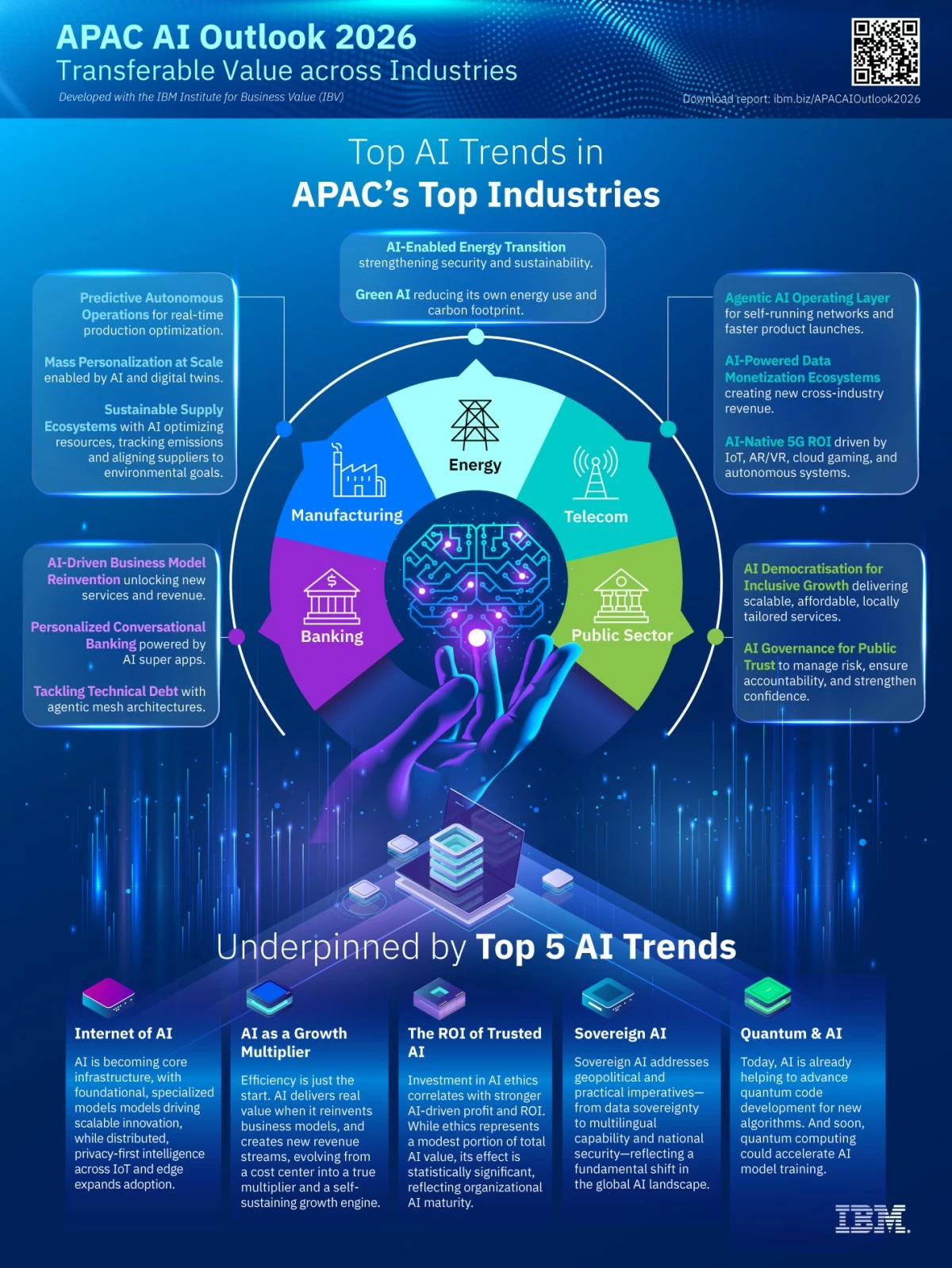
A new IBM report uncovers the latest industry and technology trends across Asia-Pacific (APAC), revealing how leading banks, manufacturers, telecom operators, energy providers, and public sector agencies are scaling AI to accelerate innovation and create new enterprise value. The report draws on insights from interviews with executives from 14 of the region’s top-performing organizations.
About APAC AI Outlook 2026
Developed with the IBM Institute for Business Value (IBV), the IBM report, APAC AI Outlook 2026: Transferable Value across Industries, highlights a fundamental shift in how APAC enterprises are now deploying AI. Beyond cost reduction, organizations are leveraging AI to drive growth, business model reinvention, and new revenue streams.
Focused on five priority industries—banking, manufacturing, telecommunications, energy, and public services—the report captures insights from leaders across 14 organizations. It examines successful AI initiatives, emerging opportunities, implementation challenges, and forward-looking visions shaping the region’s next wave of innovation.
Recent studies reveals that organizations are already redirecting 64% of AI investments toward core business functions where AI delivers the strongest measurable returns. By 2026, 95% of global executives expect generative AI to be at least partially self-funded, signaling AI’s transition from a support capability to a strategic engine of growth.
The report maps out the industry and technology trends defining APAC’s AI future, offering leaders practical guidance to scale adoption and maximize ROI.
Industry trends shaping APAC’s AI future in 2026:
• Banking
AI is reshaping banking business models and enabling new revenue streams. For example, AI-enabled embedded finance and trust-as-a-service, powered by predictive risk and compliance, are opening new pathways for growth. Hyper-personalized conversational banking is emerging through AI-powered super apps, while agentic mesh architectures help institutions tackle technical debt and improve agility.
• Manufacturing
AI enables predictive autonomous operations, real-time optimization, and mass personalization through digital twins. Sustainable, AI-driven supply ecosystems allow manufacturers to optimize resources, track emissions, and align suppliers to environmental goals.
• Telecommunications
Operators are adopting an agentic AI operating layer that supports self-managing networks and accelerates product innovation. AI-driven data monetization ecosystems are emerging as new revenue engines, while AI-native 5G unlocks new revenue from IoT, immersive experiences, and autonomous systems.
• Energy
AI is powering the energy transition by enhancing grid stability, integrating renewables, boosting asset efficiency, and reducing emissions across sectors. Advancements in Green AI are reducing energy consumption and emissions across the entire value chain.
• Public Sector
Democratizing AI expands access to affordable, responsive public services—from finance and agriculture to healthcare and education, while strengthened governance frameworks reinforce accountability, safety, and public trust.
Foundational AI trends transforming all industries:
• The Internet of AI
Generative and agentic AI are becoming core enterprise infrastructure, with foundational and specialized models working together to drive efficiency, governance, and innovation at scale. At the same time, AI is moving from centralized data centers to distributed, privacy-first ecosystems—learning across smartphones, IoT, and edge devices with persistent memory, on-device inference, and privacy-centric design—unlocking broader adoption.
• AI as a Growth Multiplier
Efficiency is just the starting point. The real ROI of AI will emerge when it drives competitive differentiation, reinvents business models, and creates entirely new products, services, or revenue streams. By enabling fundamentally new approaches to value creation and delivery, AI evolves from a cost center into a true multiplier—generating gains and expanding the company’s market and revenue base, ultimately becoming a self-sustaining investment.
• The ROI of Trusted AI
Investment in AI ethics correlates with better business results. Organizations with the highest AI ethics spending consistently achieve greater AI-driven profit and ROI, while even moderate investments show a positive impact. Though ethics accounts for a modest portion of total AI value, its effect is statistically significant, reflecting the maturity of an organization’s AI practices.
• Sovereign AI
Alongside global LLMs, indigenous models and sovereign infrastructure are rising to meet needs around data sovereignty, multilingual proficiency, cultural nuance, and national security. This signals a structural shift in the global AI landscape.
• Quantum & AI
As quantum computing approaches "advantage" — the point at which a quantum computer can solve a problem better than all classical-only methods — the emerging technology has the potential to accelerate AI model training through faster optimization, more efficient sampling, and improved simulation of complex systems. In turn, AI is already helping to optimize quantum workflows, guiding algorithm design, error correction strategies, and resource allocation across quantum-classical architectures. According to the latest IBV research, progress will rely on strong ecosystem collaboration. Early adopters are already gaining advantage—quantum-ready organizations are three times more likely to participate in multiple ecosystems than others.
Best practice and vision from APAC leaders
The report features insights and case studies from BharatGen, C-Metric, Delta Electronics, EastWest Bank, Gyeonggido Assembly, Indosat Ooredoo Hutchison (IOH), Meralco PowerGen (MGEN), Mercedes-Benz Research and Development India (MBRDI), Neurogaint System, Pronto Software, Public Safety Savings and Loan Association (PSSLAI), Stretch 365, Telkom and TruCarbon.
Transferable value across industries: the AI accelerator
The report highlights cross-industry transferability as a key accelerator of AI maturity. Because AI makes knowledge transferable, innovations in one sector can be rapidly adapted in another—helping organizations leapfrog development and avoid recreating existing solutions. For example,
• From telco to manufacturing: Manufacturers are shifting to “as-a-service” business models (like predictive maintenance) by leveraging the model pioneered by telcos. This transforms traditional products and support functions into recurring revenue streams, turning maintenance from a cost center into a growth engine.
• From banking to retail: Retailers are embracing banking's risk assessment capabilities to confidently offer embedded financial services (such as Buy-Now-Pay-Later) within their customer journey. By integrating AI-driven credit scoring and fraud detection, they gain higher margins and customer stickiness.
• From retail to financial services: Banking is taking inspiration from the retail sector’s mastery of hyper-personalization. Banks can analyze customer spending and life events to suggest real-time, relevant financial products, positioning themselves as lifestyle platforms.
• From telco to government: Government agencies are adopting digital twin technology and real-time AI analytics—tools already used effectively in the telecom sector—to enhance urban planning and traffic management, fostering the development of smarter, more responsive cities.
This cross-sector learning amplifies AI’s impact and accelerates value creation across the region.
IBM executive perspective
“The 2026 trends show enterprises embedding AI directly into their core business models, unlocking new revenue streams and accelerating innovation at scale. Organizations are moving beyond early experimentation and building AI that is governed, explainable, and aligned to national and enterprise priorities. From sovereign models to quantum-powered AI, the region is shaping an AI ecosystem that is both innovative and trusted. Our APAC AI Outlook 2026 shows how these shifts are paving the way for enterprises to grow strategically and sustainably.”
“What’s most exciting in APAC is how AI innovation is no longer confined within industries. We are seeing breakthroughs in telecom inspire advancements in manufacturing, and manufacturing models reshape the energy sector. This transferable value across industries will accelerate AI maturity across the region, helping enterprises leapfrog traditional development cycles. The APAC AI Outlook illustrates how leaders are now scaling AI with purpose, discipline, and a clear eye on measurable growth.”
— Juhi McClelland, Managing Partner, IBM Consulting APAC