






Manila Bulletin
 Business
Trade & Industry
2025 trade review: Year the Philippines navigated the 'Trump shock'
Business
Trade & Industry
2025 trade review: Year the Philippines navigated the 'Trump shock'
Business
Trade & Industry
2025 trade review: Year the Philippines navigated the 'Trump shock'
2025 trade review: Year the Philippines navigated the 'Trump shock'
Published Dec 29, 2025 12:00 am
|
Updated Dec 27, 2025 01:24 pm


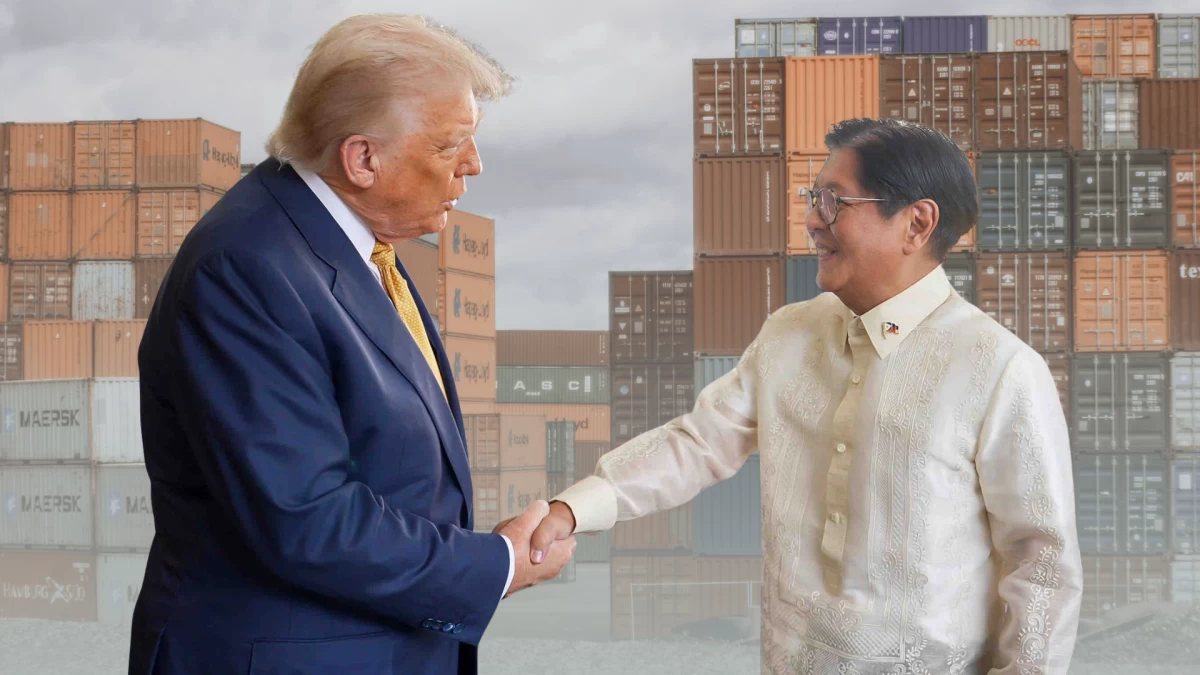
President Marcos Jr. meets with U.S. President Donald Trump at the White House on July 22, 2025. Marcos negotiated a slight reduction in reciprocal tariffs—from 20 percent down to 19 percent—in exchange for opening Philippine markets to American vehicles and agricultural goods.
There’s no better word to describe the trade environment this year than uncertainty, as the country endured a slew of changes and setbacks, particularly due to the policies of the United States (US), its closest ally and largest trading partner.
It is no surprise that when US President Donald Trump was re-elected, he would be bent on addressing what he deemed as “unfair” trade practices, echoing a similar push during his first term.
What surprised many was just how far he was willing to go.
When Trump first revealed plans to impose his so-called reciprocal tariffs, the Department of Trade and Industry (DTI) was confident that it would just be “business as usual” for the Philippines.
The higher tariff rate was, after all, designed to target trading partners with whom America carries steep deficits. Data from the Office of the US Trade Representative (USTR) showed that the US goods trade deficit with the country stood at $4.9 billion last year.
In addition, the US has long been a key partner for the Philippines, marked by decades of trade ties, military alliance, and cultural exchange—even including 48 years of colonization.
On his so-called “Liberation Day” on April 2, President Trump announced sweeping tariffs on nearly all countries, including a baseline 10-percent tariff and higher reciprocal tariffs. The Philippines was slapped with a 17 percent reciprocal tariff.
This means that shipments coming from the country would be subject to additional duties upon arrival in America.
Trump saw the protectionist policy as a move to revive domestic production, a position that the government, oddly enough, agreed with.
Then-Office of the Special Assistant to the President for Investment and Economic Affairs (OSAPIEA), and now Finance Secretary Frederick Go argued that it could inject some much-needed investments to revive the manufacturing sector since the country’s tariffs, at that time, were significantly lower than its peers in Southeast Asia.
Several business groups were also keen to take advantage of this scheme, while noting the impact of the additional cost on smaller exporters.
But as soon as the tariffs were announced, Trump changed tune and announced a 90-day suspension to give countries the opportunity to negotiate, while opting to retain the baseline tariff rate.
Back to the drawing board we go.
Finding a breakthrough
Trade Secretary Cristina Roque said the global trade market is essentially back to normal following the pause, as the government seeks to negotiate with the Trump administration for the most beneficial deal.
“It’s business as usual. We’re just really hoping to meet or [be] scheduled to meet before the 90 days [are] over,” Roque said in an interview on April 15.
Roque and Go, both members of the Marcos administration’s economic team, met with their US counterparts on May 2. While details of the meeting were not disclosed, the government said it went “extremely well.”
The following month, there was no assurance from the government that an agreement had been reached with the US. In an interview on June 18, Roque said they are optimistic about securing what they negotiated, given the seemingly positive feedback from US officials.
Without an agreement in place to calm investor sentiment, investments registered with the country’s investment promotion agencies slipped by 58.5 percent in the second quarter to ₱299.08 billion from ₱720.10 billion in the same period last year.
The situation took a turn for the worse on July 9 after the US announced a new tariff rate for the country, increasing the previous 17 percent to 20 percent.
Philippine Exporters Confederation Inc. (Philexport) President Sergio Ortiz-Luis Jr. said this was a “bad sign” for the government’s initial investment outlook, as the new levy puts the country on par with its neighbors.
With the much higher tariff rate, President Marcos took it upon himself to negotiate with President Trump at the White House on July 22.
Marcos, whom Trump described as “a very good and tough negotiator,” was able to reduce the country’s tariff by a mere one percentage point (ppt) down to 19 percent.
This is in exchange for opening the market to goods not locally produced, including American-made vehicles, soy, wheat, and pharmaceutical products.
The 19-percent reciprocal tariff took effect on August 7.
Left behind?
Although the 19-percent tariff rate remains unchanged, the country’s export and investment outlook continues to face turbulence amid unyielding uncertainties with US policies.
In particular, Trump threatened to impose tariffs on the country’s top export product, semiconductors, as high as 300 percent. Semiconductor and Electronics Industries in the Philippines Foundation Inc. (SEIPI) warned that this could have a “devastating impact” on the industry.
The government sought an exemption from this threat in the ongoing negotiations for a reciprocal tariff deal, including other products such as coconut and its derivatives, which are among the top agricultural exports to the US.
To date, Manila has not reached a deal with Washington. This stands in sharp contrast to Indonesia, Thailand, and Malaysia, which have already secured agreements.
Malacañang said the delay stems from the decision to safeguard key industries such as rice, corn, sugar, and poultry from a potential influx of American imports—concessions that neighboring countries were willing to make.
The government’s gamble paid off after Trump issued an executive order granting tariff exemptions on agricultural products not produced in the US.
This covered commodities such as coconuts, bananas, mangoes, and coffee, which generated over $1 billion in export revenue last year.
Agriculture Secretary Francisco Tiu Laurel said the government will ramp up its export promotion programs in the coming year to take advantage of the duty-free access.
The voyage ahead
On the back of the US’ protectionist policies, the public-private Export Development Council (EDC) earlier revised the country’s export targets for the year to between $110.8 billion and $113.42 billion, down from the original goal of $163.6 billion.
Philexport, the umbrella group of local exporters, is targeting to reach between $105 billion and $110 billion this year, partly due to frontloading or a surge in purchases in the first half to avert the tariff imposition.
SEIPI expects electronic exports to grow between five and seven percent from last year’s value of $42.6 billion, as semiconductors continue to enjoy duty-free access.
Even the country’s garment exports are expected to grow by 11 percent this year to $1 billion from around $900 million last year, according to the Foreign Buyers Association of the Philippines (FOBAP).
As outlined by the EDC, the export target for the coming year is between $116.1 billion and $120.22 billion.
Still, with Trump’s unpredictable policies, reaching this goal is never certain. Local exporters will now bank on expanded market access to find another avenue for their products if another set of restrictive policies is imposed.
Earlier, Roque said the country will sign at least three free-trade agreements (FTAs) next year to help maintain demand for local goods.
This includes potential FTAs with the European Union (EU), Chile, the United Arab Emirates (UAE), and even Canada.
“Let’s not limit our exports to just one country so that just in case something happens, we still have many other countries that we can rely on,” Roque said in a speech on Dec. 2.
She said the government will expand its support programs to exporters, including business trips and marketing activities to promote their products abroad.
Despite these developments, uncertainty still clouds the country’s trade environment next year, as any shift in the global market—especially in the US—could have dire consequences not only for industries but also for the people who depend on them.
Uncertainty continues to be the name of the game, and we will find out soon enough if the tide finally turns to the country’s favor.