







Marcos pushed for broad education reforms in 2025—PCO
Published Dec 28, 2025 08:00 am


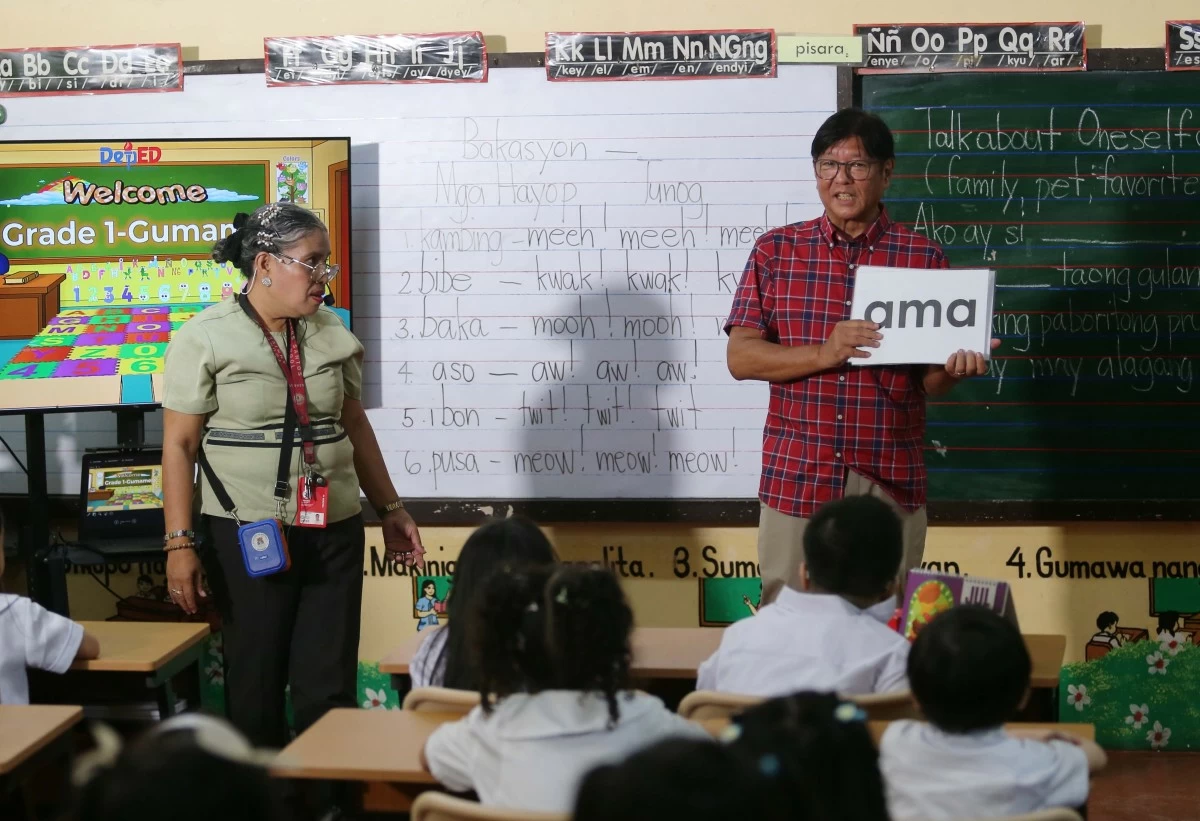
President Ferdinand 'Bongbong' Marcos Jr. interacts with Grade 1 students at Epifanio Delos Santos Elementary School in Malate, Manila, on the first day of classes for the 2025–2026 school year, on June 16, 2025. (File/Mark Balmores/MANILA BULLETIN)
Education emerged as a central pillar of President Marcos’ governance in 2025, with reforms ranging from expanded access to higher education to long-delayed promotions for public school teachers finally moving forward.
In its yearend report, the Presidential Communications Office (PCO) said the administration pursued a comprehensive education agenda this year aimed at improving learning outcomes, easing the burden on students and families, and strengthening the teaching workforce that sustains the public school system.
At the policy level, President Marcos signed into law the Expanded Tertiary Education Equivalency and Accreditation Program (ETEEAP) Act, allowing working professionals to earn college degrees through the recognition of prior learning and work experience.
The measure, long pushed by education advocates, opened new pathways for Filipinos who had acquired skills outside the traditional classroom but lacked formal credentials.
The administration also ramped up the delivery of laptops, digital learning tools, and satellite internet connectivity to public schools, particularly those in underserved and remote areas, as part of efforts to narrow the digital divide.
The PCO said these interventions empowered both learners and teachers, especially as schools continue to integrate technology into classroom instruction.
Reforms in basic education were likewise prioritized, including the fine-tuning of the K–12 curriculum, the signing of the Early Childhood Care and Development System Act, and the creation of thousands of new teaching posts nationwide.
The President also ordered stronger support for teachers’ welfare and professional growth, alongside the expansion of the Unified Student Financial Assistance System for Tertiary Education (UniFAST) to reach more deserving college students.
Measures to ease the daily burden on learners and their families were also rolled out, including transport discounts that helped reduce commuting costs for students.
While these initiatives addressed access and infrastructure, one of the most concrete outcomes of the administration’s education push this year came from inside the system itself.
More than 16,000 public school teachers were promoted after years of backlog, a development that civic leader and Palace ally Dr. Jose Antonio Goitia described as the result of coordinated leadership under President Marcos.
“This did not occur by accident. It required executive clarity and the political will to address inefficiencies that had been allowed to linger for far too long,” he said.
Teacher promotion backlogs had persisted for years, slowed by structural and administrative constraints that were often acknowledged but rarely resolved.
According to Goitia, the breakthrough reflected a whole-of-executive approach, with Department of Education (DepED) Secretary Sonny Angara translating national priorities into operational results through coordination on funding, plantilla management, and personnel approvals.
“This is what functional governance looks like. When the President sets the direction, and Cabinet members execute with discipline, long-standing problems finally move,” Goitia said.
Beyond salary increases and rank adjustments, the promotions restored morale and professional dignity among educators, reinforcing their role as the backbone of the public education system.
“You cannot speak seriously about education reform while neglecting the people who deliver it,” Goitia said.
“By acting on teacher promotions, the Marcos administration is strengthening education from the inside out,” he added.
He noted that while the decision may not generate sustained headlines, its impact will be felt daily in classrooms across the country.
“Good governance is not always loud. Sometimes, it simply works. And when it does, the results endure,” Goitia said.