

ADVERTISEMENT

A review of 'Avatar: Fire and Ash'

Published Dec 24, 2025 11:56 pm
Three movies into the planned pentalogy, and the energy of the Avatar movie universe has yet to fade. Writer-director James Cameron’s love and passion for Pandora and its various inhabitants is contagious and shows through in every shot of the over three-hour-long film.

Varang (Oona Chaplin) in 20th Century Studios' AVATAR: FIRE AND ASH. Photo courtesy of 20th Century Studios. © 2025 20th Century Studios. All Rights Reserved.
Jake Sully, (Sam Worthington), our human turned Na’vi hero from the first two films, is living with his family with the Menkayina. Taking place mere weeks after the events of Way of Water, we see them still recovering from the last battle and from the death of Neteyam, Jake’s firstborn with his Na’vi wife Neytiri (Zoe Saldaña). Things have been strained, to say the least, and their victory, short-lived as it is, is still being tested by the Resource Development Authority, the paramilitary force on Pandora that makes a profit at any cost. And to top it off, its security head, Miles Quaritch (Stephen Lang), is looking to settle a personal vendetta with Jake.
It’s been sixteen long years since we first visited Pandora, Cameron’s vision of a paradise in space, and its lush jungles, as well as its azure oceans, have never looked better. It's clear that the little moon orbiting a gas giant in the Alpha Centauri system has much more to see and be discovered.

Jake Sully (Sam Worthington) in 20th Century Studios' AVATAR: FIRE AND ASH. Photo courtesy of 20th Century Studios. © 2025 20th Century Studios. All Rights Reserved.
The first time we visited Pandora, we discovered and fell in love with the Na’vi and their deity, Eywa, the All-Mother. In Avatar: The Way of Water, back in 2002, we were first introduced to the Menkayina, an oceanic clan. They live among Pandora’s reefs and shores, deeply connected to the seas and their wildlife. And so did we, as we came to know and grew protective of the intelligent and gentle whale-like creatures, the Tulkun. In the latest installment to the billion-dollar franchise, we meet the Mangkwan, or the Ash People, raiders who live by pillaging other clans and who serve as the movie’s new baddies. These Ash People reject Eywa and her ways, harboring deep resentment and disdain for her followers.
Also new to the screen are the Tlalim Windtraders, a nomadic tribe that travels through the air, bringing news and goods for trade from clan to clan.
At three hours and seventeen minutes, not a second seemed to drag or feel placed as fluff or padding. The story, while not exactly unpredictable or full of twists, is tight and flows smoothly, so much so that you don’t notice the three hours have passed at all. There is enough depth of emotion to cut through the spectacle and keep you engrossed, more so than Way of Water.
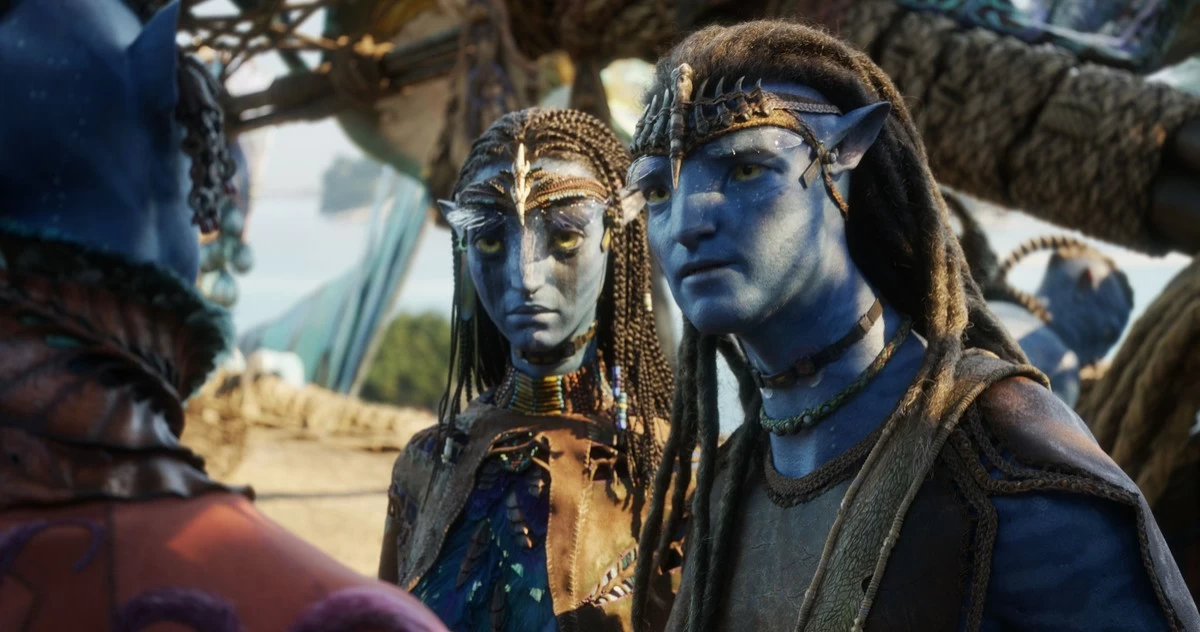
(L-R) Peylak (David Thewlis), Neytiri (Zoe Saldaña) and Jake Sully (Sam Worthington) in 20th Century Studios' AVATAR: FIRE AND ASH. Photo courtesy of 20th Century Studios. © 2025 20th Century Studios. All Rights Reserved.
Cameron is unapologetically large in his creation of the Avatar world, and this carries over well into this third film. Everything is huge and deep and epic by design; everything is experiential by intention, which makes it the perfect movie to watch on 3D IMAX screens.
Clearly, this approach works. Not only has it created a strong, solid fanbase and wowed critics, but it also proved its worth where it counts: The box office. The first and second movies are ranked first and third on the highest-grossing film of all time list, and Fire and Ash is set to join its easily brethren.
If anything, the only minor blemish would be the switch in frame rate. We saw this in the second film, where some scenes were presented at 24 frames per second, and others at 48, which technically delivers a smoother image, especially in 3D.

The drawback is that it's a jarring change when you notice it, and characters and objects on the screen seem to lose a sense of weight.
Cameron has said in interviews that the fate of the remaining two movies depends on how Fire and Ash perform at the box office. After watching this latest installment, I do not doubt that parts four and five will be released soon.
ADVERTISEMENT
.most-popular .layout-ratio{ padding-bottom: 79.13%; } @media (min-width: 768px) and (max-width: 1024px) { .widget-title { font-size: 15px !important; } }

{{ articles_filter_1561_widget.title }}

.most-popular .layout-ratio{ padding-bottom: 79.13%; } @media (min-width: 768px) and (max-width: 1024px) { .widget-title { font-size: 15px !important; } }

{{ articles_filter_1562_widget.title }}

.most-popular .layout-ratio{ padding-bottom: 79.13%; } @media (min-width: 768px) and (max-width: 1024px) { .widget-title { font-size: 15px !important; } }

{{ articles_filter_1563_widget.title }}

{{ articles_filter_1564_widget.title }}

.mb-article-details { position: relative; } .mb-article-details .article-body-preview, .mb-article-details .article-body-summary{ font-size: 17px; line-height: 30px; font-family: "Libre Caslon Text", serif; color: #000; } .mb-article-details .article-body-preview iframe , .mb-article-details .article-body-summary iframe{ width: 100%; margin: auto; } .read-more-background { background: linear-gradient(180deg, color(display-p3 1.000 1.000 1.000 / 0) 13.75%, color(display-p3 1.000 1.000 1.000 / 0.8) 30.79%, color(display-p3 1.000 1.000 1.000) 72.5%); position: absolute; height: 200px; width: 100%; bottom: 0; display: flex; justify-content: center; align-items: center; padding: 0; } .read-more-background a{ color: #000; } .read-more-btn { padding: 17px 45px; font-family: Inter; font-weight: 700; font-size: 18px; line-height: 16px; text-align: center; vertical-align: middle; border: 1px solid black; background-color: white; } .hidden { display: none; }
function initializeAllSwipers() { // Get all hidden inputs with cms_article_id document.querySelectorAll('[id^="cms_article_id_"]').forEach(function (input) { const cmsArticleId = input.value; const articleSelector = '#article-' + cmsArticleId + ' .body_images'; const swiperElement = document.querySelector(articleSelector); if (swiperElement && !swiperElement.classList.contains('swiper-initialized')) { new Swiper(articleSelector, { loop: true, pagination: false, navigation: { nextEl: '#article-' + cmsArticleId + ' .swiper-button-next', prevEl: '#article-' + cmsArticleId + ' .swiper-button-prev', }, }); } }); } setTimeout(initializeAllSwipers, 3000); const intersectionObserver = new IntersectionObserver( (entries) => { entries.forEach((entry) => { if (entry.isIntersecting) { const newUrl = entry.target.getAttribute("data-url"); if (newUrl) { history.pushState(null, null, newUrl); let article = entry.target; // Extract metadata const author = article.querySelector('.author-section').textContent.replace('By', '').trim(); const section = article.querySelector('.section-info ').textContent.replace(' ', ' '); const title = article.querySelector('.article-title h1').textContent; // Parse URL for Chartbeat path format const parsedUrl = new URL(newUrl, window.location.origin); const cleanUrl = parsedUrl.host + parsedUrl.pathname; // Update Chartbeat configuration if (typeof window._sf_async_config !== 'undefined') { window._sf_async_config.path = cleanUrl; window._sf_async_config.sections = section; window._sf_async_config.authors = author; } // Track virtual page view with Chartbeat if (typeof pSUPERFLY !== 'undefined' && typeof pSUPERFLY.virtualPage === 'function') { try { pSUPERFLY.virtualPage({ path: cleanUrl, title: title, sections: section, authors: author }); } catch (error) { console.error('ping error', error); } } // Optional: Update document title if (title && title !== document.title) { document.title = title; } } } }); }, { threshold: 0.1 } ); function showArticleBody(button) { const article = button.closest("article"); const summary = article.querySelector(".article-body-summary"); const body = article.querySelector(".article-body-preview"); const readMoreSection = article.querySelector(".read-more-background"); // Hide summary and read-more section summary.style.display = "none"; readMoreSection.style.display = "none"; // Show the full article body body.classList.remove("hidden"); } document.addEventListener("DOMContentLoaded", () => { let loadCount = 0; // Track how many times articles are loaded const offset = [1, 2, 3, 4, 5, 6, 7, 8, 9, 10]; // Offset values const currentUrl = window.location.pathname.substring(1); let isLoading = false; // Prevent multiple calls if (!currentUrl) { console.log("Current URL is invalid."); return; } const sentinel = document.getElementById("load-more-sentinel"); if (!sentinel) { console.log("Sentinel element not found."); return; } function isSentinelVisible() { const rect = sentinel.getBoundingClientRect(); return ( rect.top < window.innerHeight && rect.bottom >= 0 ); } function onScroll() { if (isLoading) return; if (isSentinelVisible()) { if (loadCount >= offset.length) { console.log("Maximum load attempts reached."); window.removeEventListener("scroll", onScroll); return; } isLoading = true; const currentOffset = offset[loadCount]; window.loadMoreItems().then(() => { let article = document.querySelector('#widget_1690 > div:nth-last-of-type(2) article'); intersectionObserver.observe(article) loadCount++; }).catch(error => { console.error("Error loading more items:", error); }).finally(() => { isLoading = false; }); } } window.addEventListener("scroll", onScroll); });

Sign up by email to receive news.