







DPWH subproject in Mati City scrutinized over apparent scale
By Ivy Tejano
Published Dec 23, 2025 03:48 pm


DAVAO CITY – A government-funded structure costing P931,787.09 has drawn scrutiny after the Department of Public Works and Highways' records and progress photos suggested a stark mismatch between the amount spent and the structure’s apparent scale.
The allocation was one of five subprojects under Contract ID 25LG0048, a DPWH-funded project titled “Construction of Multi-Purpose Building, Package 2” in Mati City, with a total contract cost of P7,855,100.15, as per data from the DPWH Transparency Portal.
While the overall project is nearing completion, attention has focused on the nearly P1-million sub-allocation after DPWH-uploaded images showed a small, open-sided structure with wooden posts and railings topped by a simple metal roof. The structure appears closer in size and form to a roadside kiosk or waiting shed than to a conventional multi-purpose building.
Construction benchmarks indicate that similar structures typically cost far less. Industry estimates place the cost of a basic kiosk or waiting shed – using wood or light steel framing, open sides, and metal roofing – at around P150,000 to P350,000.
Even a small barangay multipurpose shed with concrete footings, steel framing, and basic electrical work typically falls within the range of P400,000 to P700,000.
Against these estimates, the P931,787.09 price tag stands out unless it includes major non-visible components such as extensive foundations, site development, drainage systems, utility installations, or specialized technical specifications not evident in the publicly posted photos.
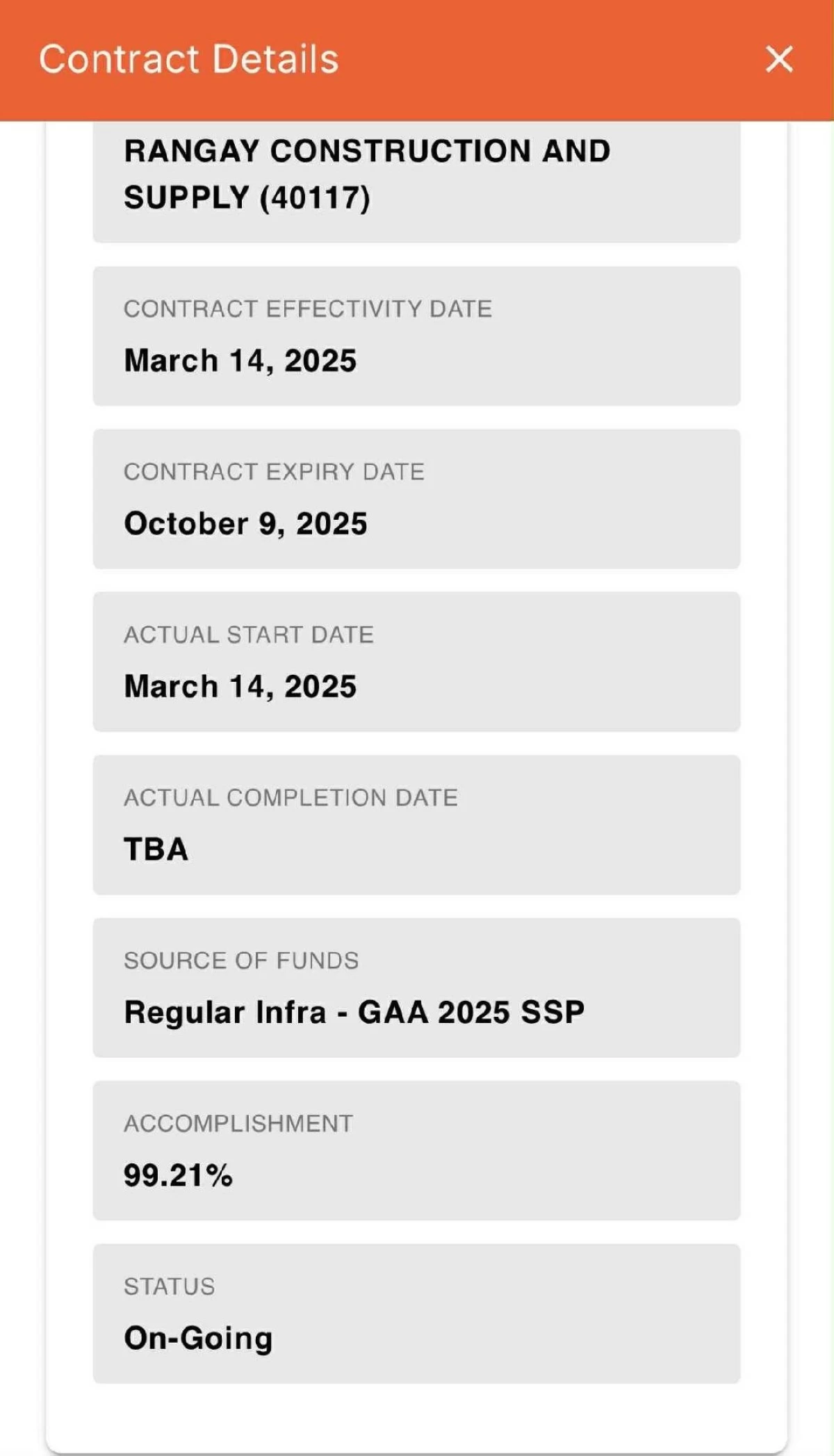
DPWH records showed that the project was awarded to Rangay Construction and Supply and implemented by the DPWH Davao Oriental Second District Engineering Office, with funding sourced from the 2025 General Appropriations Act under Regular Infrastructure-Special Support Program.
However, as of posting time, the DPWH Transparency Portal does not display an itemized bill of quantities (BOQ) or detailed technical plans for the P931,787.09 subproject. The absence of these documents makes it difficult for the public to independently assess how the cost was calculated.
The overall contract is listed as 99.21 percent complete but remains officially tagged as “ongoing,” with the actual completion date still marked as “to be announced.”
No finding of wrongdoing has been made. Infrastructure observers note that the case highlights a recurring issue in public works projects, where limited disclosure of technical details can raise questions even in the absence of proven irregularities.
With increased national attention on infrastructure spending and project pricing, critics argue that the proactive release of plans, BOQs, and detailed scopes of work is essential not only to address public concerns but also to protect implementing agencies and contractors from suspicion.
For now, the P931,787.09 structure has become a focal point for questions on transparency, underscoring how gaps in documentation can invite scrutiny in publicly funded projects.