






Manila Bulletin
 Philippines
National
The 'pick-up fare' and why LTFRB allowed TNVS to collect it from passengers starting Dec. 20
Philippines
National
The 'pick-up fare' and why LTFRB allowed TNVS to collect it from passengers starting Dec. 20
Philippines
National
The 'pick-up fare' and why LTFRB allowed TNVS to collect it from passengers starting Dec. 20
The 'pick-up fare' and why LTFRB allowed TNVS to collect it from passengers starting Dec. 20
Published Dec 18, 2025 12:27 pm


At A Glance
- The LTFRB Memorandum Circular 2025-058 allows Transport Network Vehicle Service (TNVS) the authority to charge their passengers from the moment the booking is accepted up to the time the pick-up location is reached.
- The pick-up fare is fixed, ranging from P28 to P289 depending on the distance of the TNVS to the location of the passengers and the type of vehicle that would be used.
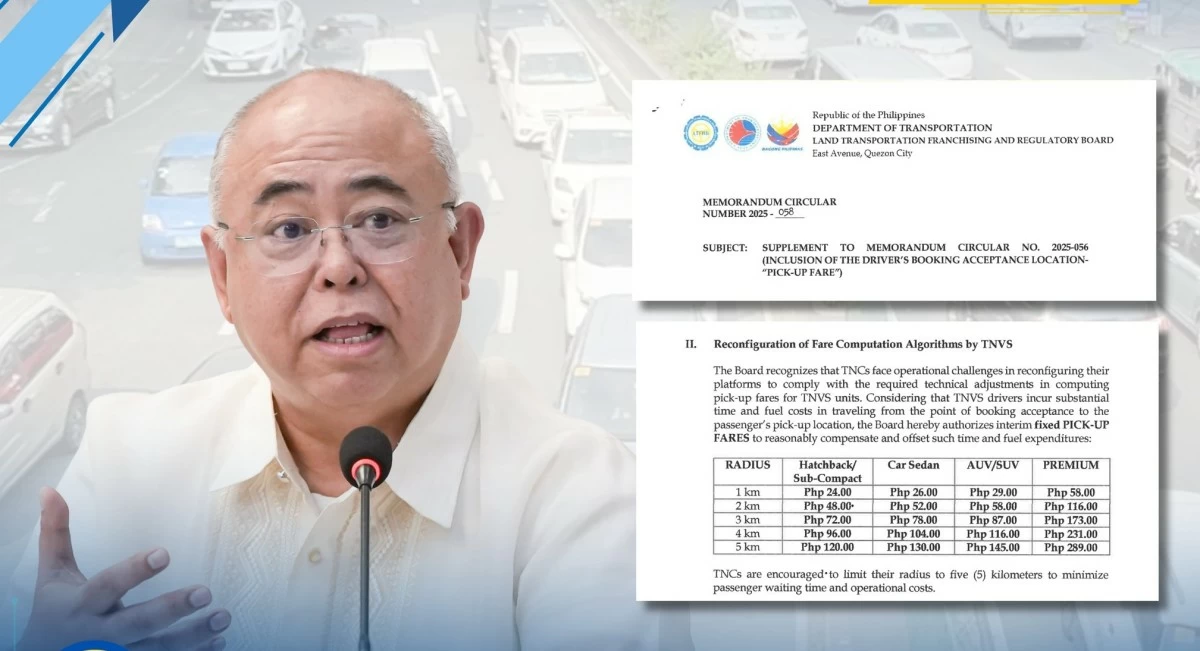
The Land Transportation Franchising and Regulatory Board (LTFRB) has given ride-hailing service drivers a go-signal to collect additional fare while the vehicles are on their way to pick up the passengers from their locations, the implementation will start on Saturday, Dec. 20.
Referred to as “pick-up fare” in the LTFRB Memorandum Circular 2025-058, the document allows Transport Network Vehicle Service (TNVS) the authority to charge their passengers from the moment the booking is accepted up to the time the pick-up location is reached.
The fixed pick-up fare—ranging from P28 for subcompact to P289 for premium TNVS—is on top of what the passengers should pay from the pick-up point to the destination.
But LTFRB chairman Vigor D. Mendoza II said the pick-up fare is fixed and varies from the distance of the TNVS to the passengers and the type of vehicles that will be used for the ride-hailing services.
The maximum distance that the TNVS could charge their client is within five kilometers.
For instance a sub-compact TNVS could charge a pick-up fare of P28 if the passenger to be picked up is within the one-kilometer radius and a maximum of P120 if within the five-kilometer radius.
Car and sedan-type TNVS could collect from P26 to P130; AUV/SUV from P29 to P145 and Premium TNVS from P58 to P289.
The LTFRB is expected to release the fixed fare-system for every kilometer and for all types of TNVS.
Middle ground
Last week, the LTFRB issued a memorandum circular that put a limit, or a cap to the surge pricing in the TNVS amid complaints from the passengers of the government’s alleged helplessness in protecting them during holidays and peak hours.
Under the LTFRB Memorandum Circular 2025-056, the surge pricing must not exceed the B+C TNVS Fare Matrix—the B refers to the per kilometer per rate while the C refers to the per minute charge of the TNVS.
Currently, the hatchback and sub-compact has a flagdown rate of P35, sedan with P45, AUV with P55 and Premium with P145 flagdown rate. The per kilometer rate for hatchback and sub-compact is P13, sedan with P15, AUV with P18 and Premium with P36 per kilometer charge.
All of them have P2 per minute travel time except for premium with P4.
But the memo was met with criticisms from TNVS drivers who argued that the additional payment they collect from surge pricing compensate for the gasoline and time they spend in traffic gridlocks during rush hours and the Holiday season.
Win-Win solution
Mendoza said the Memorandum Circular on pick-up fare will be implemented starting Dec. 20, the same day that the LTFRB memo that reduced the surge pricing cap is implemented. Both the memos will be in effect until Jan. 4 next year.
“We understand the concerns raised by the TNVS drivers and the arguments they raised are backed by studies on travel time especially in Metro Manila. That is why we are implementing this measure as an acceptable and justified solution to balance the impact of the price surging reduction by 50% to the TNVS community,” said Mendoza.
Citing studies, Chairperson Mendoza said operational data show that TNVS drivers often spend significant time in fuel traveling from their acceptance point to passenger pickup locations.
In the memo, the LTFRB cited the Metropolitan Manila Development Authority report which states that the average vehicle speed on EDSA drops to one kilometer per hour from the usual 17 to 20 KPH, or approximately five minutes per kilometer.
Another sturdy cited was the April 2024 Report of the Congressional Policy and Budget Research Department of the House of Representatives, which stated that the average travel time in Metro Manila is 25 minutes and 30 seconds per 10 kilometers, worsening to 28 minutes during the morning rush hour and 34 minutes during the evening rush hour.
“The pick-up fare system is really aimed at aligning fare computation with actual service costs, promote equitable compensation for TNVS drivers, and ensure availability of rides across all areas,” said Mendoza.
Hands off
In the memo that reduced the surge pricing by 50 percent, the LTFRB barred Transport Network Companies (TNCs) from getting a commission from the reduced surge pricing.
In the memo for the pick-up fare system, the agency also implemented the same in order to maximize the earnings of TNVS drivers.
“This is proof that we are sensitive to issues and concerns being raised by various sectors concerned. We understand the concerns of all stakeholders, that is why we do not rest in finding ways to come up with solutions acceptable to everybody,” said Mendoza.