







PIDS backs lifetime validity for PWD IDs
Published Dec 15, 2025 12:00 am
|
Updated Dec 13, 2025 03:36 pm


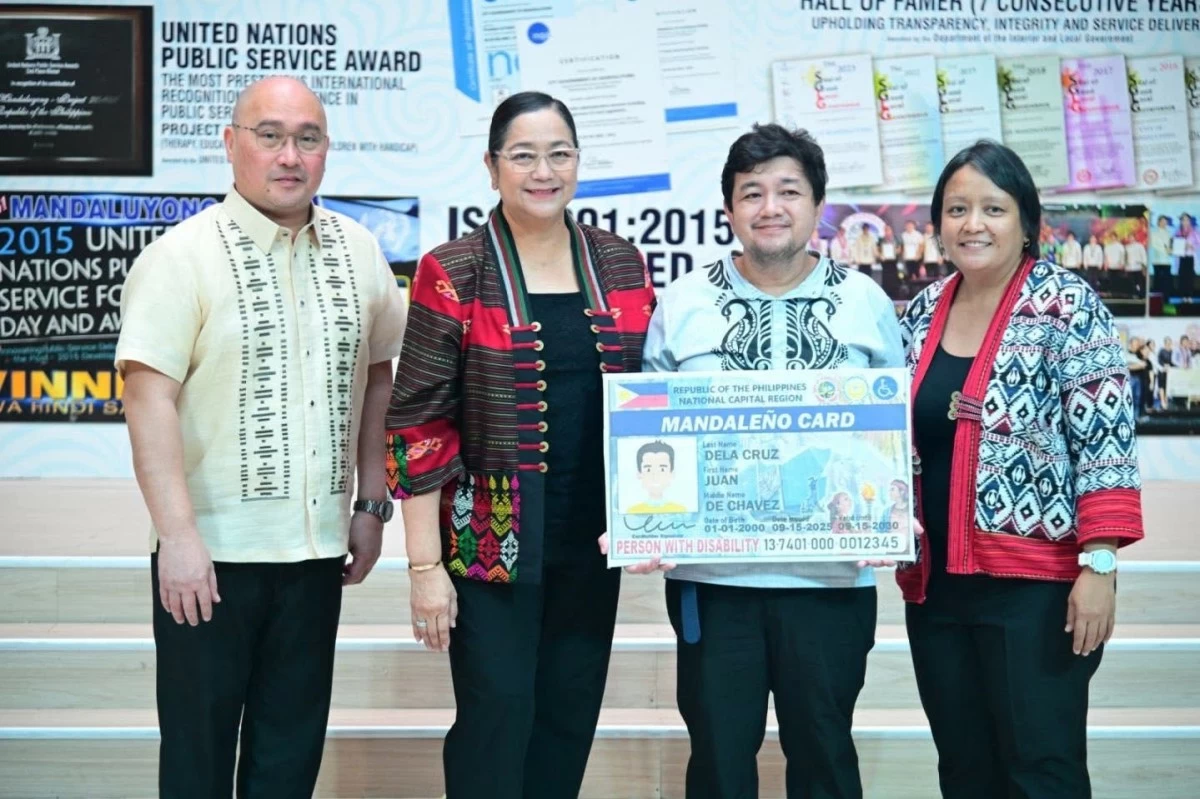
Mandaluyong City Mayor Menchie Abalos and city officials proudly present the city's latest version of its PWD ID. (Photo from Mandaluyong PIO)
State-run policy think tank Philippine Institute for Development Studies (PIDS) is backing the proposal to grant lifetime validity to ID cards for persons with permanent disabilities (PWDs), saying the reform finally addresses a long-standing and legitimate need.
In a Dec. 5 position paper, PIDS senior research fellow Jose Ramon G. Albert emphasized that the measure aligns with efforts to ease bureaucratic burdens for Filipinos with long-term disabilities and ensure they receive services with greater dignity and consistency, adding that “many PWDs and their families experience repeated inconvenience in renewing IDs despite conditions that are irreversible.”
The position paper noted that Albert himself “has permanent mobility difficulties having survived colorectal cancer twice and is thus considered a PWD.”
PIDS stressed that the law should balance ease of access with accuracy and program integrity, noting that disability definitions can be broad and that PWD IDs have at times been issued for temporary or reversible conditions.
“A key refinement needed in the proposed measure is a clear differentiation between permanent and temporary disabilities,” the think tank said.
“Extending lifetime validity without proper safeguards may worsen errors of inclusion and undermine the credibility of disability support systems,” it warned.
The think tank said that creating a more compassionate and efficient disability ID system requires carefully balancing administrative simplicity with medical complexity.
While the proposal to grant lifetime validity to PWD identification cards is welcomed, PIDS emphasized that it must be backed by clear definitions, standardized certification procedures, and robust registry management.
“These safeguards ensure that lifetime validity enhances—not weakens—the integrity and accuracy of disability support systems,” the think tank said. “Coupled with interoperable databases and strong accountability mechanisms, the measure can substantially improve how the state supports Filipinos with permanent disabilities while maintaining fairness, transparency, and fundamental respect for individual medical diversity.”
PIDS explained that some disabilities—such as severe mobility impairments, congenital physical or sensory disabilities, long-term neurological conditions, and cases where cancer or rare diseases result in lasting functional limitations—are lifelong. For individuals with these conditions, the think tank said lifetime PWD ID validity would be beneficial, as repeated renewals offer little administrative value and create unnecessary burdens.
Other disabilities, the think tank noted, can be temporary or treatable. Those recovering from injuries such as fractures, surgery, or short-term mental health episodes could see their status change, making lifetime PWD IDs risky and potentially leading to inaccurate records and misuse of benefits.
“Given these distinctions, a standardized medical certification framework should accompany the proposed reforms. Such a framework should rely not only on diagnosis but also on functional assessments consistent with international standards, such as the World Health Organization’s (WHO) international classification of functioning, disability, and health (ICF). Medical professionals issuing certifications should be accredited, and certification protocols should be uniform across local government units (LGUs),” PIDS said.
The think tank further emphasized that even with lifetime PWD IDs for permanent disabilities, “the underlying registry must remain current.” It added that while IDs would not need renewal, information such as addresses, contact details, or support needs should be reviewed every five to seven years. This would ensure accurate records for government planning and budgeting without placing undue burden on PWDs.
“Interoperability with other government systems is essential,” PIDS noted, adding that linking the PWD registry with the Philippine identification system (PhilSys), the Department of Social Welfare and Development’s (DSWD) national household targeting system for poverty reduction or Listahanan, state-run Philippine Health Insurance Corp. (PhilHealth), LGUs, local health units (LHUs), and the Department of Health’s (DOH) chronic illness registries would improve service delivery, verify eligibility for benefits, and reduce duplication across agencies.