







The enigma that is Benoit Blanc
Published Dec 13, 2025 11:58 am


At A Glance
- In some ways, Blanc is like a movie star. He shows up, dazzles and goes home to his largely unseen private life.
NEW YORK (AP) — The greatest mystery in Rian Johnson’s “Knives Out” movies might be Benoit Blanc.
Over the course of three films, Johnson and Daniel Craig have stingily dropped clues to Blanc’s past and personal life. Since Blanc first introduced himself in “Knives Out” as “a respectful, quiet, passive observer … of the truth,” following the breadcrumbs has been a sport of its own.
There are, for instance, the vague, offhand references to cases he’s cracked before: something with a tennis champion, another with a ballet dancer and, in the latest chapter, “Wake Up Dead Man: A Knives Out Mystery,” we hear about something dastardly at the Kentucky Derby that he solved.
Blanc has been profiled in The New Yorker and a guest on “The View.” He appears to live with Hugh Grant. He dislikes the board game Clue. Having been caught singing Sondheim and, in the new one, humming “Skimbleshanks: The Railway Cat,” from “Cats,” we know he loves musical theater.
Over the course of the “Knives Out” trilogy, Johnson and Craig have colored in Blanc with sporadic and comic revelations, adding subtle, and sometimes personal, characteristics.
“I’m not as much into musical theater as Rian,” Craig says, sitting beside his director in a recent interview.
“So he claims in front of a microphone,” adds Johnson.
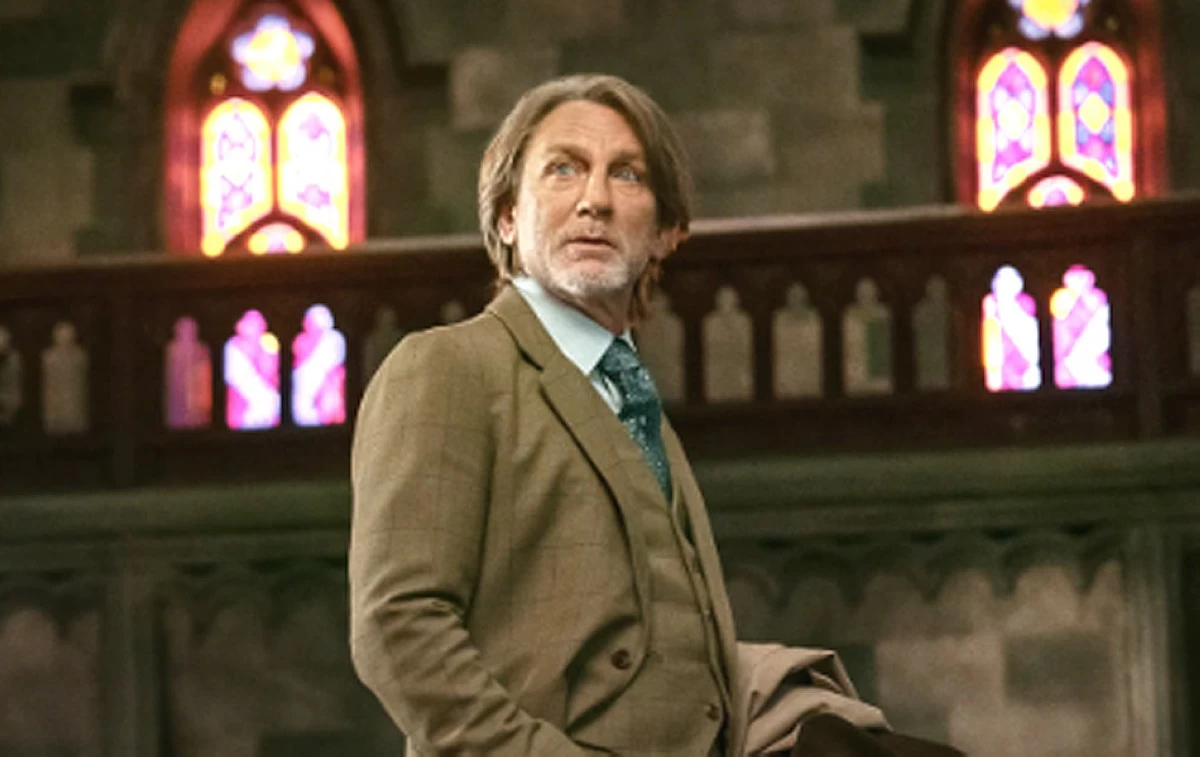
Every “Knives Out” movie is wholesale change. New setting. New case. New cast of characters. But Craig and Johnson are the mainstays. Together, they’ve turned Blanc, the last of the gentleman sleuths, into one of the greatest — “Halle Berry!” — protagonists in recent movies.
In “Wake Up Dead Man,” which opens in theaters soon, Blanc takes up the case of a monsignor (Josh Brolin) who dies mysteriously in the middle of a church service.
Of the movie’s many delights — among them, Josh O’Connor’s co-leading performance as a priest under suspicion and a cast of parishioners including Andrew Scott, Jeremy Renner and Glenn Close — is seeing Craig continue to find new little wrinkles to Blanc.
‘A Southern lilt’
Rather than being set in stone, Blanc has evolved. Take that accent. The first script, Johnson recalls, described “the slightest hint of a Southern lilt.” But Craig, taking inspiration from Tennessee Williams and Shelby Foote, pushed the accent closer to, as Chris Evans’ character says in “Knives Out”: a “Kentucky-fried Foghorn Leghorn drawl.” In “Glass Onion,” he laid it on even thicker, part of a scheme revealed only later into the film.
“My biggest fear was that it would devolve,” Craig says, chuckling. “If it ever becomes pastiche, it’s like, ‘Whoa, let’s get out of here.’ God knows I’m not comparing myself to Gene Wilder, but the way Gene Wilder did comedy was: It’s all through truth. As long as you’re as truthful as you can get in that situation, the funny comes out.”
‘Halle Berry!’
In forming the role, Craig took inspiration from Jacques Tati’s debonair but bumbling Monsieur Hulot and Cary Grant’s elegant panache in “To Catch a Thief.” He combed through out-of-print books of Southern expressions. (One that got cut: “Butter my buns and call me a biscuit.”)
Along the way, Craig has improvised some of Blanc’s best expressions. In “Wake Up Dead Man,” he suddenly blurts out, as if moved by the swelling whodunit hijinks: “Scooby Dooby Doo!” A sip of Jeremy Renner-sponsored hot sauce in “Glass Onion” led to the infamous “Halle Berry!”
“All of the best lines in there are things Daniel just brings,” says Johnson. “He says, ‘What about this?’ and I start laughing. And it’s the best line in the movie.”
“I have a security team and there’s a guy that says it,” Craig says of the etymology of “Halle Berry.” “I stole it. I said, ‘Can I have that?’ and he said ‘Yep.’”
For Craig and Johnson, Blanc has been an ongoing conversation. “Wake Up Dead Man,” the most sincere of the three mysteries, deals significantly with matters of faith and religion. The two worked to sharpen Blanc’s perspective. In the film, he declares himself “a proud heretic. I kneel at the altar of the rational.”
Then there are the ornate flourishes of dialogue Johnson pens for Blanc. Modeled on Agatha Christie’s Hercule Poirot, Blanc is the knowing product of a rich literary tradition, dusted off for modern times. In contemporary satires, Blanc is the retro lynchpin.
That means Craig delivering lines like “I suspect foul play” silhouetted against a fireplace, and vowing to uncover “what this flock of wicked wolves is hiding” while framed in a stained-glass window.
“Delicious,” Craig says with a grin.
A franchise of their own
It’s ironic that, on the heels of their own experiences with iconic film series, Johnson and Craig have built a franchise all their own. Johnson released “Knives Out” two years after the much-debated “Star Wars: The Last Jedi.” As he exited the James Bond films, Craig donned the suit of another justice-seeker, albeit one with much different swimwear.
“I don’t think either of us really thought about it that way,” Johnson says. “It’s just been making one movie after another, just trying to keep it challenging and fresh for ourselves. It feels almost accidental that suddenly we’ve made three. It definitely wasn’t setting out to build, God forbid, the filthiest word in the universe, IP. We’re just trying to make movies.”
“I’ve been doing this for long enough that as soon as you start counting your chickens on a job, it’s all over,” adds Craig.
Yet it’s now possible, especially as the two contemplate a fourth “Knives Out” film, that there are young moviegoers who know Craig more as Benoit Blanc than they do that other B-name. If Johnson and Craig do keep “Knives Out” going, even as a two-film deal with Netflix concludes, it will allow Johnson the chance to restock his whodunit cupboard. But it will just as surely offer the opportunity to relaunch, and play with, Blanc.
“I really love, in my mystery detectives, for them to be kind of enigmas. It pointedly doesn’t work when you start digging into backstory with the detective,” says Johnson. “That’s always kind of boring because character is only revealed through action and the action of a detective is such a strong thing. He’s there to solve the case.”
In some ways, Blanc is like a movie star. He shows up, dazzles and goes home to his largely unseen private life. Craig likes it that way.