






Manila Bulletin
 Philippines
National
DND hits China's radar lock on Japanese aircraft: 'Unsafe, escalatory, reckless'
Philippines
National
DND hits China's radar lock on Japanese aircraft: 'Unsafe, escalatory, reckless'
Philippines
National
DND hits China's radar lock on Japanese aircraft: 'Unsafe, escalatory, reckless'
DND hits China's radar lock on Japanese aircraft: 'Unsafe, escalatory, reckless'
Published Dec 13, 2025 08:40 am
|
Updated Dec 13, 2025 01:05 pm


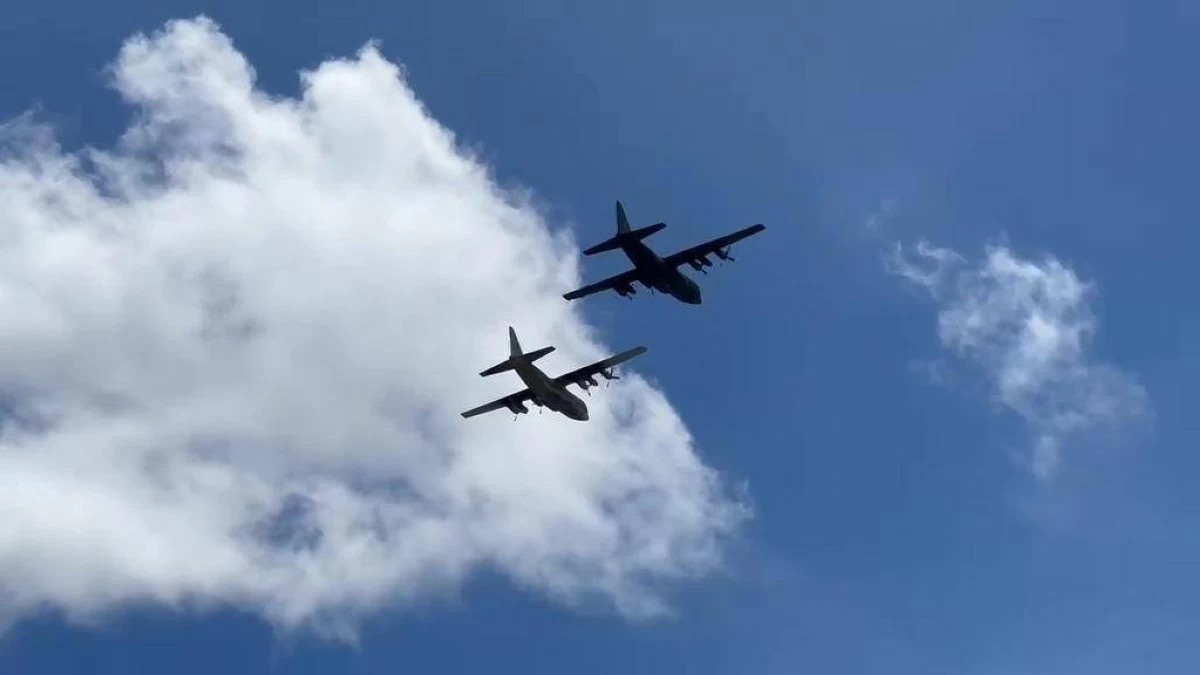
Philippine Air Force (PAF) and Japan Air Self-Defense Force (JASDF) C-130 aircraft conduct a joint flight following a bilateral air drop in Tacloban City on Oct. 9, 2025 as part of the Doshin-Bayanihan 5-25 Exercise. (Photo: PAF)
The Department of National Defense (DND) on Friday, Dec. 12, voiced serious concern over China’s repeated radar illumination targeting Japan Air Self-Defense Force (JASDF) aircraft while they were flying over international waters near Okinawa Prefecture.
According to the Japanese Embassy in the Philippines, the first incident occurred between 4:32 p.m. and 4:35 p.m. on Dec. 6 when J-15 fighter aircraft launched from the Chinese Navy aircraft carrier “Liaoning” intermittently directed radar at JASDF F-15 fighters.
The Japanese aircraft were conducting airspace intrusion countermeasures at the time.
A second incident followed between 6:37 p.m. and 7:08 p.m. on the same day involving another J-15 from the Liaoning that again illuminated a separate JASDF F-15 with radar in the same area.
The DND, in a statement, said the latest “unsafe and escalatory actions” highlighted a continuing pattern of “reckless behavior” by China that endangers regional stability and undermines long-standing international norms governing air and maritime operations.
“China’s latest unsafe and escalatory actions underscore a pattern of reckless behavior that threatens regional stability, undermines established norms, and threatens states conducting lawful and responsible operations,” it said.
It stressed that illuminating military aircraft with fire-control radar in international airspace is a dangerous act that increases the risk of miscalculation and unintended confrontation.
“This dangerous act has no place in international airspace and underscores the urgency of upholding the rules-based order that keeps the Indo-Pacific stable,” the DND noted.
“The Philippines stands with Japan and all like-minded partners who choose transparency, restraint, and adherence to international law over intimidation and provocation,” it added.
Last Dec. 9, the Armed Forces of the Philippines (AFP) confirmed it had monitored two separate Chinese naval formations operating near the eastern seaboard of Luzon amid rising tensions between China and Japan.
AFP spokesperson for West Philippine Sea (WPS) Rear Adm. Roy Vincent Trinidad said the Liaoning aircraft carrier group was detected northeast of Luzon near Okinawa while a separate amphibious assault ship group sailed south toward Palau and Australia days later.
The two formations were operating independently outside the country’s 200-nautical-mile exclusive economic zone (EEZ) but remained within AFP’s monitoring range.
Tension between Japan and China escalated after Tokyo publicly suggested that a Chinese military move against Taiwan could be considered a “survival-threatening situation” for Japan, opening the door for a potential Japanese military involvement.
Beijing viewed this as a direct challenge as China considers the self-governing Taiwan as part of its core territory that is subject to “reunification.”
Rocket launch
Meanwhile, the Philippine Navy (PN) has placed its units on heightened alert after China confirmed the launch of its Long March 12 rocket with an expected debris drop zone identified within Philippine waters.
The Philippine Space Agency (PhilSA) said the Long March 12 rocket was launched from the Hainan International Commercial Launch Center in Wenchang, Hainan, at around 7:00 a.m. (PST) on Dec. 12.
The possible debris drop zones were located about 23 nautical miles from Puerto Princesa City and around 21 nautical miles from the Tubbataha Reefs Natural Park.
Captain Marissa Martinez, PN spokesperson, said the Western Naval Command (WNC) has taken precautionary measures to ensure maritime safety including close monitoring, coordination with partner agencies, and the readiness of naval surface and air assets for the retrieval of possible rocket debris.
She said no casualties or damage have been reported so far within its area of operations. However, residents in Puerto Princesa City reported hearing a loud explosion-like sound during the rocket launch. Monitoring stations near Tubbataha Reef also reported no unusual sightings.
Martinez said maritime and aerial surveillance will continue during the post-launch phase as authorities remain on heightened alert to protect coastal and maritime communities.
The PN urged the public to avoid touching any suspected debris as it may contain harmful chemicals. It advised the public to immediately report sightings of possible debris to local authorities.