ADVERTISEMENT

Marcos wants standard design for ports around PH

Published Dec 12, 2025 02:53 pm
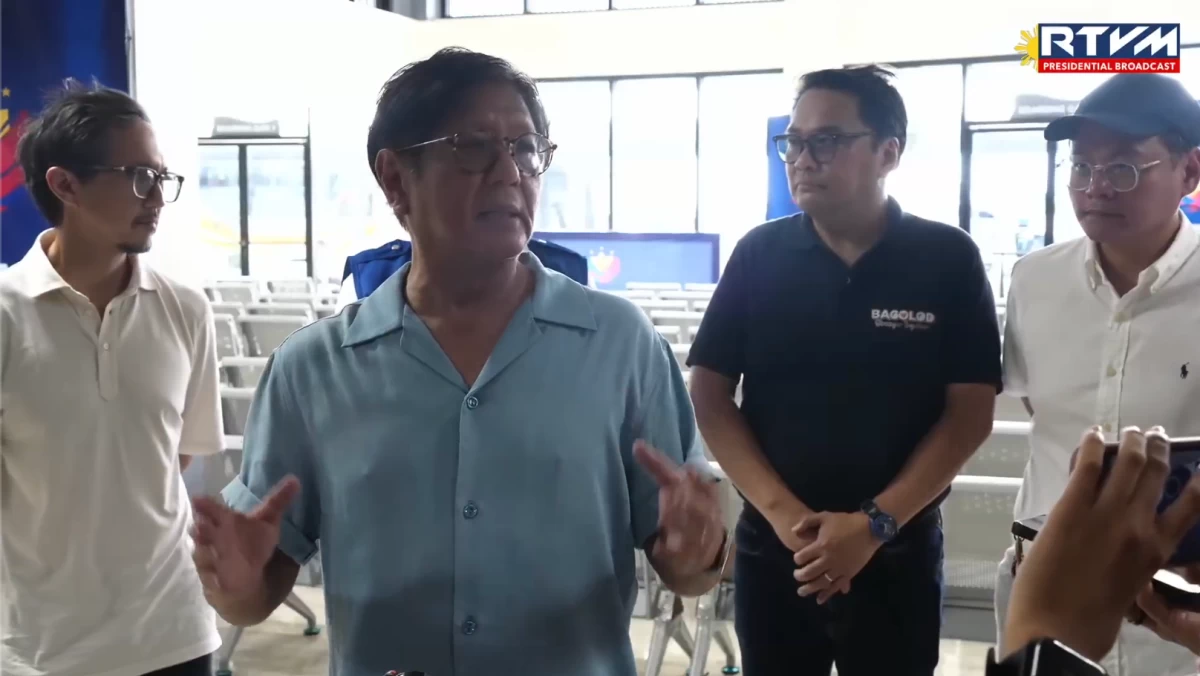
President Ferdinand R. Marcos Jr. inspect the Banago Port in Bacolod City on Dec. 12, 2025. (RTVM)
President Marcos said the ongoing improvement works at the Banago Port in Bacolod City will be the standard design for all port terminals in the country.
Marcos inspected the Banago Port Improvement Project on Friday, Dec. 12, which houses an old terminal building that needs total renovation.
"Lahat ng tao dito hindi alam na kung kailan pa ginawa pero 60s daw. Kaya kailangan nang baguhin (People here do not know when was the terminal made but it was during the 1960s. So, it needs to be changed)," Marcos said.
"So that's what we have done here. This is now going to be the standard design for our terminals, for our ports around the country," he added.
The President stressed the need to standardize the design of port terminals in the country in order to provide better designated areas for passengers, improving the flow of passengers within the terminals.
"And the reason it's important to have a standard design so that ang tao, ang pasahero, kahit saan sumasakay, saan bumababa, alam nila kung saan bibili ng ticket, saan maghihintay, saan papasok, saan sila dadaan (passengers know where to board, where to get off, they know where to buy tickets, where to wait, where to enter, and which way they should go) all of that," Marcos explained.
According to Marcos, the old building used to cater to only 50 passengers at the same time, but with the improvement project, the capacity increased to 500.
"Ang capacity ngayon nito is 500 passengers. Kaya malaking bagay at saka nakita naman ninyo, iba na talaga pagka maayos at maaliwalas at make the traveling experience para sa ating mga kababayan a little more pleasant (Its capacity now is 500 passengers. So this is a big improvement, and as you can see, it really makes a difference when the place is orderly and bright, making the traveling experience for our fellow citizens a little more pleasant)," Marcos said.
Situated in Barangay Banago, the port plays a crucial role in passenger transportation, Roll-on/Roll-off (RoRo) services, and the shipment of vital goods such as sugar, rice and corn that support the local and regional economies. It also facilitates easier access to nearby tourist destinations, including Mambukal Resort and Wildlife Sanctuary, Patag in Silay City, and Lakawon Island.
The new facility features a modern, dedicated operations center, allowing the existing terminal to serve passengers exclusively. Additional improvements include widening the causeway to improve road access, enhancing vehicular flow, and installing a covered walkway to protect passengers from inclement weather.
According to Malacañang, the modernization of Banago Port is expected to boost broader economic activity throughout Negros Occidental. Its upgraded infrastructure is set to generate ripple effects in shipping, transportation, retail, tourism and related sectors, reinforcing the Province's position as a vibrant economic center.
During his visit in Bacolod City, the President also launched Oplan Kontra Baha and inspected the ongoing clearing operations at Mambuloc Creek in Barangay 2 in the city.
Simultaneous clearing operations were held in Banago Creek, Maupay Creek, Lupit River, Magsungay River, Tangub Creek, Pahanocoy Creek, Sum-ag River, Circumferential Road, and Mandalagan River.
Marcos said based on scientific estimates, restoring the full water carrying capacity of waterways and drainage systems could reduce flooding by around 60 percent.
Oplan Kontra Baha was launched in Metro Manila and Metro Cebu last November 12 and 21, respectively. It involves declogging of drainage systems; dredging and cleaning of rivers, creeks and esteros; clearing obstructions and managing waste disposal.
In Bacolod City, the Oplan Kontra Baha program targets to clean up nine priority waterways and drainage systems or almost 170 kilometers of rivers, creeks, and esteros, and 138 kilometers of drainage systems.

Related Tags

President Marcos ports port terminals Banago Port
ADVERTISEMENT
.most-popular .layout-ratio{ padding-bottom: 79.13%; } @media (min-width: 768px) and (max-width: 1024px) { .widget-title { font-size: 15px !important; } }

{{ articles_filter_1561_widget.title }}

.most-popular .layout-ratio{ padding-bottom: 79.13%; } @media (min-width: 768px) and (max-width: 1024px) { .widget-title { font-size: 15px !important; } }

{{ articles_filter_1562_widget.title }}

.most-popular .layout-ratio{ padding-bottom: 79.13%; } @media (min-width: 768px) and (max-width: 1024px) { .widget-title { font-size: 15px !important; } }

{{ articles_filter_1563_widget.title }}

{{ articles_filter_1564_widget.title }}

.mb-article-details { position: relative; } .mb-article-details .article-body-preview, .mb-article-details .article-body-summary{ font-size: 17px; line-height: 30px; font-family: "Libre Caslon Text", serif; color: #000; } .mb-article-details .article-body-preview iframe , .mb-article-details .article-body-summary iframe{ width: 100%; margin: auto; } .read-more-background { background: linear-gradient(180deg, color(display-p3 1.000 1.000 1.000 / 0) 13.75%, color(display-p3 1.000 1.000 1.000 / 0.8) 30.79%, color(display-p3 1.000 1.000 1.000) 72.5%); position: absolute; height: 200px; width: 100%; bottom: 0; display: flex; justify-content: center; align-items: center; padding: 0; } .read-more-background a{ color: #000; } .read-more-btn { padding: 17px 45px; font-family: Inter; font-weight: 700; font-size: 18px; line-height: 16px; text-align: center; vertical-align: middle; border: 1px solid black; background-color: white; } .hidden { display: none; }
function initializeAllSwipers() { // Get all hidden inputs with cms_article_id document.querySelectorAll('[id^="cms_article_id_"]').forEach(function (input) { const cmsArticleId = input.value; const articleSelector = '#article-' + cmsArticleId + ' .body_images'; const swiperElement = document.querySelector(articleSelector); if (swiperElement && !swiperElement.classList.contains('swiper-initialized')) { new Swiper(articleSelector, { loop: true, pagination: false, navigation: { nextEl: '#article-' + cmsArticleId + ' .swiper-button-next', prevEl: '#article-' + cmsArticleId + ' .swiper-button-prev', }, }); } }); } setTimeout(initializeAllSwipers, 3000); const intersectionObserver = new IntersectionObserver( (entries) => { entries.forEach((entry) => { if (entry.isIntersecting) { const newUrl = entry.target.getAttribute("data-url"); if (newUrl) { history.pushState(null, null, newUrl); let article = entry.target; // Extract metadata const author = article.querySelector('.author-section').textContent.replace('By', '').trim(); const section = article.querySelector('.section-info ').textContent.replace(' ', ' '); const title = article.querySelector('.article-title h1').textContent; // Parse URL for Chartbeat path format const parsedUrl = new URL(newUrl, window.location.origin); const cleanUrl = parsedUrl.host + parsedUrl.pathname; // Update Chartbeat configuration if (typeof window._sf_async_config !== 'undefined') { window._sf_async_config.path = cleanUrl; window._sf_async_config.sections = section; window._sf_async_config.authors = author; } // Track virtual page view with Chartbeat if (typeof pSUPERFLY !== 'undefined' && typeof pSUPERFLY.virtualPage === 'function') { try { pSUPERFLY.virtualPage({ path: cleanUrl, title: title, sections: section, authors: author }); } catch (error) { console.error('ping error', error); } } // Optional: Update document title if (title && title !== document.title) { document.title = title; } } } }); }, { threshold: 0.1 } ); function showArticleBody(button) { const article = button.closest("article"); const summary = article.querySelector(".article-body-summary"); const body = article.querySelector(".article-body-preview"); const readMoreSection = article.querySelector(".read-more-background"); // Hide summary and read-more section summary.style.display = "none"; readMoreSection.style.display = "none"; // Show the full article body body.classList.remove("hidden"); } document.addEventListener("DOMContentLoaded", () => { let loadCount = 0; // Track how many times articles are loaded const offset = [1, 2, 3, 4, 5, 6, 7, 8, 9, 10]; // Offset values const currentUrl = window.location.pathname.substring(1); let isLoading = false; // Prevent multiple calls if (!currentUrl) { console.log("Current URL is invalid."); return; } const sentinel = document.getElementById("load-more-sentinel"); if (!sentinel) { console.log("Sentinel element not found."); return; } function isSentinelVisible() { const rect = sentinel.getBoundingClientRect(); return ( rect.top < window.innerHeight && rect.bottom >= 0 ); } function onScroll() { if (isLoading) return; if (isSentinelVisible()) { if (loadCount >= offset.length) { console.log("Maximum load attempts reached."); window.removeEventListener("scroll", onScroll); return; } isLoading = true; const currentOffset = offset[loadCount]; window.loadMoreItems().then(() => { let article = document.querySelector('#widget_1690 > div:nth-last-of-type(2) article'); intersectionObserver.observe(article) loadCount++; }).catch(error => { console.error("Error loading more items:", error); }).finally(() => { isLoading = false; }); } } window.addEventListener("scroll", onScroll); });

Sign up by email to receive news.