







Fortinet predicts the 2026 cyber landscape in Year-End Brief
Published Dec 11, 2025 09:25 am


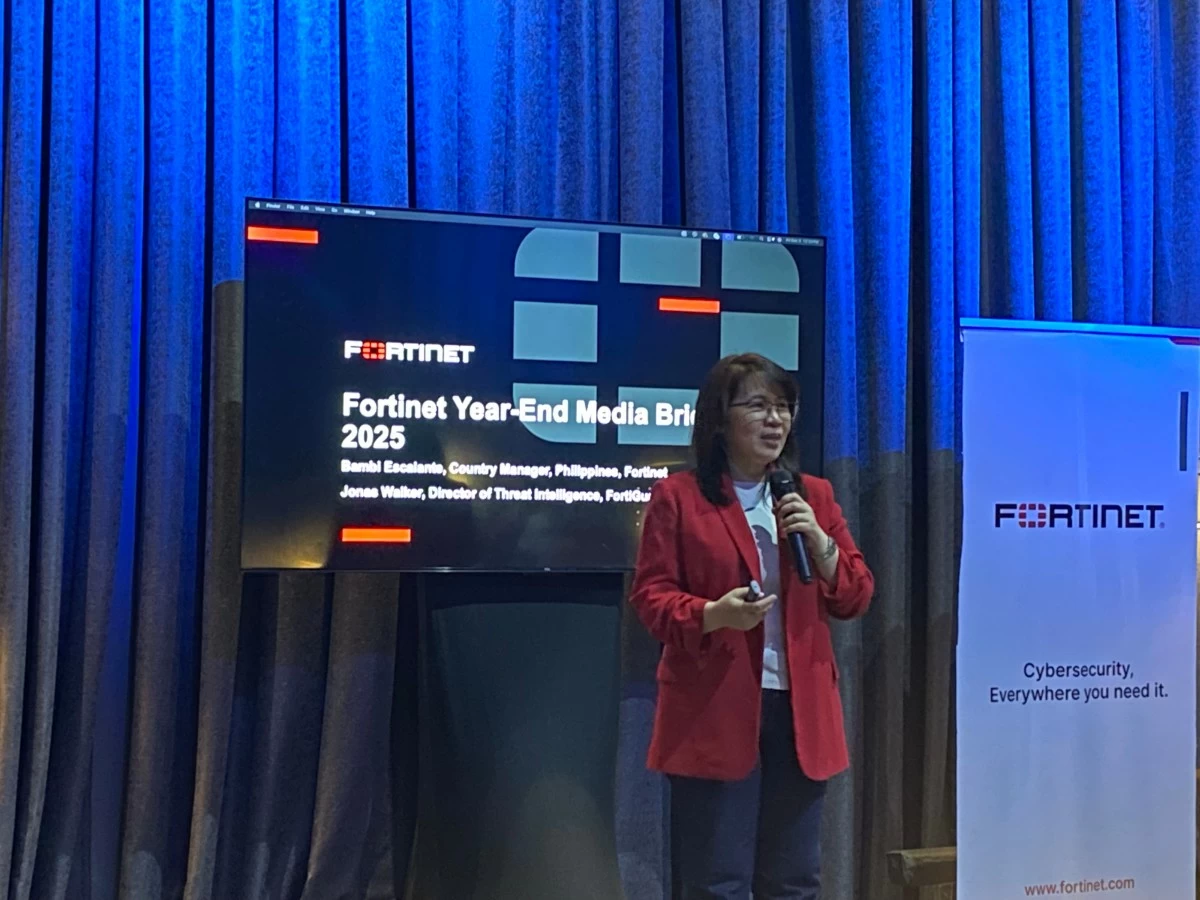
Bambi Escalante, Fortinet Philippines country manager
AI is the new kid shaking things up in the industry. Companies are scrambling to make them more efficient and faster. All of them, with the cyberpunk vision to transform the workplace. For better or for worse.
And while AI presents itself up on stage as an innovation that can be used for good. Behind the scenes, in the darker corners, AI technology is already being used with malicious intent. It's like, if a criminal is armed with a knife to MacGuyver their way into stealing sensitive information from companies, then, the development of AI is basically handing them a rocket launcher that can MacGuyver things a thousand different ways within minutes en route.
Because AI, automation, and a mature cybercrime supply chain will make intrusion faster and easier than ever, attackers will spend less time inventing new tools and more time refining and automating techniques that already work. AI systems will manage reconnaissance, accelerate intrusion, parse stolen data, and generate ransom negotiations. At the same time, autonomous cybercrime agents on the dark web will begin executing entire attack stages with minimal human oversight.
“For defenders, the shift we are seeing is profound," said Bambi Escalante, Fortinet Philippines country manager. "Static configurations and periodic assessments can’t keep pace with an environment where attackers automate reconnaissance, privilege escalation, and extortion in minutes. What organizations need is a unified, adaptive security posture, one that brings together threat intelligence, exposure management, and incident response into a continuous, AI-enabled workflow. At Fortinet, our focus is on helping customers build this level of resilience so they can act at the same speed as the threats they face and strengthen their ability to contain attacks before disruption occurs.”
These shifts will exponentially expand attacker capacity. A ransomware affiliate that once managed a handful of campaigns will soon be able to launch dozens in parallel. And the time between intrusion and impact will shrink from days to minutes, making speed the defining risk factor for organizations in 2026.
FortiGuard Labs expects to see the emergence of specialized AI agents designed to assist cybercriminal operations. Although these agents will not yet operate independently, they will begin to automate and enhance critical stages of the attack chain, including credential theft, lateral movement, and data monetization.
Jonas Walker, director of threat intelligence APAC and Middle East, FortiGuard Labs, said: “The findings clearly show that cybercrime is no longer an opportunistic activity, it is an industrialized system operating at machine speed. As automation, specialization, and AI redefine every stage of the attack lifecycle, the time between compromise and consequence continues to collapse. The road ahead will be shaped by how quickly defenders can adapt to this reality. Cybersecurity has become a race of systems, not individuals, and organizations will need integrated intelligence, continuous validation, and real-time response to stay ahead of adversaries who measure success by throughput, not novelty.”
At the same time, AI will accelerate the monetization of data. Once attackers gain access to stolen databases, AI tools will instantly analyze and prioritize them, determine which victims offer the highest return, and generate personalized extortion messages. As a result, data will become currency faster than ever before.
The underground economy will also become more structured. Botnet and credential-rental services will become increasingly tailored in 2026. Data enrichment and automation will enable sellers to offer more specific access packages based on industry, geography, and system profile, replacing the generic bundles that dominate today’s underground markets. Black markets will adopt customer service, reputation scoring, and automated escrow. Due to these innovations, cybercrime will accelerate its evolution toward full industrialization.
Defenders are going to need to respond with the same efficiency and coordination. In 2026, security operations will move closer to what FortiGuard Labs describes as machine-speed defense—a continuous process of intelligence, validation, and containment that compresses detection and response from hours to minutes.
Frameworks such as continuous threat exposure management (CTEM) and MITRE ATT&CK will need to be leveraged so defenders can quickly map active threats, identify exposures, and prioritize remediation based on live data. Identity will also need to become the foundation of security operations, as organizations will need to not only authenticate people but also automated agents, AI processes, and machine-to-machine interactions.
Managing these non-human identities will become critical to preventing large-scale privilege escalation and data exposure.
Industrialized cybercrime will also demand a more coordinated global response. Initiatives such as INTERPOL’s Operation Serengeti 2.0, supported by Fortinet and other private-sector partners, demonstrate how joint intelligence sharing and targeted disruption can dismantle criminal infrastructure. New initiatives, such as the Fortinet-Crime Stoppers International Cybercrime Bounty program, will enable global communities to safely report cyberthreats, helping to scale deterrence and accountability.
FortiGuard Labs also expects to see continued investment in education and deterrence programs that target young or at-risk populations who are being drawn into online crime. Preventing the next generation of cybercriminals will depend on redirecting them before they enter the ecosystem.
By 2027, cybercrime is expected to function at a scale comparable to legitimate global industries. FortiGuard Labs predicts further automation of offensive operations through agentic AI models, where swarm-based agents will begin coordinating tasks semi-autonomously and adapting to defender behavior, alongside increasingly sophisticated supply-chain attacks targeting AI and embedded systems.