






Manila Bulletin
 Business
The Economy
Flood-control corruption risks Marcos' big-ticket infrastructure projects
Business
The Economy
Flood-control corruption risks Marcos' big-ticket infrastructure projects
Business
The Economy
Flood-control corruption risks Marcos' big-ticket infrastructure projects
Flood-control corruption risks Marcos' big-ticket infrastructure projects
Published Dec 11, 2025 07:00 pm
|
Updated Dec 11, 2025 02:47 pm


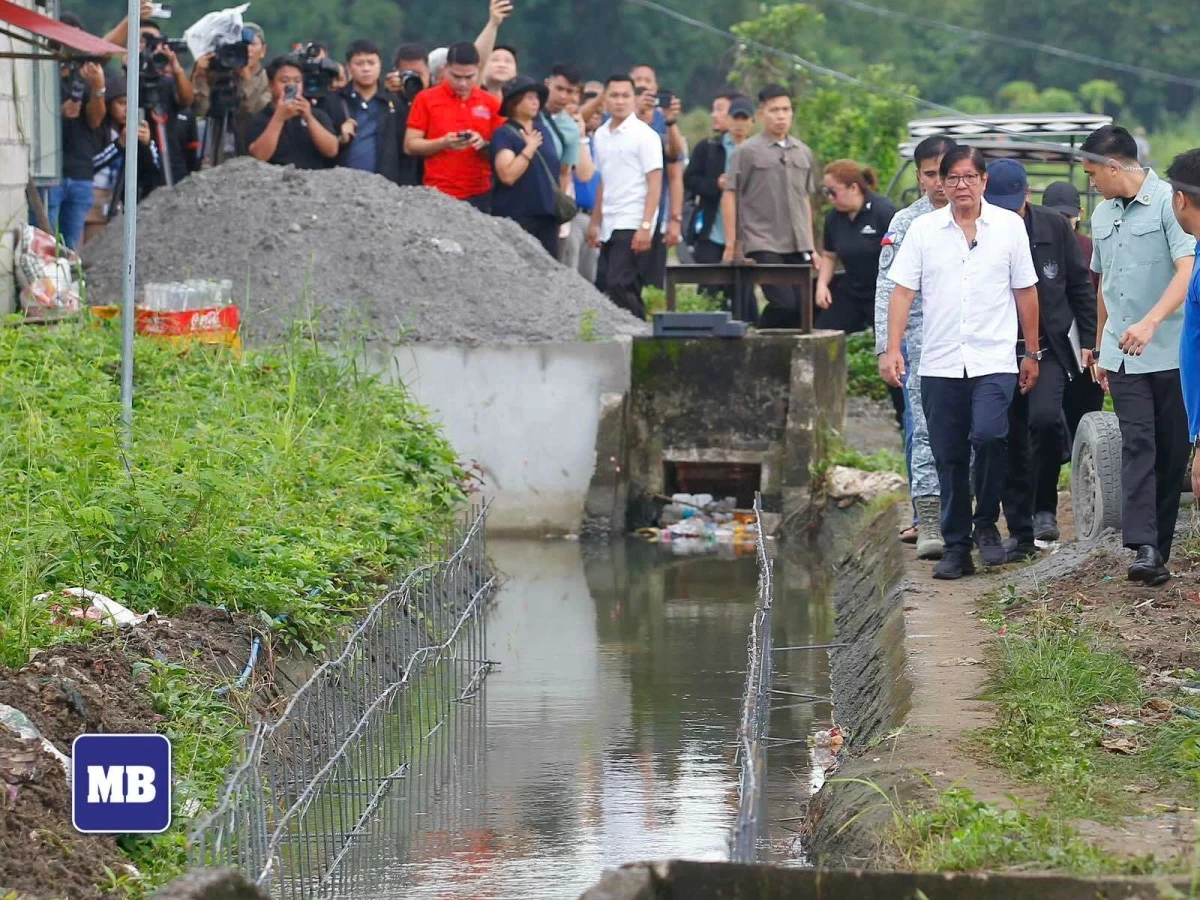
President Ferdinand R. Marcos Jr. leads the inspection of a riverwall in Barangay Piel, Baliuag, Bulacan which was tagged as a 'ghost project.' (Mark Balmores)
The economic team of President Ferdinand R. Marcos Jr. has cautioned that the flood-control corruption scandal may slow down progress on the much-touted Build Better More (BBM) infrastructure program.
In its Fiscal Risks Statement 2026 published on Thursday, Dec. 11, the Cabinet-level, interagency Development Budget Coordination Committee (DBCC) noted that no less than the President himself jump-started the probe on “ghost” and substandard flood-control projects during his fourth State of the Nation Address (SONA) last July.
The DBCC said that this resulted in the 4.5-year low third-quarter gross domestic product (GDP) growth of four percent, making the impact of the President’s directive to investigate flood-control anomalies immediately felt by the economy.
“This was also evidently seen in the disbursement performance as of end-September 2025, wherein spending for capital outlays fell short by ₱111.3 billion (9.4 percent) from the ₱1.181-trillion program for the period. This was due mainly to the contraction in the spending of the Department of Public Works and Highways (DPWH),” which was the lead agency rolling out flood-control infrastructure, said the DBCC.
It noted that the slowdown in the DPWH’s spending in the aftermath of the corruption scandal was mainly due to contractors delaying or failing to submit billings while DPWH offices conducted inspections to verify project progress. Oversight agencies have also imposed stricter scrutiny, leading to more cautious processing of payments, while some DPWH offices are unable to disburse funds because their bank accounts are under investigation and currently frozen, it added.
“Over the medium to long term, these factors pose some risks to the government’s ability to hit its targeted infrastructure-to-GDP ratio of five to six percent,” the DBCC warned.
The proposed ₱6.793-trillion 2026 national budget set aside a record ₱1.556 trillion for the centerpiece BBM program. The infrastructure disbursements program for next year totaling ₱1.558 trillion—including subsidy, equity, and transfers to local government units (LGUs)—is higher than this year’s total allocation of ₱1.513 trillion and 2024’s actual ₱1.545 trillion spent on infra projects.
The annual budget on public infrastructure development is projected to increase to new highs of ₱1.692 trillion in 2027 and ₱1.904 trillion in 2028. But as a share of gross domestic product (GDP), the 2026 infrastructure program is equivalent to 5.1 percent of GDP, lower than the programmed 5.3 percent for 2025 and the 5.8 percent recorded in 2024. According to the President’s budget message, the current administration targets annual infrastructure spending equivalent to five to six percent of GDP until Marcos steps down in mid-2028.
Despite the current tempered expenditures on public goods and services, the DBCC remains optimistic that “infrastructure spending is expected to remain above five percent of GDP, with increased private-sector participation under enhanced public-private partnership (PPP) frameworks.”
“The government will enhance transparency and accountability to rebuild investor confidence. The Department of Budget and Management (DBM) has implemented stricter monitoring in the issuance of notices of cash allocation (NCAs) for payments related to public works,” the DBCC said.
“Moreover, the government will prioritize digitalization across project procurement, bidding, contract awarding, monitoring, and evaluation through the launching of the Modernized PhilGEPS Open Data Portal and further enhancements of the Digital Imaging for Monitoring and Evaluation (DIME) Project. In parallel, expediting the graft and corruption probe through the Independent Commission for Infrastructure (ICI) and enforcing the rule of law will signal the government’s strong commitment to accountability and help rebuild public trust,” it added.
In particular, the DBCC laid down risk-mitigating measures to ensure the sustained BBM infrastructure program by strengthening oversight and efficiency as well as strategic flood-control measures. The DBCC noted that the government immediately responded to the corruption scandal by creating the ICI to investigate a decade’s worth of infrastructure projects, especially flood-control works, and to recommend corrective actions and possible legal cases.
Reforms under the recently enacted New Government Procurement Reform Act (NGPA) also further strengthened transparency through open contracting and mandatory beneficial ownership disclosure, while DIME enhances real-time monitoring of projects using satellite and drone technology, helping detect irregularities, verify progress, and improve accountability in public spending, it added.
As the government continues to ensure flood protection despite the billions, if not trillions, of pesos wasted in previously corrupted projects, the DBCC said the Marcos Jr. administration is improving coordination on PPPs and developing a comprehensive flood-control masterplan to better cluster projects by river basin, reduce overlaps, and strengthen oversight by the Investment Coordination Committee (ICC) while expanding access to foreign-assisted funding.
The President has also ordered the DPWH to align project costs with market rates to generate substantial savings—of up to 50 percent in reduced material costs—that can be redirected to priority programs, the DBCC noted.
“The government emphasizes that the fight against corruption requires whole-of-society effort. While it takes the lead in holding wrongdoers accountable and strengthening its systems and processes, the private sector also plays a vital role in promoting good governance. At the same time, an engaged and vigilant civil society serves as an essential partner in reporting irregularities and ensuring accountability,” the DBCC said.