






Manila Bulletin
 Business
The Stock Market
Retail, manufacturing firms accelerate solar shift ahead of peak demand season
Business
The Stock Market
Retail, manufacturing firms accelerate solar shift ahead of peak demand season
Business
The Stock Market
Retail, manufacturing firms accelerate solar shift ahead of peak demand season
Retail, manufacturing firms accelerate solar shift ahead of peak demand season
Published Dec 10, 2025 01:46 pm


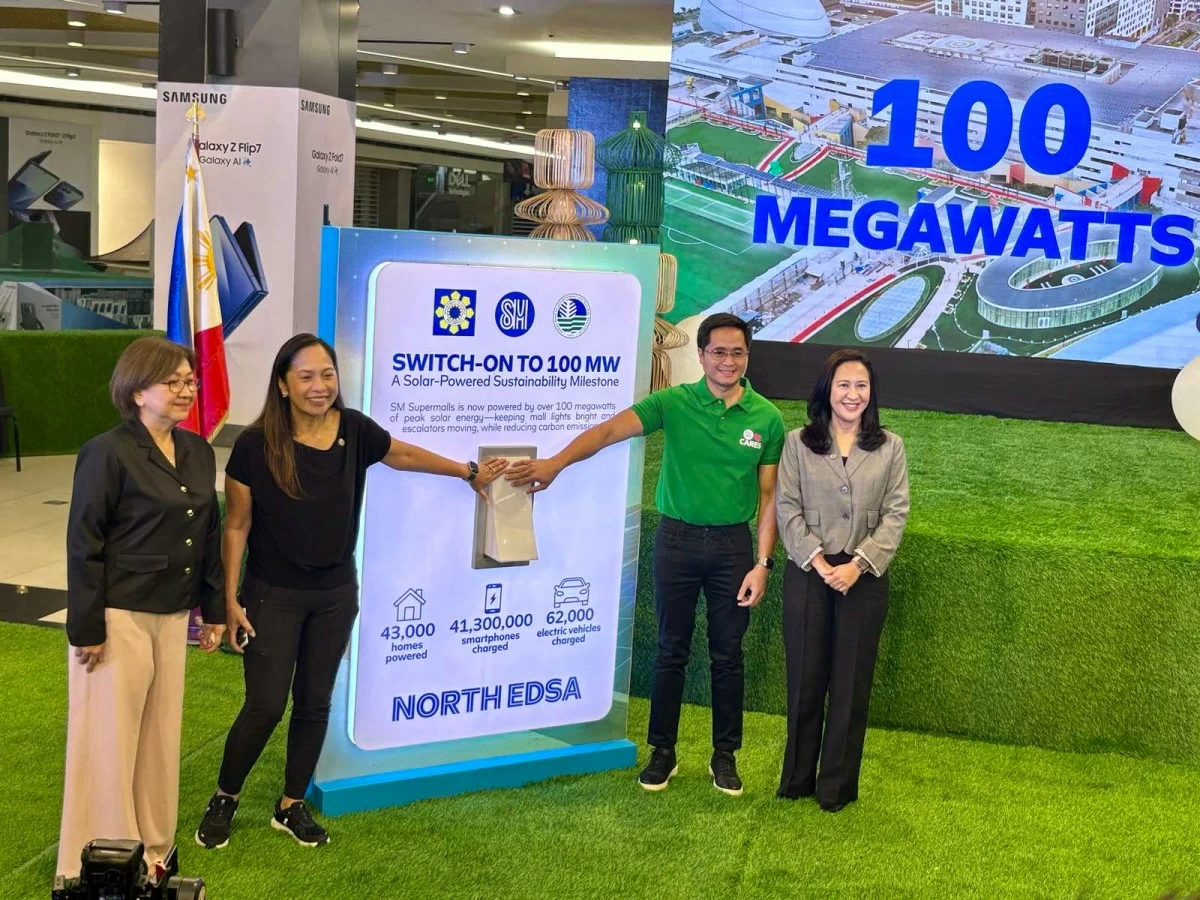
SM Supermalls has reached a significant clean-energy milestone with its 100-megawatt peak (MWp) solar capacity now powering malls nationwide, delivering renewable energy equivalent to running 6,200 escalators, lighting 413,000 LED bulbs twice yearly, and supporting the needs of 43,000 homes, 41.3 million smartphones, and 62,000 electric vehicles. With over 200,000 solar panels installed across 59 malls and covering 65 hectares of rooftop space, the initiative transforms mall infrastructure into a large-scale sustainability engine. Anchored by the country’s biggest rooftop solar PV system at SM North EDSA—pioneering mall-based solar technology in 2014—SM Prime Holdings, Inc. continues to lead climate initiatives through the SM Green Movement.
Major Philippine retail and manufacturing firms are accelerating the deployment of solar energy in their operations, moving to secure power supply and manage rising costs as the country enters the high-demand Christmas season.
The Department of Energy (DOE) announced Wednesday, Dec. 10, that SM Prime Holdings Inc. has expanded its solar photovoltaic (PV) rooftop capacity to 59 properties, involving 200,000 solar modules covering 65 hectares of rooftop space.
The expansion brings SM Prime closer to its target of 100 MWp in rooftop solar capacity.
“SM Prime’s achievement sends a clear message: sustainability can be accessible, visible, and part of daily life. The DOE is proud to work with companies that take the initiative to build a healthier and more energy-secure future for all Filipinos,” Energy Secretary Sharon Garin.
The company earlier launched the Philippines’ largest rooftop solar system at SM City Fairview this year. The 3.785 MWp facility currently sources 11 percent of the mall’s total electricity needs.
The shift to solar extends beyond retail. RE provider GreenHeat Corp. has partnered with Honda Parts Manufacturing Corp. to power its facility with solar energy for a decade.
GreenHeat recently activated a 1.35 MW solar rooftop system for Honda, which will supply a portion of the manufacturer’s power requirements.
The system is projected to offset 773,726 kilograms of carbon dioxide emissions in its inaugural year, aiming for a 19.3 million kilogram reduction in Honda Parts' carbon footprint over the next 25 years. The installation fully complies with local electrical and structural codes.
GreenHeat currently reports managing 35 MWp of installed solar rooftop capacity across 68 commercial and industrial sites, including factories, malls, and cold storage facilities nationwide.
Data from the Institute for Climate and Sustainable Cities’ (ICSC) SPECTRUM platform confirms the sustained momentum in solar integration. SPECTRUM, an online mapping tool using satellite imagery and learning algorithms, estimates the total national solar capacity from integrated rooftops at approximately 3,093.32 MW.
The platform has identified integrated solar PV installations in 236 cities and municipalities. Luzon remains the dominant region, holding the largest share of solar rooftop capacity at 2,137.68 MW.