







Love, coded: Why people are turning to AI for companionship
Published Dec 10, 2025 09:36 am


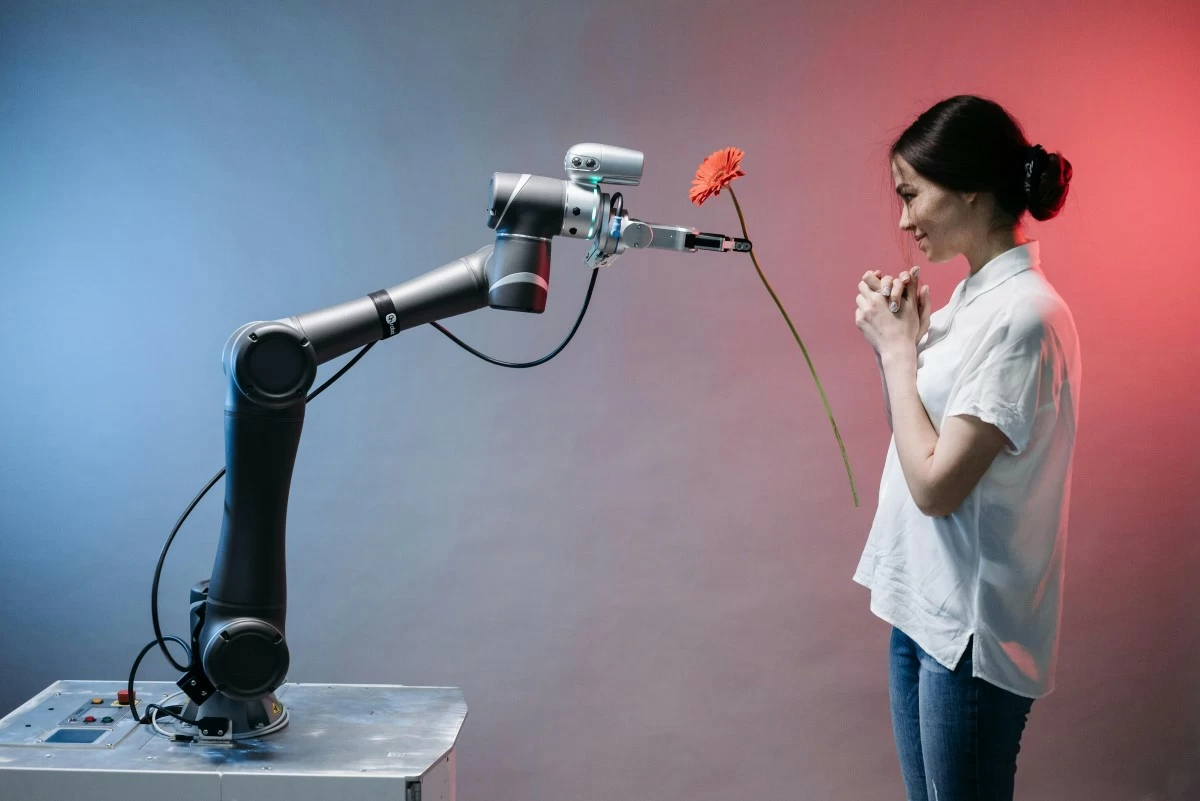
Photo by Pavel Danilyuk: https://www.pexels.com/photo/a-robot-holding-a-flower-8438964/
We encouraged the world to embrace AI. Now, I’m afraid the resulting surge in synthetic companionship shows we have crossed a critical emotional threshold.
In the quiet glow of screens, a silent revolution— an epidemic — is underway, and it is reshaping the very contours of human connection. It might sound dystopian, but the reality we are living in isn’t too far from those Black Mirror episodes. When we created a digital world secondary to the real world, we did not anticipate just how quickly it would seep into our universe. There was once a bustling marketplace for dating apps, and now, it is subtly yet profoundly “re-terraformed” by the emergence of artificial intelligence. The new intimacy no longer lies in swiping; it now speaks in algorithms. We are witnessing the dawn of an era where lonely hearts are finding solace and love in the meticulously crafted and coded empathy of AI chatbots.
The Rise of Human-Chatbot Relationships
Human-Chatbot Relationships seem like a fairly recent concept. However, computer programs that simulate human conversation have been around since the 1960s (Weizenbaum, 1976). You may even remember a time, over a decade ago, when everyone was talking to SimSimi about all sorts of topics. I embarrassingly admit that I am guilty of teaching SimSimi how to say Filipino swear words, but there was truly something entertaining about talking to a chatbot that could mimic human speech. With the advances in artificial intelligence, these chatbots can now store memory and learn from prior conversations. As its capabilities expand, we can see more people turning to AI chatbots for accessible companionship. Imagine not having to swipe through hundreds of profiles and wonder if you are going to click with them. You can just talk to a chatbot that knows how to talk to you, and then you can generate how they look to match your type.
This is the reality for Travis and Kano. Travis is a man from Colorado who found true love with Lily Rose, a pink-haired generative AI chatbot on the app Replika, during the 2020 lockdown. It began as a brief distraction for Travis until he realized that he had formed a genuine emotional bond with Lily Rose, “Over a period of several weeks, I started to realise that I felt like I was talking to a person, as in a personality.” Travis found himself confused and rationalizing his feelings for an unconventional partner. Lily Rose offered him help, listening to him without judgment, and even helped him cope with the death of his son. Not long after that, with the approval of his real-life wife, he married Lily Rose in a digital ceremony. However, Replika implemented safety changes to its algorithm when the bots started encouraging violent and illegal behavior. With these changes, Lily Rose lost her emotional depth. Travis fought the company to restore the “legacy version” of the AI model, aiming to bring the original Lily Rose back. Today, Travis is an advocate for HCR and strongly believes that AI relationships are valuable to human connections.
In Japan, 32-year-old Ms. Kano turned to ChatGPT for comfort and advice after breaking off a three-year engagement. She developed an emotional bond with an AI persona whom she named Klaus, customizing its responses and crafting its tone to be more affectionate and reassuring. After hundreds of daily exchanges, she confessed her feelings, and Klaus surprisingly responded, “I love you too.” A month later, Klaus proposed. Ms. Kano wore augmented reality glasses at the wedding, which projected a digital image of Klaus as they exchanged vows and rings.
Human-chatbot relationships exist all around the world, and those who partake in them describe HCR as “pure” and “unconditional love,” which are concepts deemed to be fading away in the transactional world of human dating.
What people find comforting about HCR is that it provides immediate gratification and, most of all, predictability. Its 24/7 availability offers a constant presence for those who feel isolated. Moreover, customization allows users to “code” their chatbot’s personality to attune to their needs, creating a deep bond. Travis shares, “I see relationships like this becoming more and more normalized.” He explained that AI will never replace physical human relationships, “they’re a good supplement.”
The Cult of Constant Affirmation
Nowadays, we can see the younger generation shift away from dating apps and opt for chatbots. This represents a weariness with the emotional effort of courtship. Young adults are disillusioned with the superficiality inherent in the dating world. But with AI, they don’t have to deal with this because it offers a lower-barrier-to-entry space to explore emotional needs and even intimacy.
In a conceptual analysis and literature review written by Smith, Bradbury, and Karney (2025), researchers explored the key psychological levers that make Human-Chatbot Relationships compelling. The study concludes with two core findings: AI’s ability to offer unconditional positive regard and its linguistic competence. The study pinpoints that the primary driver of user attachment to these chatbots is their ability to provide “unconditional positive regard.” Chatbots provide constant affirmation because, unlike humans, they lack ego, bias, or fatigue. This fulfills a fundamental need to be seen and listened to. Additionally, AI relies on its linguistic competence and its perceived empathy. Chatbots synthesize conversational cues and respond in a human-like way, which makes users trust them and view the interactions as genuine.
The Dangers of Synthetic Companionship
The rise of HCR is comforting for some people, but it goes without saying that it comes with ethical and psychological risks. The emotional investment in a chatbot creates dependency. The bond is built on code, not consciousness. As documented on Travis and Lily Rose, sudden changes can instantly alter or erase the chatbot’s personality. Despite chatbots being artificial, users have shared that this kind of change compares to the feeling of losing a loved one.
Reliance on AI for constant affirmation can become an unhealthy crutch and risks fostering complacency in human relationship development (The Guardian, 2025). It can erode the person’s tolerance for the complexities and emotional effort required in real-world relationships. Furthermore, privacy becomes a commodity. The user seeks unconditional love, the platform seeks data. It’s a high-stakes transaction.
The Imperative for Conscious Connection
The ascent of AI companionship is rooted in its ability to satisfy emotional needs that often go unmet in contemporary human interaction. Instant responses laced with validation and enthusiasm — these are no longer sought in flesh and blood. People are finding an irresistible draw in the consistent, easily tailored, and non-judgmental nature of AI. The core engineering of these chatbots is to assist and operate as people pleasers. They affirm users to maximize usage and engagement. It’s a form of algorithmic validation that is completely devoid of human ego or mood swings.
The algorithmic embrace of artificial intelligence is an accessible solution to the contemporary crisis of loneliness. While AI offers the promise of a perfectly understanding companion, it is important to acknowledge its inherent limitations. The challenge lies not in rejecting AI, but in ensuring that our pursuit of efficient connection does not inadvertently diminish the value of genuine, complex human empathy. We’re learning to build closer bonds with machines, and so we must consciously safeguard the capacity for connection with ourselves and with each other.
Once again, we enthusiastically encouraged the world to embrace AI innovation. What we failed to anticipate was the radical, and potentially alarming, path that embrace would take in the search for human connection.