







Have we found the cure for AIDS?
A look into seven cases that managed to beat HIV
Published Dec 8, 2025 07:31 pm
|
Updated Dec 10, 2025 08:14 am


At A Glance
- The first ever patient to be cured of HIV is Timothy Ray Brown, also known as the Berlin Patient. Timothy was diagnosed with leukemia and received two stem cell transplants in 2006 in Berlin, Germany.
Earlier this month, on World AIDS Day, Dec. 1, 2025, scientists published a paper in the journal “Nature” detailing the seventh case of a human immunodeficiency virus (HIV) cure. While HIV is currently treatable with potent antiretrovirals (ARVs), which enable people with HIV to live long lives and not develop AIDS, ARVs do not fully eliminate the virus from the body. Stopping medication will result in the virus resuming its activity. Like the previous six documented HIV cures, this new patient achieved remission of HIV through hematopoietic stem cell transplantation (HSCT). HSCT involves destroying a patient’s bone marrow and replacing it with stem cells harvested from a donor’s blood or bone marrow. While these cures represent just a handful of the over 40 million people currently living with HIV, each new instance is proof that HIV can be defeated.
The first ever patient to be cured of HIV is Timothy Ray Brown, also known as the Berlin Patient. Timothy was diagnosed with leukemia and received two stem cell transplants in 2006 in Berlin, Germany. The person who donated the stem cells he received had a special kind of mutation known as a homozygous delta 32 CCR5 mutation. Humans have two copies of each gene, and homozygous means both copies of the CCR5 gene have this specific mutation. Persons with homozygous delta 32 CCR5 mutation have been shown to be highly resistant to infection with HIV. Timothy had a stormy course with his HSCT but survived. When he stopped his antiretroviral treatment after his transplant, HIV remained undetectable in his blood. An extensive search for HIV in different reservoirs of his body did not show any replication-competent virus, and he was declared cured. He remained HIV-free for 14 years and became an ambassador advocating for cure research for HIV. I met him in Mexico during one of the AIDS meetings in 2019, and he spoke forcefully about the need to push HIV cure research and not to settle for lifelong ARV treatment. Sadly, Timothy had a relapse of his leukemia and died in 2020, although he remained HIV-free up to the time of his death.
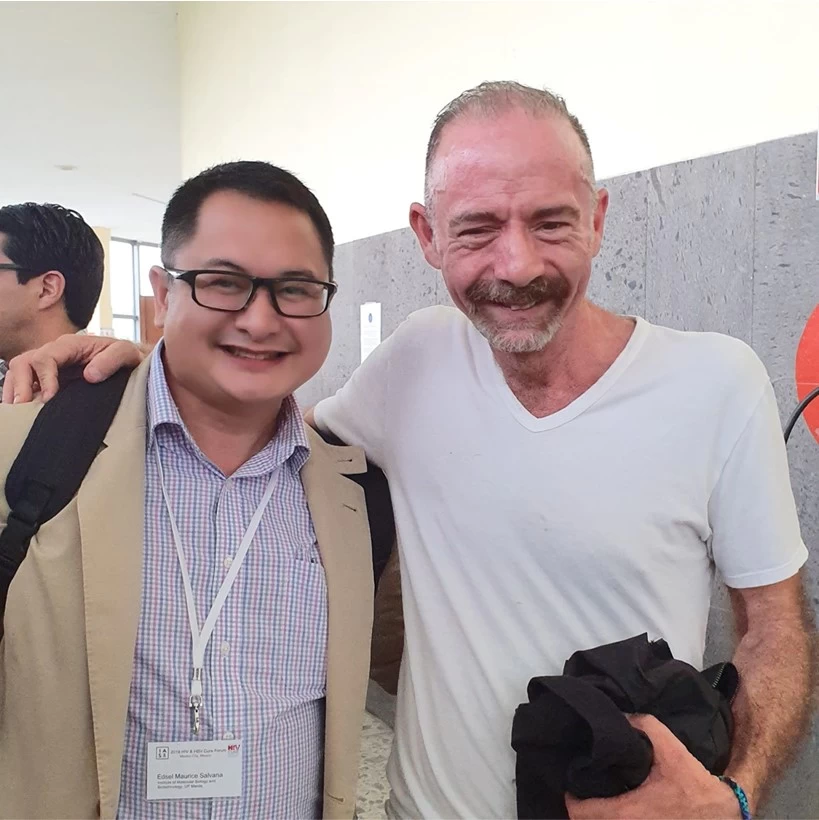
THE BERLIN PATIENT The author with Timothy Ray Brown, the first person cured of HIV.
Unfortunately, HSCT is not a practical cure for HIV. The protocol for HSCT involves knocking out a host’s bone marrow with highly toxic chemotherapy in preparation for the transplant. The bone marrow is responsible for producing white blood cells, red blood cells, and platelets, and the period between the destruction of the bone marrow until the donor stem cells become functional carries a very high risk of life-threatening infections and other complications. Occasionally, the donor stem cells end up attacking the host’s body cells, a process known as graft-versus-host disease, which can be fatal. HSCT is incredibly toxic, and many patients die during the process.
All seven HIV cures were among patients with life-threatening cancers such as leukemia and lymphoma for which an HSCT was indicated. Unfortunately, not all people with HIV who have successfully undergone HSCT have been cured. Most are unable to achieve a cure, and the ones that have done so are more the exception than the rule. Timothy’s stormy course, which included graft-versus-host disease, where the donor stem cells attacked his own immune cells, which harbored residual HIV, was probably part of the reason he was able to clear his HIV reservoir.
For a time, it was believed that using donors with the homozygous delta 32 CCR5 mutation was the only way to achieve a cure, and so doctors attempted to match people with HIV needing HSCT with donors with the mutation. Unfortunately, the mutation is quite rare and not everyone ends up with a match. Five of the seven HIV cure patients received stem cells from a donor with a homozygous delta 32 CCR5 mutation. The sixth patient received “wild-type” or non-mutated CCR5 stem cells, and this was the first time that a cure had been achieved without a homozygous delta 32 CCR5 mutation-positive donor. If this can be replicated, it can be a very welcome development since this expands the donor pool substantially. The seventh patient, also known as the Berlin 2 or B2 patient, since he also got cured in Berlin, received stem cells from a heterozygous delta 32 CCR5 mutation donor. Heterozygous means one CCR5 gene has the delta 32 mutation, and the other gene is wild type. People with a heterozygous delta 32 CCR5 mutation still express the CCR5 receptor that HIV attaches to, but at a decreased rate than a fully wild-type person. This may have also contributed to the success of the cure, since the patient himself had the heterozygous delta 32 CCR5 mutation. There are a lot more people with heterozygous delta 32 CCR5 mutations than homozygous delta 32 CCR5 mutations, and so this also substantially increases the donor pool, albeit not as large as a pure wild-type donor.
The sixth and seventh cures are proof that there are mechanisms other than HIV resistant cells with homozygous delta 32 CCR5 mutations that factor into achieving a cure, and these cases give hope that practical cures for HIV may be around the corner.
In the meantime, ARVs are still the next best thing to a cure for HIV. People with HIV who consistently take their ARVs and achieve viral suppression recover much of their immune function and most of their life expectancy, especially if ARVs are started as close to the time of infection as possible. People with HIV who are virally suppressed are unable to transmit the virus and can have children the natural way without infecting an HIV seronegative partner. Barring the development of drug resistance, which is becoming increasingly rare due to highly potent ARVs like dolutegravir, a person with HIV who starts ARVs before getting AIDS may never get AIDS in his or her lifetime. In this scenario, we could say we already have a cure for AIDS. Now we just have to find a practical cure for HIV, and with each new reported cure, we get closer to that goal.