






Manila Bulletin
 Business
The Economy
ADB warns: Philippine water gains mask deep health, environmental risks
Business
The Economy
ADB warns: Philippine water gains mask deep health, environmental risks
Business
The Economy
ADB warns: Philippine water gains mask deep health, environmental risks
ADB warns: Philippine water gains mask deep health, environmental risks
Published Dec 8, 2025 05:10 pm


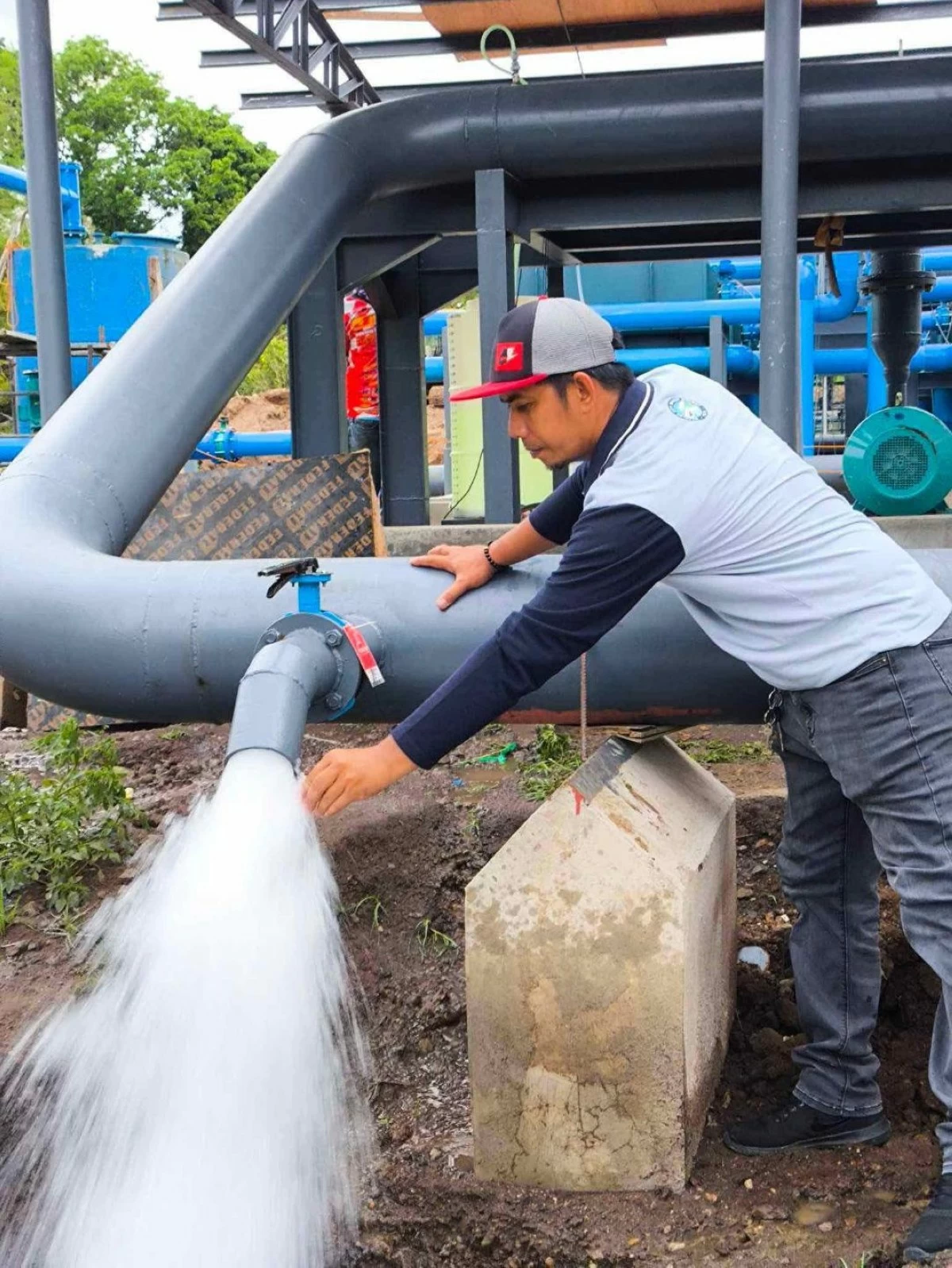
THE Bacolod City Water District (Baciwa)-PrimeWater announced on Wednesday, May 7, the activation of the Matab-ang Water Treatment Plant in Barangay Granada, Bacolod City that will provide an additional three million liters per day (MLD) of water to around 5,000 households. (Photo via Baciwa-PrimeWater/FB)
The Philippines has improved rural water, sanitation, and hygiene (WASH) infrastructure, but health outcomes and environmental security still lag, the Manila-based Asian Development Bank (ADB) said in its Asian Water Development Outlook (AWDO) 2025 report.
Speaking at a virtual media briefing last week, ADB principal urban development specialist Vivek Raman, a lead author of the AWDO 2025 report, noted that in the Philippines, the “health score needs to catch up” despite improvements in WASH.
“It’s not about the volume of water that you have, but how smart and how well you’re managing that,” he said, noting that “there are some countries that may be water abundant, but not managing it as well.”
In the Philippines, the ADB report showed a significant jump in WASH infrastructure score, rising from 5.3 in 2020 to 8.7 in 2025. However, the report noted that “this rise is mainly due to the structure of the scoring method and is not yet matched by improvements in health outcomes.” Raman urged the government to take a closer look at the underlying data.
The report also noted that the Philippines was among the countries classified as “capable,” characterized by broad access to basic services but limited delivery of safely managed services. It added that health gains were modest.
The report added that Indonesia and the Philippines each recorded a one-point increase in urban water security, driven by wider access to “at least basic” water services. It said Indonesia, the Philippines, Timor-Leste, and Vietnam also recorded improvements in sanitation scores.
“The Philippines has made inclusivity a priority in its urban utilities, protecting access for low-income users,” the report added.
The AWDO 2025 report highlighted that while 2.7 billion people in Asia and the Pacific have been lifted out of water insecurity over the past 12 years, around four billion still live in economies that continue to struggle with water quality issues, inadequate ecosystem protection, or vulnerability to natural hazards despite broad access to water and sanitation services.
The report also emphasized that Asia-Pacific is confronting a major challenge in closing the region’s growing water investment gap. To meet WASH requirements from 2025 to 2040, the region will need to raise an estimated $4 trillion—equivalent to about $250 billion annually.
Raman underscored that the Philippines offers a strong example of pro-poor tariff reforms and can serve as a model for other Asia-Pacific countries.
He also pointed to several community-led initiatives in the country that demonstrate effective grassroots solutions—particularly Kapit-Bisig Laban sa Kahirapan-Comprehensive and Integrated Delivery of Social Services (KALAHI-CIDSS).
“They mobilized the community and improvements in local planning directly because of community involvement, as well as some youth-centric programs,” he noted.
The report highlighted “the youth leading local solutions for water security in the Philippines,” noting that alongside the Philippines, Vietnam has seen significant declines in aquatic ecosystems due to increased groundwater extraction and hydrological changes.
However, Raman warned that “the biggest red light that is flashing at the moment is environmental security,” stressing that plastic pollution remains severe across the region and that “the Philippines stands out in that.”
The report emphasized that urban flooding is becoming an increasingly serious threat in rapidly growing cities across Southeast Asia—including Indonesia, Myanmar, and the Philippines—where drainage capacity has weakened since 2013.
Raman stressed the importance of addressing service quality over infrastructure, ecosystem protection, and involving local community and integrated planning, noting that doing so “helps to kind of tie all this together.”
ADB senior director for water and urban development Norio Saito also emphasized that, “It’s not the water resource endowment that matters. What matters is really how you’re going to utilize it effectively and efficiently with good governance systems.”
Saito also noted that corruption carries “far-reaching economic consequences” and can undermine the country’s private investment climate. He added that the ADB “takes [a] corruption issue very seriously, and it has zero tolerance for corruption.”
He said the institution has recently reaffirmed its commitment to supporting the Philippine government’s governance and anti-corruption agenda, noting that “we take this seriously, and we’ll continue to work with the government to address this issue.”
(Ricardo M. Austria)