






Manila Bulletin
 Business
The Economy
Inflation unexpectedly eases to 1.5% in November as food costs plunge
Business
The Economy
Inflation unexpectedly eases to 1.5% in November as food costs plunge
Business
The Economy
Inflation unexpectedly eases to 1.5% in November as food costs plunge
Inflation unexpectedly eases to 1.5% in November as food costs plunge
Published Dec 5, 2025 09:25 am
|
Updated Dec 5, 2025 01:09 pm


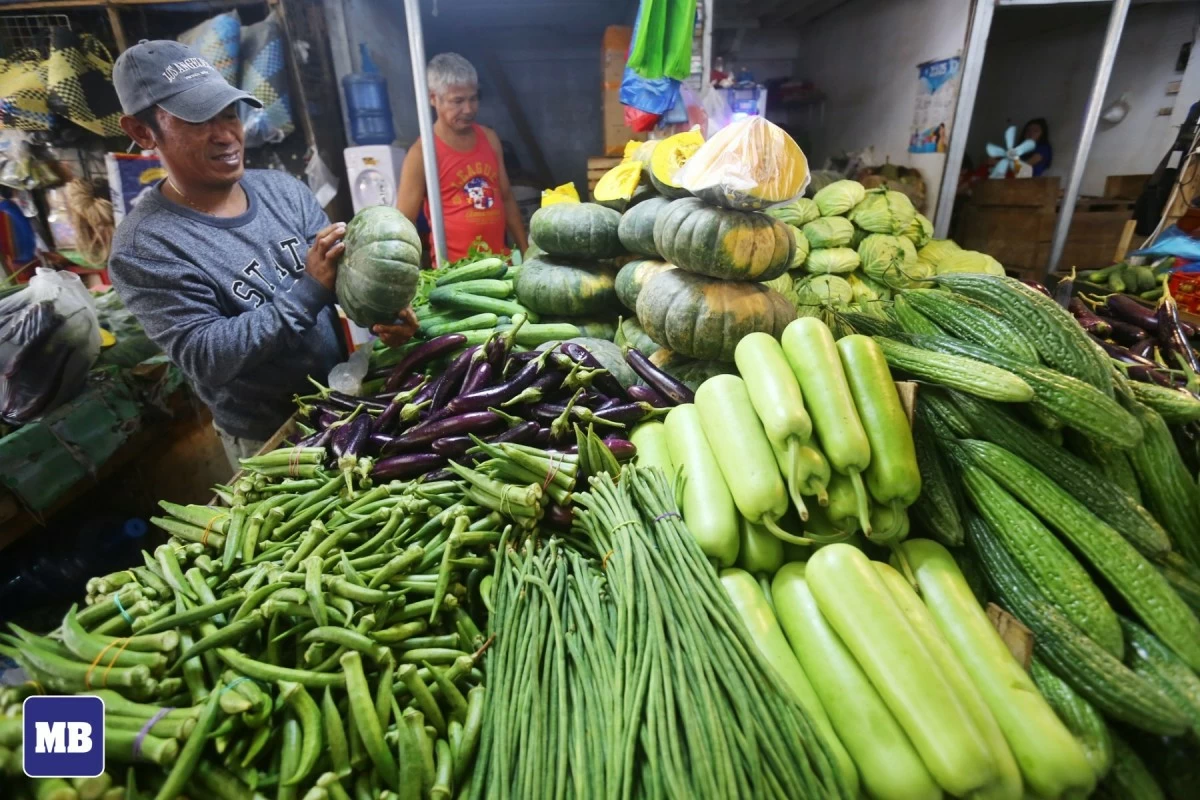
Sharply rising food prices, particularly for vegetables and fish, were the main drivers of the Philippines’ inflation increase to 1.5 percent in August. (Photo by Keith Bacongco | MB)
The country’s inflation rate slowed to 1.5 percent in November, easing from 1.7 percent in October and 2.5 percent in the same month last year, largely due to lower food prices, the Philippine Statistics Authority (PSA) reported on Friday, Dec. 5.
Headline inflation averaged 1.6 percent during the first 11 months of 2025, below the government’s two- to four-percent target range of annual consumer price increases deemed manageable and conducive to economic growth.
In a press briefing, PSA Assistant Secretary Divina Gracia L. Del Prado emphasized that November’s inflation slowdown was largely due to the easing in food and non-alcoholic beverage prices, which posted a slower increase of 0.1 percent in November compared to 0.5 percent in October. She noted that this category accounted for 85.3 percent of the overall downtrend in inflation.
In the food sector, Del Prado stressed that rice carries the largest weight, noting that it has been recording negative inflation since January due to the Department of Agriculture’s (DA) implementation of a maximum suggested retail price (MSRP) for imported rice.
“We started ₱58 per kilo, I remember. But now, [after] a series of reductions of the MSRP in a year... now it’s ₱43 per kilo. So we still see negative inflation for rice.”
She added that rice accounts for about nine percent of the total food basket, which has a combined weight of 35 percent. She noted that any decline in rice prices significantly influences the food sector because of its substantial weighting.
“That’s where we attribute the decline in food prices—it’s actually because of rice,” she said.
PSA data showed that rice’s deflation eased to -15.4 percent in November, from -17 percent in October. It also showed that corn recorded a more moderate deflation in November at -4.1 percent, compared to -8.1 percent in the previous month.
Del Prado added that in the bottom 30-percent income households, the deflation of -0.2 percent in November was mainly driven by rice. She noted that rice accounts for about 18 percent of the total 51-percent food weight in these households, adding that rice is the main food component for this group.
“Since rice is experiencing negative inflation, it pulls down the overall inflation for the bottom 30 percent of households. That’s why the figure is negative,” she explained.
Among other food groups that contributed to the deceleration of November inflation were meat and other products (4.2 percent), milk, other dairy products, and eggs (one percent), and vegetables and tubers (four percent). Meanwhile, sugar, confectionery, and desserts reported faster deflation of -0.3 percent, from -0.1 percent in October.
However, PSA data showed higher inflation in certain items, including flour and bread at 1.6 percent (up from 1.5 percent in October), fish and other seafood at 8.6 percent (from 8.2 percent), and oils and fats at 9.7 percent (up from 9.4 percent).
Another key factor in November’s slower headline inflation, the PSA noted, was the slower rise in prices for furnishings, household equipment, and routine household maintenance, which recorded a two-percent inflation rate in November, down from 2.4 percent in October. The sector contributed 7.3 percent to the overall downtrend in inflation.
In a statement, Department of Economy, Planning, and Development (DEPDev) Secretary Arsenio M. Balisacan said government efforts to stabilize food supply and prices helped ease headline inflation in November, despite ongoing global and domestic challenges.
Balisacan added that the government will continue managing price pressures and easing inflation through measures such as expanding the “Benteng Bigas, Meron Na!” program to all 81 provinces before year-end, aiming to provide affordable rice to vulnerable households by 2026.
He added that the DA has also issued guidelines to strengthen safeguards against African swine fever (ASF) while facilitating safe pork imports, allowing regionalization by recognizing “ASF-free zones” in DA-accredited exporting countries and permitting imports from these areas.
To address the impact of rising electricity prices, Balisacan emphasized that, “the government is automating the registration of qualified 4Ps [Pantawid Pamilyang Pilipino Program] beneficiaries for the lifeline rate subsidy to extend electricity bill discounts to more households. In the long term, the proposed Waste-to-Energy Bill, once passed, will enable the establishment of facilities that will simultaneously help manage residual solid waste and contribute to the country’s energy mix by utilizing waste as a feedstock for energy production.”
“The sustained moderation in inflation reflects our commitment to protect consumers and strengthen our economic resilience against global and domestic headwinds. We will continue implementing timely, well-coordinated policies to keep prices stable and ensure progress is felt by every Filipino,” the country’s chief economist added.
(Ricardo M. Austria)