ADVERTISEMENT

Voucher amendments to Free Tertiary Education Law may divert funds from SUCs to private schools, group warns

Published Dec 3, 2025 07:22 pm
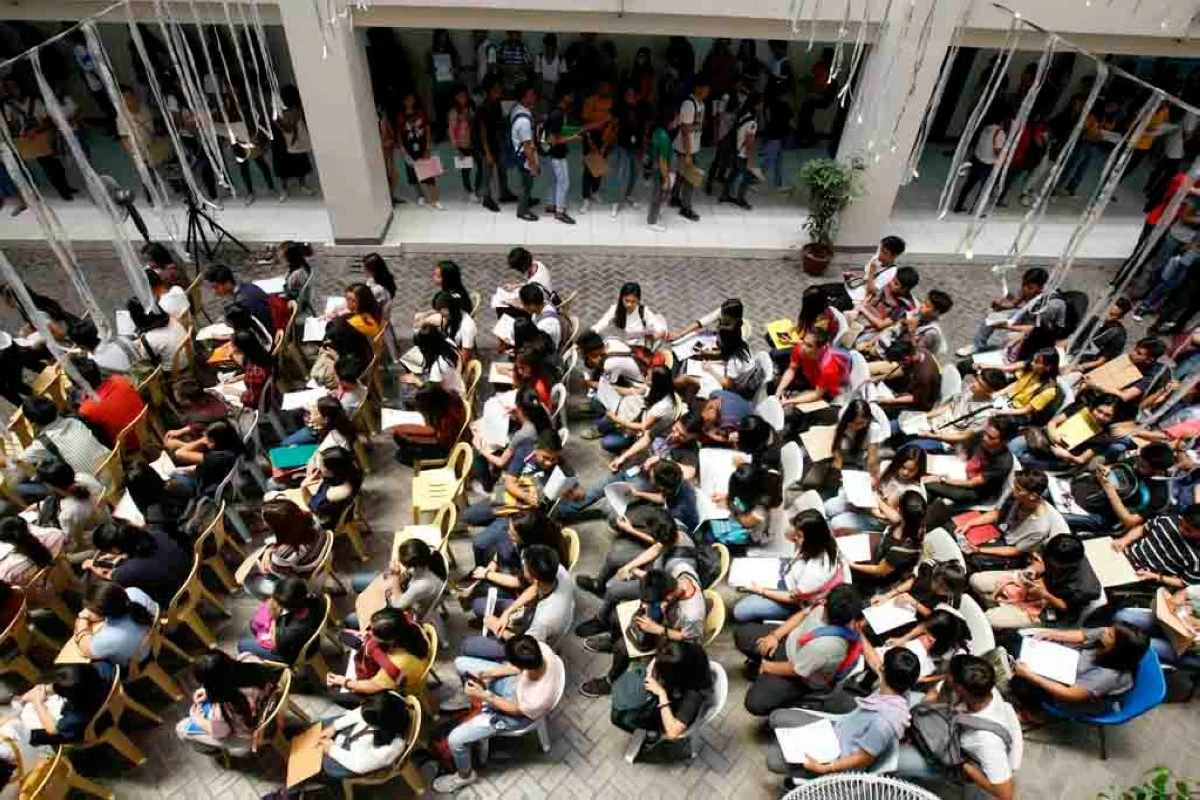
ACT Philippines warns that proposed voucher amendments may divert public funds from state universities and colleges to private schools. (Mark Balmores / Manila Bulletin / file)
A teachers’ group on Wednesday, December 3, expressed strong opposition to proposals introducing a voucher system under the Universal Access to Quality Tertiary Education Act, warning that the measure could weaken state universities and colleges (SUCs) instead of improving access for poor students.
In a statement, the Alliance of Concerned Teachers (ACT) Philippines said the House committee recently approved amendments that would allow students in private higher education institutions (HEIs) and technical–vocational institutions (TVIs) to receive government-funded vouchers.
While the expansion aims to support more learners, ACT argued that it risks redirecting scarce public education funds to private schools—mirroring issues seen in the K to 12 program.
Core problem: SUC underfunding, not lack of vouchers
“The problem is not the lack of vouchers. The problem is the decades-long starvation of our public higher education system,” ACT Chairperson Ruby Bernardo said.
“Kung mahina ang SUCs, kung kulang sa facilities, kulang sa faculty, at kulang sa programa—tapos ang solusyon ay iasa sa pribado (If SUCs are weak, if they lack facilities, lack faculty, and lack programs—and then the solution is to rely on the private sector)—then we are slowly abandoning the mandate of free and quality tertiary education,” Bernardo said.
She added that SUCs continue to suffer from shortages in facilities, faculty, and course offerings. Relying more on private institutions, she warned, could mean “slowly abandoning the mandate of free and quality tertiary education.”
ACT compared the proposal to the Senior High School voucher program, where public funding largely benefited private schools while public institutions remained overcrowded and under-resourced.
Vouchers may push the poorest students to private schools due to weak SUCs
The group cautioned that unless SUCs are strengthened, a voucher-based system could unintentionally force the poorest learners to enroll in private institutions because their local SUCs cannot offer equivalent programs.
ACT also cited EDCOM 2 data showing a sharp drop in Tertiary Education Subsidy (TES) coverage for the poorest students—from 74 percent in AY 2018–2019 to only 30 percent in AY 2022–2023. This decline, the group said, reflects a “structural failure” in how state subsidies are targeted.
“Hindi dapat maging pretext ang vouchers para iwasan ang tunay na solusyon (Vouchers should not become a pretext to avoid the real solution): increasing state funding to SUCs so they can offer full programs, expand campuses, and serve students within their communities,” Bernardo added.
ACT backs HB 212 for a comprehensive free tertiary education system
The group welcomed upcoming deliberations on House Bill 212, authored by ACT Teachers Rep. Antonio Tinio and Kabataan Rep. Raoul Manuel (formerly Co).
The bill aims to establish a more comprehensive free tertiary education system that covers not just tuition, but lodging, learning materials, transportation, and student allowances in all SUCs and public institutions.
ACT said this approach strengthens—rather than substitutes—the role of public higher education.
“This is the direction the country needs: not shifting public funds to private schools, but guaranteeing that every public university is strong, well-funded, and fully capable of providing high-quality, accessible education,” ACT said.
ACT also acknowledged other proposals offering stipends to tertiary learners, saying these support the broader goal of universal access.
Call for lawmakers to prioritize strengthening of public universities
ACT urged legislators and the UniFAST Board to ensure that any amendments to the Free Tertiary Education Law reinforce public education and prevent policies that could lead to privatization “disguised as options.”
“The spirit of free higher education is simple: education is a public good,” Bernardo said. “Any amendment to the law must reinforce public education—not weaken it, not outsource it, and not pave the way for privatization disguised as ‘options’,” she added. 

Related Tags

ACT Philippines Free Tertiary Education Law amendments SUC underfunding voucher system private schools UniFAST free tertiary education Tertiary Education Subsidy EDCOM 2
ADVERTISEMENT
.most-popular .layout-ratio{ padding-bottom: 79.13%; } @media (min-width: 768px) and (max-width: 1024px) { .widget-title { font-size: 15px !important; } }

{{ articles_filter_1561_widget.title }}

.most-popular .layout-ratio{ padding-bottom: 79.13%; } @media (min-width: 768px) and (max-width: 1024px) { .widget-title { font-size: 15px !important; } }

{{ articles_filter_1562_widget.title }}

.most-popular .layout-ratio{ padding-bottom: 79.13%; } @media (min-width: 768px) and (max-width: 1024px) { .widget-title { font-size: 15px !important; } }

{{ articles_filter_1563_widget.title }}

{{ articles_filter_1564_widget.title }}

.mb-article-details { position: relative; } .mb-article-details .article-body-preview, .mb-article-details .article-body-summary{ font-size: 17px; line-height: 30px; font-family: "Libre Caslon Text", serif; color: #000; } .mb-article-details .article-body-preview iframe , .mb-article-details .article-body-summary iframe{ width: 100%; margin: auto; } .read-more-background { background: linear-gradient(180deg, color(display-p3 1.000 1.000 1.000 / 0) 13.75%, color(display-p3 1.000 1.000 1.000 / 0.8) 30.79%, color(display-p3 1.000 1.000 1.000) 72.5%); position: absolute; height: 200px; width: 100%; bottom: 0; display: flex; justify-content: center; align-items: center; padding: 0; } .read-more-background a{ color: #000; } .read-more-btn { padding: 17px 45px; font-family: Inter; font-weight: 700; font-size: 18px; line-height: 16px; text-align: center; vertical-align: middle; border: 1px solid black; background-color: white; } .hidden { display: none; }
function initializeAllSwipers() { // Get all hidden inputs with cms_article_id document.querySelectorAll('[id^="cms_article_id_"]').forEach(function (input) { const cmsArticleId = input.value; const articleSelector = '#article-' + cmsArticleId + ' .body_images'; const swiperElement = document.querySelector(articleSelector); if (swiperElement && !swiperElement.classList.contains('swiper-initialized')) { new Swiper(articleSelector, { loop: true, pagination: false, navigation: { nextEl: '#article-' + cmsArticleId + ' .swiper-button-next', prevEl: '#article-' + cmsArticleId + ' .swiper-button-prev', }, }); } }); } setTimeout(initializeAllSwipers, 3000); const intersectionObserver = new IntersectionObserver( (entries) => { entries.forEach((entry) => { if (entry.isIntersecting) { const newUrl = entry.target.getAttribute("data-url"); if (newUrl) { history.pushState(null, null, newUrl); let article = entry.target; // Extract metadata const author = article.querySelector('.author-section').textContent.replace('By', '').trim(); const section = article.querySelector('.section-info ').textContent.replace(' ', ' '); const title = article.querySelector('.article-title h1').textContent; // Parse URL for Chartbeat path format const parsedUrl = new URL(newUrl, window.location.origin); const cleanUrl = parsedUrl.host + parsedUrl.pathname; // Update Chartbeat configuration if (typeof window._sf_async_config !== 'undefined') { window._sf_async_config.path = cleanUrl; window._sf_async_config.sections = section; window._sf_async_config.authors = author; } // Track virtual page view with Chartbeat if (typeof pSUPERFLY !== 'undefined' && typeof pSUPERFLY.virtualPage === 'function') { try { pSUPERFLY.virtualPage({ path: cleanUrl, title: title, sections: section, authors: author }); } catch (error) { console.error('ping error', error); } } // Optional: Update document title if (title && title !== document.title) { document.title = title; } } } }); }, { threshold: 0.1 } ); function showArticleBody(button) { const article = button.closest("article"); const summary = article.querySelector(".article-body-summary"); const body = article.querySelector(".article-body-preview"); const readMoreSection = article.querySelector(".read-more-background"); // Hide summary and read-more section summary.style.display = "none"; readMoreSection.style.display = "none"; // Show the full article body body.classList.remove("hidden"); } document.addEventListener("DOMContentLoaded", () => { let loadCount = 0; // Track how many times articles are loaded const offset = [1, 2, 3, 4, 5, 6, 7, 8, 9, 10]; // Offset values const currentUrl = window.location.pathname.substring(1); let isLoading = false; // Prevent multiple calls if (!currentUrl) { console.log("Current URL is invalid."); return; } const sentinel = document.getElementById("load-more-sentinel"); if (!sentinel) { console.log("Sentinel element not found."); return; } function isSentinelVisible() { const rect = sentinel.getBoundingClientRect(); return ( rect.top < window.innerHeight && rect.bottom >= 0 ); } function onScroll() { if (isLoading) return; if (isSentinelVisible()) { if (loadCount >= offset.length) { console.log("Maximum load attempts reached."); window.removeEventListener("scroll", onScroll); return; } isLoading = true; const currentOffset = offset[loadCount]; window.loadMoreItems().then(() => { let article = document.querySelector('#widget_1690 > div:nth-last-of-type(2) article'); intersectionObserver.observe(article) loadCount++; }).catch(error => { console.error("Error loading more items:", error); }).finally(() => { isLoading = false; }); } } window.addEventListener("scroll", onScroll); });

Sign up by email to receive news.