






Manila Bulletin
 Philippines
National
Meet Jerome 'Captain Blind' Jacuba: The trailblazing soldier who triggered disability policy reform in the AFP
Philippines
National
Meet Jerome 'Captain Blind' Jacuba: The trailblazing soldier who triggered disability policy reform in the AFP
Philippines
National
Meet Jerome 'Captain Blind' Jacuba: The trailblazing soldier who triggered disability policy reform in the AFP
Meet Jerome 'Captain Blind' Jacuba: The trailblazing soldier who triggered disability policy reform in the AFP
Published Dec 3, 2025 12:50 pm
|
Updated Dec 3, 2025 01:48 pm


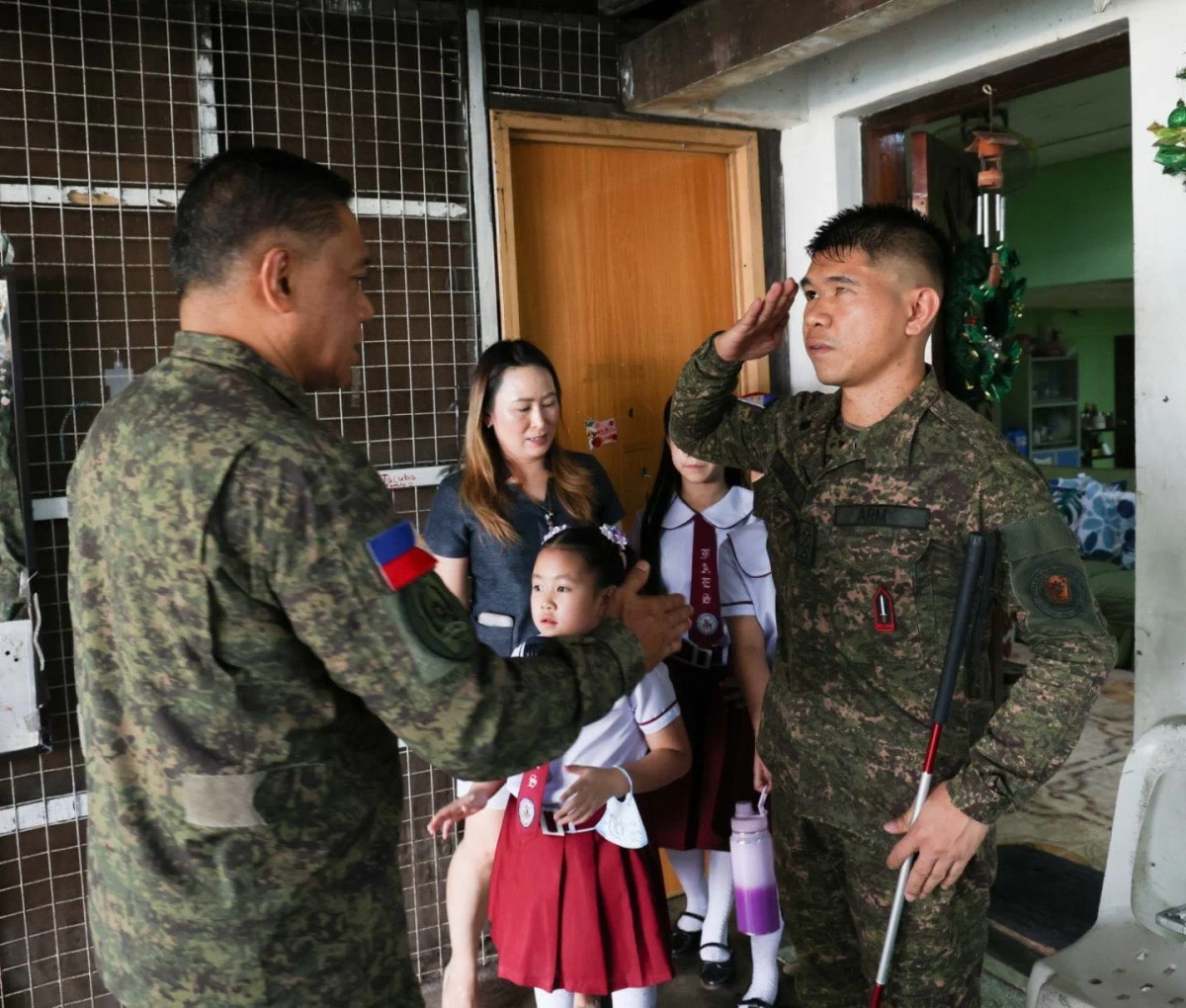
Captain Jerome Jacuba (right) salutes as Armed Forces of the Philippines (AFP) Chief of Staff Gen. Romeo S. Brawner Jr. visits him to honor his service and sacrifice on Dec. 2, 2025. (Photo: AFP)
Captain Jerome Jocson Jacuba spent 15 years in uniform believing that a soldier’s worth was measured not only by the battles he survived but by the country he chose to serve with his whole being.
In late November, he posted a raw and heartfelt video of his farewell, announcing his Complete Disability Discharge (CDD) from the uniformed service after he totally went blind from a blast during an operation in Maguindanao in 2016.
He thought he had reached the quiet end of his military career. However, his story sparked a reform that is now reshaping how the Armed Forces of the Philippines (AFP) treats its wounded personnel.
From farewell to finding new purpose
Jacuba, known as “Captain Blind” on social media, lost his sight in a combat operation against the Bangsamoro Islamic Freedom Fighters (BIFF), a breakaway component of the Moro Islamic Liberation Front (MILF), nine years ago.
On March 2, 2016, Jacuba and his comrades in the Philippine Army (PA) were on a security operation in Datu Salibo, Maguindanao when an improvised explosive device (IED) exploded and shattered his right eye while leaving his left eye barely able to perceive light.
He was admitted to the V. Luna General Hospital, the premier medical facility of the AFP, for treatments and rehabilitation. There, he learned Braille and mastered screen-reader software just to function again.
He refused to fade into the background and even ran in military charity events, trained in adaptive technology, and pushed himself back into relevance.
“I entered the Philippine Army whole, and I would be leaving without my sight. But I didn’t lose it for nothing, I gave it to my country. It is an honor to lose my sight for our country,” he said in a now-viral video posted on his Facebook page on November 30.
It was supposed to be his discharge date from the uniformed service because of his disability. However, fate had other plans.
Personal battles causing ripples of change
Jacuba’s post quickly went viral until it reached President Marcos Jr. Because of this, the Commander-in-Chief ordered the immediate suspension of Jacuba’s discharge. He also directed the Department of National Defense (DND) to review disability-related separation rules, and approved Jacuba’s spot promotion to Major.
AFP Chief of Staff Gen. Romeo Brawner Jr. visited Jacuba, who was accompanied by his wife and three daughters, in his home on Tuesday, Dec. 2, to personally deliver the good news that his promotion is already up for approval and that he will be assigned to "adaptive duties" which fully leverage his 15 years of professional service and operational expertise.
In coordination with the DND, Brawner added that the AFP has initiated a “comprehensive review” of the CDD policy “to strengthen protections for wounded and disabled personnel while reaffirming its commitment to uphold dignity, provide long-term support, and stand firmly beside those injured in the line of duty.”
Under the AFP’s CDD policy, a service member is officially separated from military service when they suffer a service-related physical disability that makes them entirely unable to resume duty.
Once discharged under CDD, the service member becomes eligible for benefits or retirement-oriented supports.
But the AFP’s review may open doors for disabled soldiers to continue serving in adaptive roles such as in administrative functions, training, strategic planning, support, or even redeployment in non-combat capacities.
For now, Jacuba will soon return to uniform, only this time not as a combat officer but as a voice pushing the military toward a more humane and inclusive system. He proved that service does not end when the body breaks, and that courage takes many forms.
If there is one good thing that came out of Jacuba's predicament, it's that the institution he fought for is now preparing to do its part for him and for every soldier whose scars carry the cost of peace.
“To all my countrymen, to all Filipinos who paid for my salary, thank you very much. It means a lot that at least my blindness has honor, it has purpose. It was for all of you,” Jacuba said.