






Manila Bulletin
 Philippines
National
Think tank highlights PH role in countering China's ambition for global 'domination'
Philippines
National
Think tank highlights PH role in countering China's ambition for global 'domination'
Philippines
National
Think tank highlights PH role in countering China's ambition for global 'domination'
Think tank highlights PH role in countering China's ambition for global 'domination'
Fisherfolk communities tapped as force multipliers in new push for WPS monitoring
Published Dec 1, 2025 01:14 pm


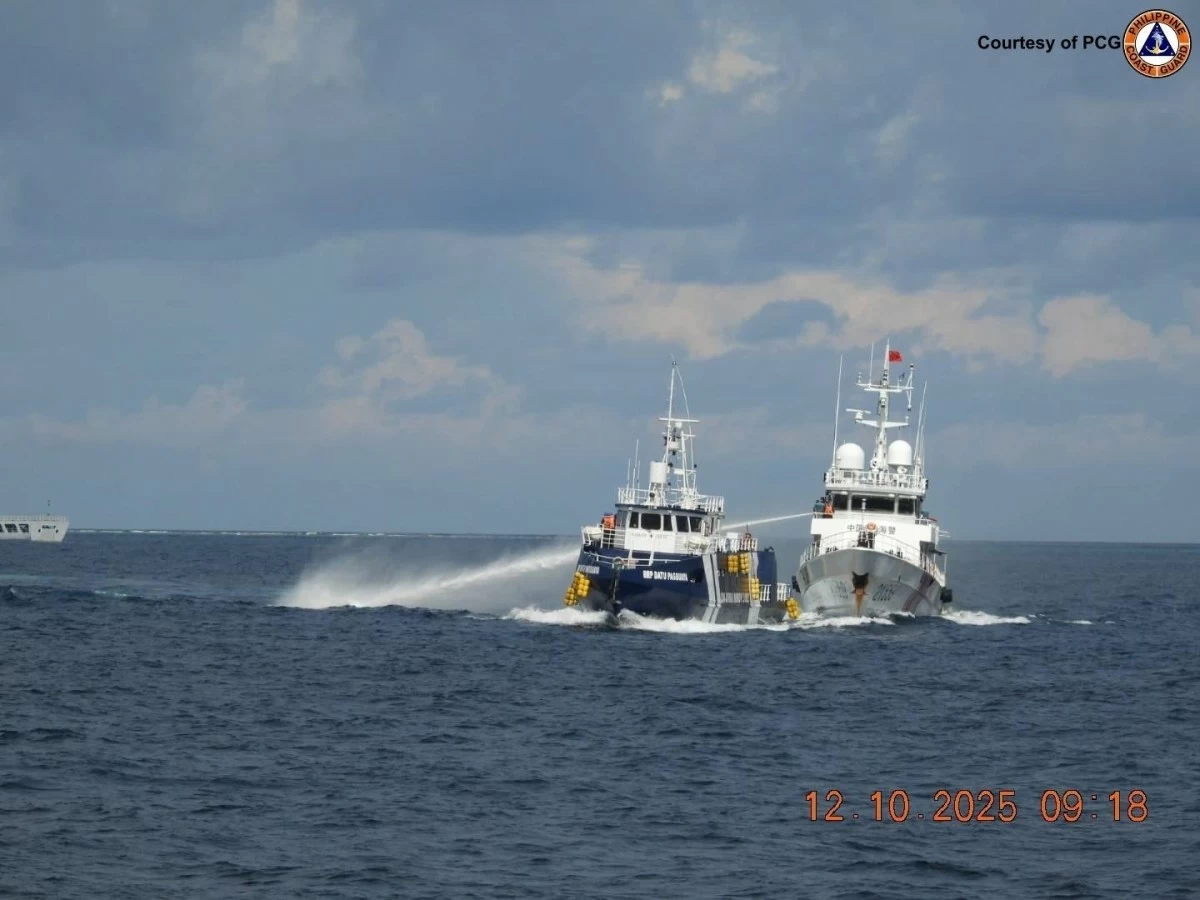
A China Coast Guard (CCG) ship fires a water cannon and rams a Bureau of Fisheries and Aquatic Resources (BFAR) vessel anchored in the territorial waters of Pag-asa (Thitu) Island in the West Philippine Sea (WPS) on Oct. 12, 2025, according to the Philippine Coast Guard (PCG). (Photo: PCG)
The national government should stay firm in asserting its maritime rights in the West Philippine Sea (WPS) as an international think tank warned on Monday, Dec. 1, that China’s long-term strategic ambitions under President Xi Jinping frame the Philippines as a critical factor in Beijing’s broader push for global “domination.”
Stratbase ADR Institute president Prof. Victor Andres “Dindo” Manhit said China’s actions in the WPS continue despite sustained diplomatic protests, international rulings, and growing international criticism because these moves align with Beijing’s long-term plans leading up to 2049 under the so-called “China Dream.”
“We’ve always been asked: Does it work? So what’s next? We’ve done everything but China remains the same,” Manhit said during the “Eyes on the Sea: Community-Based Maritime Monitoring and Reporting in the West Philippine Sea” forum in Makati City.
“China would remain the same because they have their own national interest, and they define their national interest, especially under the Xi Jinping era, as one of domination,” he added.
He argued that the Philippines should not adjust to China’s agenda as he stressed that Manila’s maritime positions stem from international law including the landmark 2016 arbitral ruling that invalidated Beijing’s expansive nine-dash line claim.
He said rising tension in the WPS places the Philippines at the center of China’s strategic calculus.
As of the third quarter of 2025, authorities recorded 78 incidents in the WPS including radio challenges, dangerous maneuvers, water cannon attacks, ramming, vessel shadowing, blocking of fisherfolk, and China’s declaration of Scarborough Shoal as a “nature reserve.”
The forum was organized by the Stratbase Institute, together with the United States Embassy Manila’s Fish Right Program and the National Maritime Center.
Gov’t urges stronger community role
While the Stratbase outlined the strategic dimension of the dispute, national government officials stressed the need to strengthen frontline monitoring through coastal communities.
Presidential Assistant for Maritime Concerns Secretary Andres Centino said the Philippines’ maritime area, which he said is seven times larger than its landmass, requires surveillance mechanisms that go beyond state assets.
Based on government records , the country has a total maritime area of about 2.2 million square kilometers, which is more than seven times bigger than the officially reported land area of roughly 300,000 square kilometers.
“The Philippines exercises sovereignty, jurisdiction, and sovereign rights over a maritime domain approximately seven times larger than its land area. This domain encompasses our internal waters, archipelagic waters, territorial sea, contiguous zone, a very extensive exclusive economic zone, as well as the continental shelf. Located at the apex of Coral Triangle, our waters host globally significant biodiversity, sustain fisheries vital to the food security of more than 50 million Filipinos, and provide employment and livelihood to almost two million of our citizens,” Centino said.
He warned that illegal fishing, illicit trade, marine environmental degradation, climate change, and incursions by “external actors” continue to test the country’s sovereign rights and resource security.
“National authorities alone cannot maintain a continuous presence across such a vast maritime area,” he admitted.
As such, he highlighted as examples the scenarios in other coastal states in the Pacific such as Fiji, Vanuatu, the Solomon Islands, the Marshall Islands, Vietnam, and Indonesia where community-based surveillance and communication systems serve as effective “force multipliers” for national enforcement.
Bantay Dagat
In the local setting, the country has its own Bantay Dagat volunteers to illustrate such similar model as other coastal nations. Bantay Dagat has been informally active since the 1970s and officially created in 1994, according to Centino.
However, he acknowledged that Bantay Dagat volunteers have long struggled with coordination and a lack of support from the national government. At present, Centino said the Bureau of Fisheries and Aquatic Resources (BFAR) is completing an inventory and issuing uniform guidelines to standardize the operations of Bantay Dagat volunteers.
Meanwhile, Centino also highlighted ongoing government support programs including the Kadiwa ng Bagong Bayaning Mangingisda (KBBM), which provides fuel subsidies and supplies to fisherfolk operating near Bajo de Masinloc (Scarborough or Panatag Shoal), and the Layag West Philippine Sea initiative, which offers training on fisheries management and maritime governance.
The National Maritime Center is likewise expanding incident reporting and information-sharing systems, he added.
Further, Centino noted that during a recent gathering of more than 200 fisherfolk from 22 associations in an event organized by Fish Right Program, local fishermen expressed readiness to report maritime incidents to the national government if they are equipped and protected.
However, he bared that many of them also raised concerns about retaliation or harassment particularly from violators and aggressors that could be armed and organized. They also expressed doubts about the speed of government response if they asked for help, according to Centino.
PCG leans on transparency to rally support
For his part, Philippine Coast Guard (PCG) Commandant Adm. Ronnie Gil Gavan said the maritime environment now faces pressures “on multiple fronts,” including geopolitical tensions, climate impacts, and illicit activities at sea.
Asserting that the PCG is mandated to address safety, environmental protection, resource management, and law enforcement, Gavan said the agency continues to rely on its “Transparency Initiative” to publicize China’s actions and encourage coastal communities to work with authorities.
“We believe that the support we can get from the communities that we serve will only be just as good as how well they have understood their responsibilities in addressing the threat,” he said.
Gavan said the PCG is also accelerating its modernization efforts including plans to add around 50 vessels within the next five years and increase its personnel from 36,000 this year to 37,000 in 2026.
Empowering fisherfolk
For Manhit, strengthening community surveillance is not only a governance issue but a strategic necessity as China intensifies activities in contested waters.
He said empowering fisherfolk and supporting coastal communities directly reinforces the country’s ability to defend its maritime domain. He added that the Philippines’ role in resisting China’s assertiveness is integral to the broader regional security landscape.
“Why will we adjust based on [China’s] interests? Our interests, I think, has to be to defend what is ours. We protect our seas, we protect our archipelagic sea lanes, our archipelagic nation,” Manhit stressed.