







Late-inning heavy batters
Published Dec 1, 2025 07:36 pm


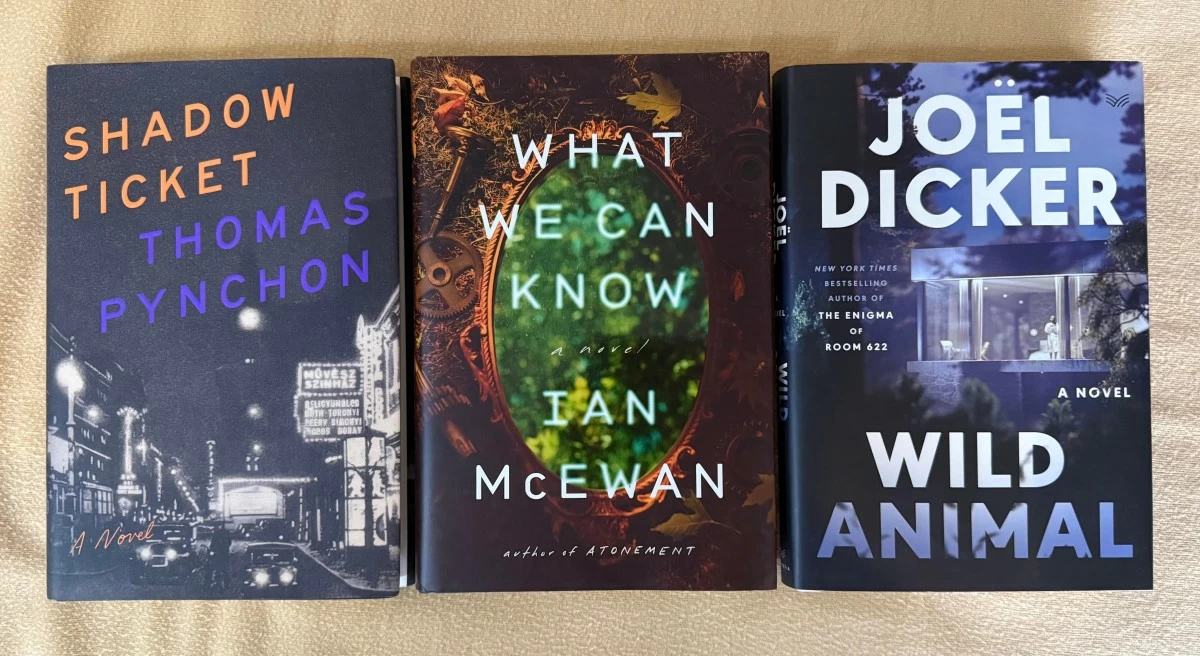
Excuse the sports parlance, but if writing were like baseball, these three would be among the ‘late-inning dependable’ you’d bring out of the dugout. The works of these three authors are always hotly anticipated.
"Shadow Ticket" by Thomas Pynchon
Just the author of Gravity’s Rainbow, Vineland, and Inherent Vice, among others, the notoriously reclusive Pynchon now offers up a new novel at the age of 88 - his first new work in 12 years. Known for his complex postmodern fiction, this new one takes us back to 1932 Milwaukee, with a former strikebreaker, now private eye, as the main character. After the opening of a bomb being rolled under the booze-smuggling truck during this Prohibition era, PI Hicks McTaggart is surprised when he’s given the routine case of the missing heiress of a Wisconsin cheese fortune - Daphne Airmont, a woman he had had one early encounter with. It would seem she’s has disappeared with a swing band, and one musician boyfriend named Hop; and they’re on an European tour.
Of course, in Pynchon’s universe, nothing is ever routine. The two cases prove to be connected, and before we can blink an eye, Hicks has been shanghaied and wakes up in Hungary - but still with the assignment of finding Daphne and bringing her back to Wisconsin. There are British counterspies, Nazi and Fascist agents, jazz musicians who double as mercenaries, and Hungary as a very unique European country. Filled with snappy dialogue and frenetic action, there is a sense of there being a discombobulating narrative, and one is led to question if it is all "sound and fury, signifying nothing?" Once again, it’s the fallback Pynchon theme of history overtaking a person, so that he’s out of his depth and just trying to stay afloat. Is it great ‘Late Style’ Pynchon like Inherent Vice? I would not like to say, as it seems to be more a case of Pynchon-Lite. Enjoyable, but an airy read.
"What We Can Know" by Ian McEwan
"The Child In Time," "The Comfort of Strangers," "Atonement," and "Amsterdam" are just among the titles of the numerous novels that McEwan has come up with, and has been awarded and celebrated for over the decades. Along with his contemporary Julian Barnes, the two have consistently produced genre-bending novels that play with time and history, and this latest is as fine an example as any. The first chapter surprises us as it’s set in the year 2119, introducing us to Thomas Metcalfe, a scholar researcher whose field of expertise would be Literature of the 1990s to the 2030s. He lives in a future world that has been destroyed by a nuclear accident, and a number of countries we know today have been submerged underwater due to rising seas. A celebrated poet of his time, Francis Blundy, and his wife Vivien, who had her 40th birthday dinner with close friends in 2014, are the subject of Metcalfe’s research.
A missing poem, entitled A Corona for Vivien, is the focus of this literary detective story. Written in honor of his wife, the generations that came after 2014 have speculated on the meaning of the series of sonnets and why it has disappeared. Thomas Metcalfe is obsessed with Blundy’s poem, teasing out revelations of entangled lives and loves, and a possible brutal crime that was committed. It’s literally a love story and a literary detective story that’s stretched over time, to a little over a century. And along the way, the novel becomes a dissertation on the nature of memory, of history, and of truth and meaning. It’s easy to take all the recorded material that’s accumulated over a century over a dinner that happened in the past, but as this book reveals, it may not come any closer to what really happened or the truth about those events. The blurred line between fiction and history is what lies at the foundation of this powerful speculative novel.
"Wild Animal" by Joël Dicker
His previous novels, which include "The Truth About the Harry Quebert Affair," had critics hailing Dicker as an original voice in crime fiction, a master of the plot twist. This latest stems from a robbery of a Geneva jewelry shop that was supposed to have happened on July 2, 2022. At the center of the story are two couples and their families. Sophie Braun is celebrating her 40th birthday in late June, and with her husband, Arpad, they seem to be leading an idyllic life, with Sophie still very much an attractive woman. Then there’s Katrine and Greg, and he’s a member of the local SWAT police team. Greg harbors an unhealthy obsession for Sophie, spying on the richer couple who live in a Glass House that’s to be found near the townhouses where the second couple reside. How it all connects to the jewelry store robbery is where Dicker once again proves he’s such a master.
Flitting between flashbacks and time jumps, a complicated tapestry is woven about duplicity, that inner spirit to do the unthinkable, and falling prey to temptation. We have two husbands keeping up appearances in their own ways, plus wives who dream of another life in ways that can wreck the present one that they also hold dear to their hearts. It’s a diabolical plot that owes much to roots that were planted in the distant past and somehow continue to exert strong influence on the today of our protagonists. There’s even one solitary figure that emerges from the past, known as The Beast, and what this bodes for our couple on a social pedestal, Sophie and Arpad, we won’t be expecting. As usual, Dicker shows that he still has it in him to provide that delicious plot twist that comes out of left field. And what’s nice to note is how ordinary this couple could be in real life, and it’s really about the secrets they harbor.