






Manila Bulletin
 Philippines
National
Angara: 2026 DepEd budget sustains universal, targeted school feeding
Philippines
National
Angara: 2026 DepEd budget sustains universal, targeted school feeding
Philippines
National
Angara: 2026 DepEd budget sustains universal, targeted school feeding
Angara: 2026 DepEd budget sustains universal, targeted school feeding
By Jel Santos
Published Dec 1, 2025 12:50 pm
|
Updated Dec 1, 2025 01:02 pm


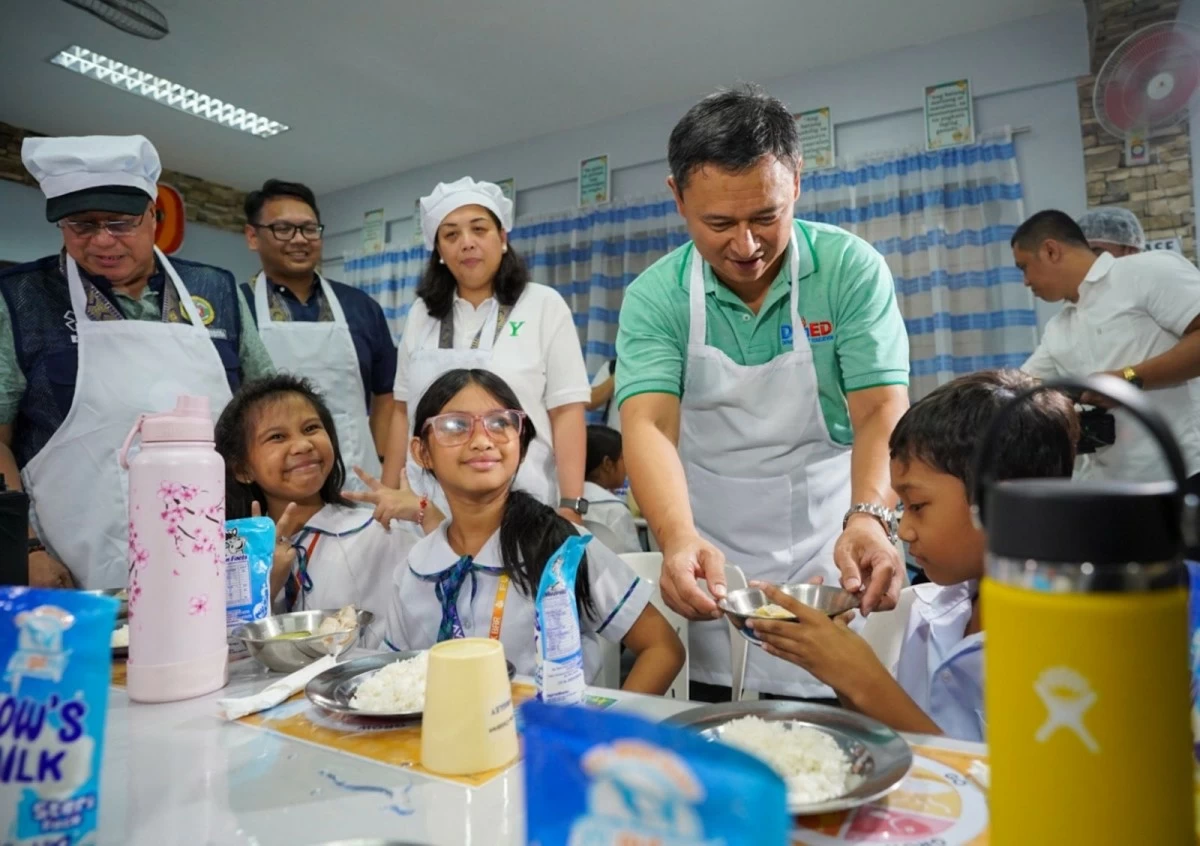
(PHOTO: DEPED)
Department of Education (DepEd) Secretary Sonny Angara on Monday, Dec. 1, said the 2026 budget of the DepEd will allow the agency to sustain its combined approach of universal and targeted school feeding, as lawmakers approved a significant increase to strengthen the government’s efforts to curb undernutrition and support early learning.
Angara said the funding boost in the Senate-approved 2026 national budget will enable DepEd to continue providing hot meals to all Kindergarten and Grade 1 learners, while expanding focused feeding for older learners who are wasted and severely wasted.
“Pinapalakas natin ang pundasyon sa Kinder at Grade 1, pero hindi rin natin iniiwan ang pinaka-nanganganib sa mas matataas na baitang (We are strengthening the foundation in Kinder and Grade 1, but we are also not abandoning those most at risk in the higher grade levels),” he said.
“Kung gusto nating manatili ang mga bata sa eskwela, kailangan nating siguraduhin na may laman ang tiyan at lakas ang katawan (If we want children to stay in school, we must ensure they have food in their stomachs and strength in their bodies).”
Under the 2026 budget, DepEd said the School-Based Feeding Program (SBFP) will receive P28.66 billion, more than double its 2025 allocation of P11.78 billion.
The increased funding raises overall coverage to 4.49 million learners next year and extends feeding duration to 200 days, it added.
It also provides 45-day feeding for 604,134 junior high school and 200,663 senior high school wasted and severely wasted learners, and 30-day feeding for 7,276 adolescent pregnant learners.
Angara earlier noted that the effectiveness of the feeding program is reflected not only in data but also in daily classroom experiences.
“Kita namin sa mga bata at sa mga kwento ng ating mga guro na mas gising, mas masigla, mas handang makinig ang mga mag-aaral basta may laman ang kanilang tiyan. Iyan ang pinaka-pruweba na gumagana ang programa (We see in the children and in the stories of our teachers that learners are more alert, more energetic, and more ready to listen as long as they have food in their stomachs. That is the clearest proof that the program works),” he said.
“May datos at may kwento. Nakita ito ng Pangulo at nagkaisa ang Senado at Kamara (There is data and there are stories. The President saw this, and the Senate and the House agreed),” he added. “Kapag nakikita mong bumababa ang bilang ng severely wasted, alam mong tama ang direksyon (When you see the number of severely wasted learners decreasing, you know you are heading in the right direction).”
DepEd said it began implementing a broader SBFP for School Year 2025–2026 with the inclusion of all Kindergarten learners—not just undernourished ones—as part of its shift to universal early nutrition. Early outcomes have been encouraging, with severely wasted Kindergarten learners dropping from 113,451 to 47,281 in one year.
Angara said he has overseen improvements in SBFP infrastructure, including the operation of more than 74 central kitchens nationwide and the participation of over 44,000 schools in the Gulayan sa Paaralan Program, which supplies vegetables for meals and strengthens hands-on nutrition education.
For 2026, the agency said funding has been secured for 219 central kitchens and new mobile kitchen units, with more local government units expected to take on direct implementation of the program.