







Act with expediency before plastic drowns us
Published Nov 28, 2025 12:01 am
|
Updated Nov 27, 2025 04:41 pm


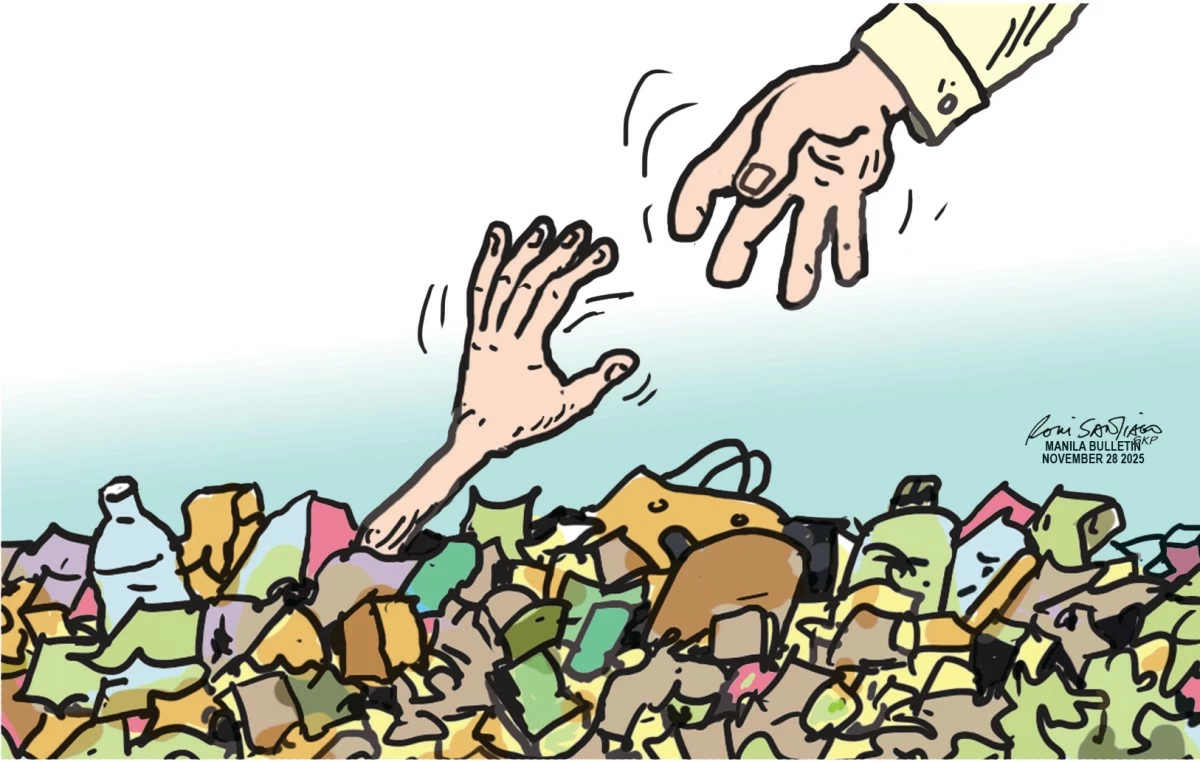
Plastic pollution in the Philippines is no longer an environmental issue waiting to erupt—it is a crisis unfolding in real time.
Science and Technology Secretary Renato U. Solidum Jr. stressed this at the International High-Level Forum on NUTEC Plastic as he warned that this crisis is suffocating our seas, burdening coastal communities, and harming our economy. With the country generating approximately 2.7 million metric tons of plastic waste annually and consuming 163 million sachets every single day, the Philippines sits precariously as one of the world’s largest contributors to marine plastic pollution.
Despite this reality, are we doing enough to address the problem?
The government has made strides in recent years. The Extended Producer Responsibility (EPR) Act, or Republic Act No. 11898 signed into law in 2022, mandates large companies to recover a portion of their plastic packaging. Local governments have also implemented ordinances banning single-use plastics, while national agencies continue to partner with international organizations to explore innovative waste treatment technologies—including nuclear-based recycling methods under the NUTEC Plastic initiative. These efforts show progress, but they remain fragmented, unevenly enforced, and insufficiently ambitious compared to the scale of the problem. Implementation leaves a lot to be desired.
To strengthen the fight against plastic pollution, the government must first ensure robust enforcement of existing laws. The EPR Law should be tightened: companies must not only collect plastic waste but demonstrate verifiable recycling and reduction outcomes. Local government units (LGUs) need stronger financial and technical support to implement waste segregation at source—an area where compliance remains dismal. The national government should also accelerate the development of materials recovery facilities (MRFs), especially in rural and coastal areas where waste often leaks directly into waterways.
Moreover, it is time to reconsider the country’s dependence on sachet-based packaging. Regulatory measures should encourage industries to shift toward refill systems, biodegradable materials, and reusable packaging. The state must also impose clearer accountability on multinational corporations whose business models rely heavily on single-use plastics. Incentives for green innovation—tax breaks, grants, and public-private R&D programs—could accelerate the transition.
One good news is the revelation of President Marcos that the government is working on the Post-Radiation Reactive Extrusion (PREx) Plastic Project that aims to strengthen low-value plastic waste and turn them into upcycled products, including the use of processed plastic to support community infrastructure.
Yet government action alone is not enough. The private sector must serve as a genuine partner, not a reluctant participant. Companies should redesign products for circularity and invest in large-scale recycling and upcycling facilities. Retailers must expand refill and return schemes beyond pilot sites and integrate them into mainstream operations. Corporations wield immense influence over consumer behavior; they must use it responsibly.
At the heart of this crisis, however, lies personal responsibility. Every Filipino—every household, business owner, tenant, and visitor—has a role. Simple daily actions matter: segregating waste properly, reducing unnecessary plastic use, supporting local brands that adopt sustainable packaging, and participating in community cleanups. Behavioral change is slow but powerful when multiplied by millions.
Plastic pollution is a shared burden. Its solution must be a shared mission. The government must lead with stronger policy and enforcement; the private sector must innovate and be accountable; citizens must act with intention and discipline. This is a fight for the environment, public health, food security, and sustainable growth.
We are a nation surrounded by water. Our seas feed us, protect us, and shape our identity. Allowing plastic to drown us is a betrayal of our future. Only through concerted action can the Philippines turn the tide—from a nation known for plastic pollution to a model of resilience and responsibility.
Can we attain it? The choice is ours.