ADVERTISEMENT

Why rice awareness must be a year-round commitment

Published Nov 27, 2025 12:01 am  |  Updated Nov 26, 2025 04:29 pm
As National Rice Awareness Month (NRAM) draws to a close this November, the message it carries must not end with the turning of the calendar. For a nation where rice is more than a staple—where it is comfort food, cultural anchor, and the economic pulse of millions—awareness should not be seasonal. It must be a daily habit, a discipline, and, increasingly, a moral responsibility.
Rice has always been central to the Filipino identity. We measure hunger by the availability of rice, and we judge leadership by whether ordinary families can afford it. A good year for rice means fewer worries for the poorest households; a bad year—whether from typhoons, drought, or rising global prices—ripples painfully through the entire population. Thus, rice is not just food. It is also a yardstick of governance, social equity, and national resilience.
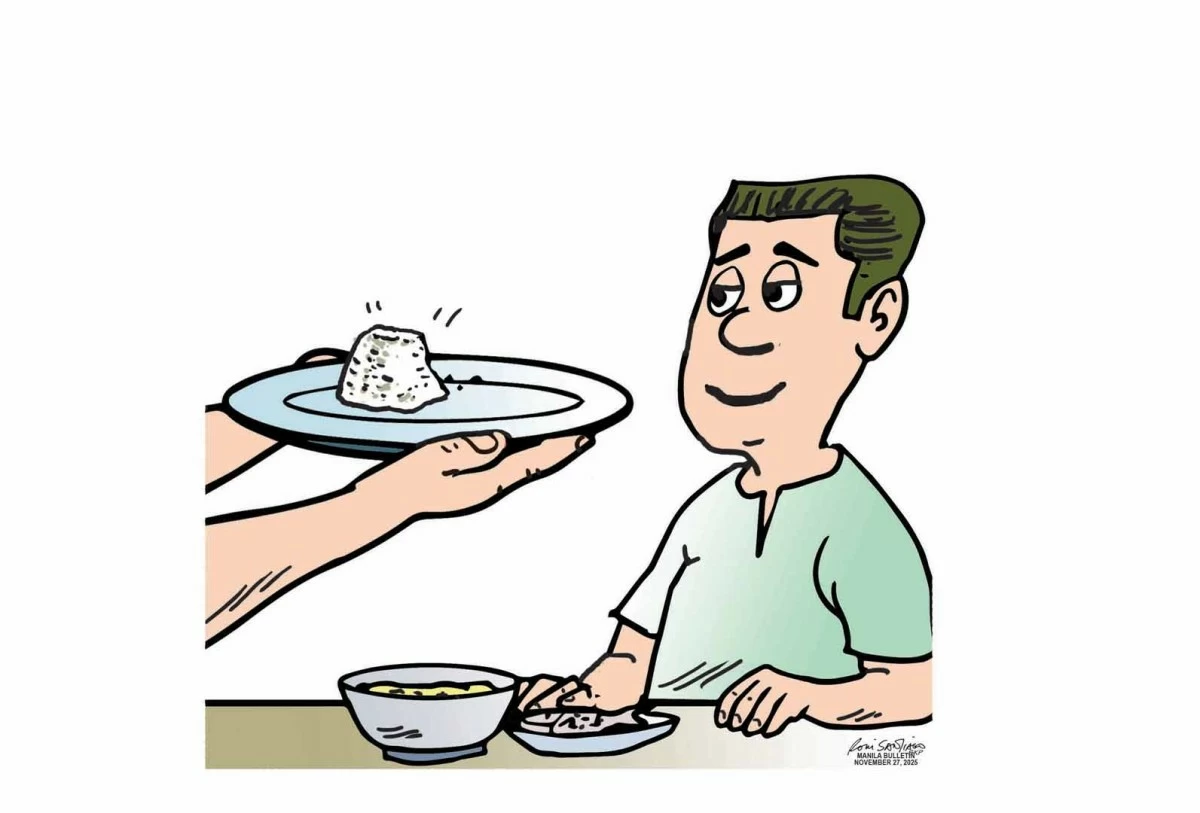
This year’s NRAM theme, “Be RICEponsible,” states a growing concern: while we fight for supply, affordability, and farmer welfare, Filipinos continue to waste rice. Data from the Department of Science and Technology–Food and Nutrition Research Institute and PhilRice show that the country wasted 255,000 metric tons of rice in 2024, down from 340,000 MT in previous years, but still enough to feed 2.79 million Filipinos for an entire year. Translated to the individual level, each Filipino wastes an esti-mated six grams of rice per day—small grains that, when combined nationwide, become mountains of lost labor, land, water, and opportunity.
This is where the push for a half-cup rice option becomes more than a quirky idea. Reviving the bill that would require restaurants and food establishments to offer half servings is a simple yet powerful measure. First filed in the 16th Congress, the proposal aims to give diners real choice: to take only what they can finish. Without such options, full cups are served automatically, and leftover rice becomes in-evitable waste. The Department of Agriculture now wants the measure institutionalized, even suggest-ing that the President issue an executive order requiring all government offices to offer half-cup serv-ings as a pilot program. If successful, the private sector would follow.
Such reforms matter because the country’s rice situation remains fragile. A recent Ateneo study shows the Philippines consumed 2.3 million metric tons more rice than it produced in 2022, reflecting an 18 percent national rice deficit. Production has been stagnant for years—palay output rose only nine percent from 2013 to 2023, while consumption continues to soar. Climate disruptions, limited irrigated areas, shrinking farmland, and uneven regional support all contribute to the shortfalls.
This is the heart of the matter: rice tells our story as a people. It is sown with labor, harvested with hope, and shared across every Filipino table—from Iloilo’s arrozcaldo stalls to urban carinderias to family dining rooms preparing for the holidays. As Christmas nears and lechon, hamon, and pasta take center stage, rice will still be there beside every dish, quietly supporting our festivities.
November may be National Rice Awareness Month—but our responsibility continues long after this month. Let us honor the toil of our farmers, support programs that keep rice affordable, and rethink our own habits so that no grain is wasted. In a country where millions still struggle to afford three meals a day, mindfulness is not just courtesy—it is compassion.
Support “Be RICEponsible;” do not waste rice, and protect our farmers by choosing to buy local rice.

Related Tags

Be RICEponsible National Rice Awareness Month
ADVERTISEMENT
.most-popular .layout-ratio{ padding-bottom: 79.13%; } @media (min-width: 768px) and (max-width: 1024px) { .widget-title { font-size: 15px !important; } }

{{ articles_filter_1561_widget.title }}

.most-popular .layout-ratio{ padding-bottom: 79.13%; } @media (min-width: 768px) and (max-width: 1024px) { .widget-title { font-size: 15px !important; } }

{{ articles_filter_1562_widget.title }}

.most-popular .layout-ratio{ padding-bottom: 79.13%; } @media (min-width: 768px) and (max-width: 1024px) { .widget-title { font-size: 15px !important; } }

{{ articles_filter_1563_widget.title }}

{{ articles_filter_1564_widget.title }}

.mb-article-details { position: relative; } .mb-article-details .article-body-preview, .mb-article-details .article-body-summary{ font-size: 17px; line-height: 30px; font-family: "Libre Caslon Text", serif; color: #000; } .mb-article-details .article-body-preview iframe , .mb-article-details .article-body-summary iframe{ width: 100%; margin: auto; } .read-more-background { background: linear-gradient(180deg, color(display-p3 1.000 1.000 1.000 / 0) 13.75%, color(display-p3 1.000 1.000 1.000 / 0.8) 30.79%, color(display-p3 1.000 1.000 1.000) 72.5%); position: absolute; height: 200px; width: 100%; bottom: 0; display: flex; justify-content: center; align-items: center; padding: 0; } .read-more-background a{ color: #000; } .read-more-btn { padding: 17px 45px; font-family: Inter; font-weight: 700; font-size: 18px; line-height: 16px; text-align: center; vertical-align: middle; border: 1px solid black; background-color: white; } .hidden { display: none; }
function initializeAllSwipers() { // Get all hidden inputs with cms_article_id document.querySelectorAll('[id^="cms_article_id_"]').forEach(function (input) { const cmsArticleId = input.value; const articleSelector = '#article-' + cmsArticleId + ' .body_images'; const swiperElement = document.querySelector(articleSelector); if (swiperElement && !swiperElement.classList.contains('swiper-initialized')) { new Swiper(articleSelector, { loop: true, pagination: false, navigation: { nextEl: '#article-' + cmsArticleId + ' .swiper-button-next', prevEl: '#article-' + cmsArticleId + ' .swiper-button-prev', }, }); } }); } setTimeout(initializeAllSwipers, 3000); const intersectionObserver = new IntersectionObserver( (entries) => { entries.forEach((entry) => { if (entry.isIntersecting) { const newUrl = entry.target.getAttribute("data-url"); if (newUrl) { history.pushState(null, null, newUrl); let article = entry.target; // Extract metadata const author = article.querySelector('.author-section').textContent.replace('By', '').trim(); const section = article.querySelector('.section-info ').textContent.replace(' ', ' '); const title = article.querySelector('.article-title h1').textContent; // Parse URL for Chartbeat path format const parsedUrl = new URL(newUrl, window.location.origin); const cleanUrl = parsedUrl.host + parsedUrl.pathname; // Update Chartbeat configuration if (typeof window._sf_async_config !== 'undefined') { window._sf_async_config.path = cleanUrl; window._sf_async_config.sections = section; window._sf_async_config.authors = author; } // Track virtual page view with Chartbeat if (typeof pSUPERFLY !== 'undefined' && typeof pSUPERFLY.virtualPage === 'function') { try { pSUPERFLY.virtualPage({ path: cleanUrl, title: title, sections: section, authors: author }); } catch (error) { console.error('ping error', error); } } // Optional: Update document title if (title && title !== document.title) { document.title = title; } } } }); }, { threshold: 0.1 } ); function showArticleBody(button) { const article = button.closest("article"); const summary = article.querySelector(".article-body-summary"); const body = article.querySelector(".article-body-preview"); const readMoreSection = article.querySelector(".read-more-background"); // Hide summary and read-more section summary.style.display = "none"; readMoreSection.style.display = "none"; // Show the full article body body.classList.remove("hidden"); } document.addEventListener("DOMContentLoaded", () => { let loadCount = 0; // Track how many times articles are loaded const offset = [1, 2, 3, 4, 5, 6, 7, 8, 9, 10]; // Offset values const currentUrl = window.location.pathname.substring(1); let isLoading = false; // Prevent multiple calls if (!currentUrl) { console.log("Current URL is invalid."); return; } const sentinel = document.getElementById("load-more-sentinel"); if (!sentinel) { console.log("Sentinel element not found."); return; } function isSentinelVisible() { const rect = sentinel.getBoundingClientRect(); return ( rect.top < window.innerHeight && rect.bottom >= 0 ); } function onScroll() { if (isLoading) return; if (isSentinelVisible()) { if (loadCount >= offset.length) { console.log("Maximum load attempts reached."); window.removeEventListener("scroll", onScroll); return; } isLoading = true; const currentOffset = offset[loadCount]; window.loadMoreItems().then(() => { let article = document.querySelector('#widget_1690 > div:nth-last-of-type(2) article'); intersectionObserver.observe(article) loadCount++; }).catch(error => { console.error("Error loading more items:", error); }).finally(() => { isLoading = false; }); } } window.addEventListener("scroll", onScroll); });

Sign up by email to receive news.