ADVERTISEMENT

PH in 'right moment' to revisit push for nuclear energy—IAEA

Published Nov 26, 2025 10:53 am  |  Updated Nov 26, 2025 02:10 pm
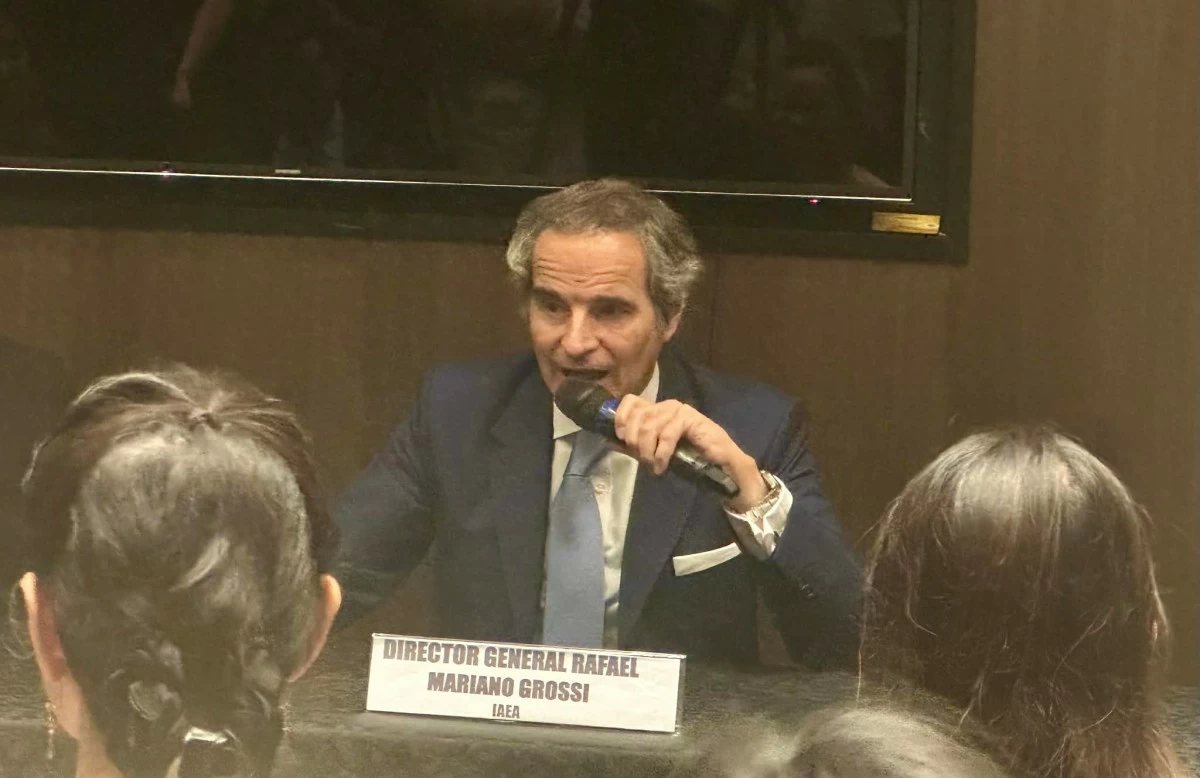
IAEA Director General Rafael Mariano Grossi speaks during a press conference in Pasay City on Tuesday, Nov. 25, 2025. (Raymund Antonio/MANILA BULLETIN)
The Philippines is at the “right moment” to begin pushing for nuclear energy use amid its aim to achieve energy security and reduce its reliance on fossil fuels like coal, the International Atomic Energy Agency (IAEA) said.
IAEA Director General Rafael Mariano Grossi made this remark during the International High Level Forum on Nuclear Technology (NUTEC) Plastics in Pasay City on Tuesday, Nov. 25.
He underscored that the Philippines is not new to nuclear power.
“Let's go a little bit back in history. Your country was a pioneer long, long, long before any other countries in this region and in the world were looking at nuclear energy. But the reality is that I like to say that the Philippines is not a newcomer, it's a revisiting country,” he said in a press conference.
“It's a country that is reviewing, taking into account its technological capacities, what was being done here in the late 70s, early 80s, and considering that it is perhaps the right moment, as many other countries in the world, to avail itself of a notion of a clean energy that is providing solutions in many parts of the world. Why not here?,” he added.
The Philippines, during the time of former president Ferdinand Marcos Sr., once attempted to build a nuclear power plant in Bataan. While it was completed, it was never operated because of safety concerns, political issues, and corruption allegations.
Grossi said that what the Philippines is doing today with its nuclear energy push is “extremely important,” adding that small- or big-sized nuclear projects are significant and require initial capital investment.
He also noted that banks and international financial institutions in the past have turned their backs on nuclear power plants because of their “bad image.”
“But with passage of time and the safety record of nuclear and the ability to demonstrate by the industry that banks are a conservative, of course, in what they finance, there has been an important change which was initiated earlier this year when I signed with the president of the World Bank a similar agreement,” he shared.
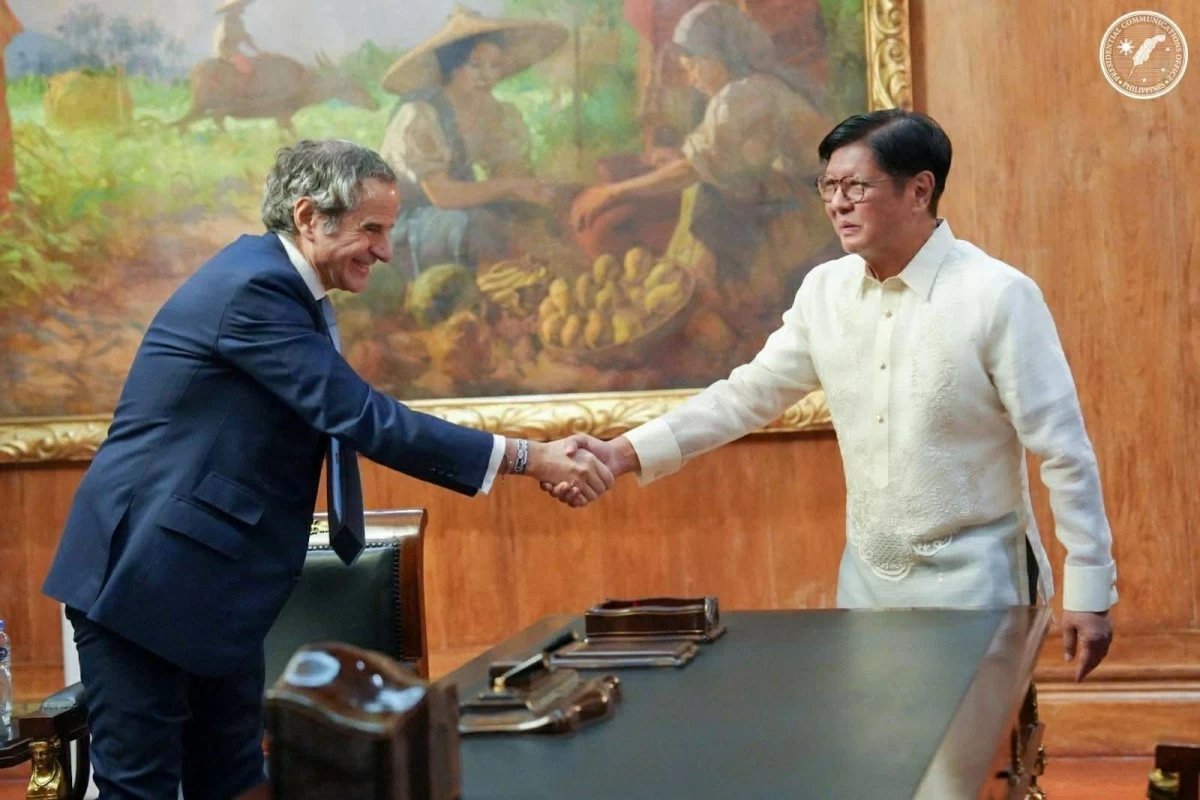
President Ferdinand 'Bongbong' Marcos Jr. and IAEA Director General Rafael Mariano Grossi shake hands during their meeting in Malacañang. (Photo from the Presidential Communications Office)
“So, when the World Bank sent this, you know how it happens in the economy in general, when they sign from the leading institutions, the leading financing institutions in the world that there is no problem, basically, there is really no problem, no technical problem, no fundamental problem in financing nuclear,” he added.
The IAEA director pointed out that with China, India, and Pakistan, Asia “and in particular this region, is the most dynamic in terms of nuclear growth in the world.”
Malaysia, Vietnam, Singapore, and Indonesia, he cited, are also starting their own nuclear programs, as well as African countries that need grants and loans for their own nuclear push.
“People talk about the exponential growth of renewable energy, which is a very good thing, I must say. I am very positive about renewable energies,” Grossi asserted, lamenting the lack of subsidies and access to finance in the past.
“So, I believe that we are entering now a new phase. We will see how far it goes, we will see how fast it goes, but it is clearly, in my opinion, a watershed that has happened. Very important. So, it's a very good day in that sense,” he added.
The IAEA official also met with President Marcos on Tuesday during a courtesy call at Malacañan Palace.
Grossi, who assumed office in 2019, is on his first official visit to the Philippines for the International High-Level Forum on Nuclear Technology for Controlling Plastic Pollution (NUTEC Plastics): Scaling Solutions and Partnerships for Global Impact.
The Philippines, who became a member of the IAEA in 1958, is hosting the forum from Nov. 25 to 26.
Also with Marcos were Department of Science and Technology (DOST) Secretary Renato Solidum Jr., Department of Environment and Natural Resources (DENR) Secretary Raphael Lotilla, and Ambassador to Austria, and Permanent Representative to the IAEA Evangelina Lourdes Bernas.

Related Tags

nuclear energy President Marcos NUTEC Rafael Mariano Grossi IAEA
ADVERTISEMENT
.most-popular .layout-ratio{ padding-bottom: 79.13%; } @media (min-width: 768px) and (max-width: 1024px) { .widget-title { font-size: 15px !important; } }

{{ articles_filter_1561_widget.title }}

.most-popular .layout-ratio{ padding-bottom: 79.13%; } @media (min-width: 768px) and (max-width: 1024px) { .widget-title { font-size: 15px !important; } }

{{ articles_filter_1562_widget.title }}

.most-popular .layout-ratio{ padding-bottom: 79.13%; } @media (min-width: 768px) and (max-width: 1024px) { .widget-title { font-size: 15px !important; } }

{{ articles_filter_1563_widget.title }}

{{ articles_filter_1564_widget.title }}

.mb-article-details { position: relative; } .mb-article-details .article-body-preview, .mb-article-details .article-body-summary{ font-size: 17px; line-height: 30px; font-family: "Libre Caslon Text", serif; color: #000; } .mb-article-details .article-body-preview iframe , .mb-article-details .article-body-summary iframe{ width: 100%; margin: auto; } .read-more-background { background: linear-gradient(180deg, color(display-p3 1.000 1.000 1.000 / 0) 13.75%, color(display-p3 1.000 1.000 1.000 / 0.8) 30.79%, color(display-p3 1.000 1.000 1.000) 72.5%); position: absolute; height: 200px; width: 100%; bottom: 0; display: flex; justify-content: center; align-items: center; padding: 0; } .read-more-background a{ color: #000; } .read-more-btn { padding: 17px 45px; font-family: Inter; font-weight: 700; font-size: 18px; line-height: 16px; text-align: center; vertical-align: middle; border: 1px solid black; background-color: white; } .hidden { display: none; }
function initializeAllSwipers() { // Get all hidden inputs with cms_article_id document.querySelectorAll('[id^="cms_article_id_"]').forEach(function (input) { const cmsArticleId = input.value; const articleSelector = '#article-' + cmsArticleId + ' .body_images'; const swiperElement = document.querySelector(articleSelector); if (swiperElement && !swiperElement.classList.contains('swiper-initialized')) { new Swiper(articleSelector, { loop: true, pagination: false, navigation: { nextEl: '#article-' + cmsArticleId + ' .swiper-button-next', prevEl: '#article-' + cmsArticleId + ' .swiper-button-prev', }, }); } }); } setTimeout(initializeAllSwipers, 3000); const intersectionObserver = new IntersectionObserver( (entries) => { entries.forEach((entry) => { if (entry.isIntersecting) { const newUrl = entry.target.getAttribute("data-url"); if (newUrl) { history.pushState(null, null, newUrl); let article = entry.target; // Extract metadata const author = article.querySelector('.author-section').textContent.replace('By', '').trim(); const section = article.querySelector('.section-info ').textContent.replace(' ', ' '); const title = article.querySelector('.article-title h1').textContent; // Parse URL for Chartbeat path format const parsedUrl = new URL(newUrl, window.location.origin); const cleanUrl = parsedUrl.host + parsedUrl.pathname; // Update Chartbeat configuration if (typeof window._sf_async_config !== 'undefined') { window._sf_async_config.path = cleanUrl; window._sf_async_config.sections = section; window._sf_async_config.authors = author; } // Track virtual page view with Chartbeat if (typeof pSUPERFLY !== 'undefined' && typeof pSUPERFLY.virtualPage === 'function') { try { pSUPERFLY.virtualPage({ path: cleanUrl, title: title, sections: section, authors: author }); } catch (error) { console.error('ping error', error); } } // Optional: Update document title if (title && title !== document.title) { document.title = title; } } } }); }, { threshold: 0.1 } ); function showArticleBody(button) { const article = button.closest("article"); const summary = article.querySelector(".article-body-summary"); const body = article.querySelector(".article-body-preview"); const readMoreSection = article.querySelector(".read-more-background"); // Hide summary and read-more section summary.style.display = "none"; readMoreSection.style.display = "none"; // Show the full article body body.classList.remove("hidden"); } document.addEventListener("DOMContentLoaded", () => { let loadCount = 0; // Track how many times articles are loaded const offset = [1, 2, 3, 4, 5, 6, 7, 8, 9, 10]; // Offset values const currentUrl = window.location.pathname.substring(1); let isLoading = false; // Prevent multiple calls if (!currentUrl) { console.log("Current URL is invalid."); return; } const sentinel = document.getElementById("load-more-sentinel"); if (!sentinel) { console.log("Sentinel element not found."); return; } function isSentinelVisible() { const rect = sentinel.getBoundingClientRect(); return ( rect.top < window.innerHeight && rect.bottom >= 0 ); } function onScroll() { if (isLoading) return; if (isSentinelVisible()) { if (loadCount >= offset.length) { console.log("Maximum load attempts reached."); window.removeEventListener("scroll", onScroll); return; } isLoading = true; const currentOffset = offset[loadCount]; window.loadMoreItems().then(() => { let article = document.querySelector('#widget_1690 > div:nth-last-of-type(2) article'); intersectionObserver.observe(article) loadCount++; }).catch(error => { console.error("Error loading more items:", error); }).finally(() => { isLoading = false; }); } } window.addEventListener("scroll", onScroll); });

Sign up by email to receive news.