






Manila Bulletin
 Philippines
Metro Manila
Manila businesses show strong confidence despite national economic challenges
Philippines
Metro Manila
Manila businesses show strong confidence despite national economic challenges
Philippines
Metro Manila
Manila businesses show strong confidence despite national economic challenges
Manila businesses show strong confidence despite national economic challenges
Published Nov 26, 2025 05:07 pm


Courtesy of the Manila Public Information Office
The City of Manila continues to register robust business activity heading into 2026, with new business registrations far outpacing closures, an indicator of sustained investor confidence in the capital despite the country’s tempered economic outlook.
Manila Mayor Francisco “Isko Moreno" Domagoso said Wednesday, Nov. 26, that data from the Bureau of Permits (BOP) show entrepreneurs “continue to bet on Manila,” even as external risks weigh on national growth prospects.
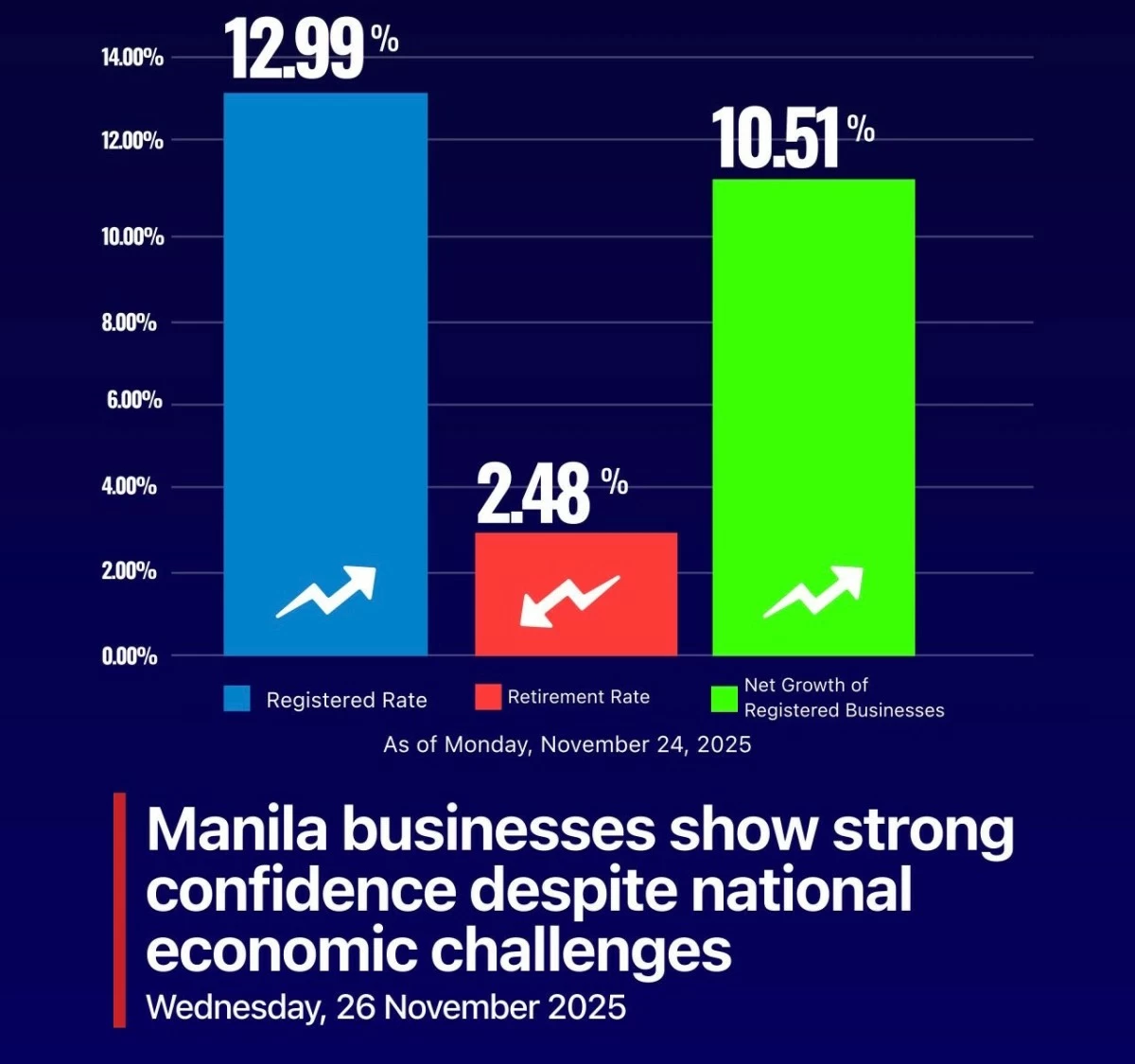
Of the 55,924 registered businesses in the city, only 1,390 have retired so far this year, reflecting a 2.8 percent retirement rate.
In contrast, new registrations have reached 7,265, equivalent to a 12.99 percent registration rate.
This results in a net business growth rate of 10.51 percent, which Domagoso described as a strong signal of Manila’s resilient economic environment.
The mayor attributed the stronger numbers to reforms implemented since July 2025, including the full reactivation of the electronic Business One Stop Shop (eBOSS), the streamlining of zoning requirements from 25 steps to seven, and the reduction of zoning appeals from 15 steps to five.
These measures, combined with stricter revenue enforcement, boosted the city’s collection efficiency from 61 percent in the first half of the year to 81 percent from July to September.
Domagoso noted that Manila’s gains come at a time when national economic projections have become more cautious.
On Nov. 24, the ASEAN+3 Macroeconomic Research Office (AMRO) lowered its 2024 Philippine growth forecast to 5.2 percent following a softer third quarter and weather-related disruptions.
The next day, Fitch Solutions unit BMI warned of a potential slowdown in foreign direct investment through 2026 due to corruption concerns and global uncertainty, putting pressure on the peso, which was trading around P58.90 to the US dollar.
Despite these headwinds, Domagoso said Manila’s latest numbers show the city “holding firm,” backed by permitting reforms, improved fiscal management, and strengthened frontline services.
In October, he reported that his first 100 days in office had delivered 12,752 new jobs and P7.1 billion in total investments.
The city’s fiscal standing likewise improved, with collection efficiency rising from 61 percent in the year's first half to 81 percent between July and September.